
At a Glance
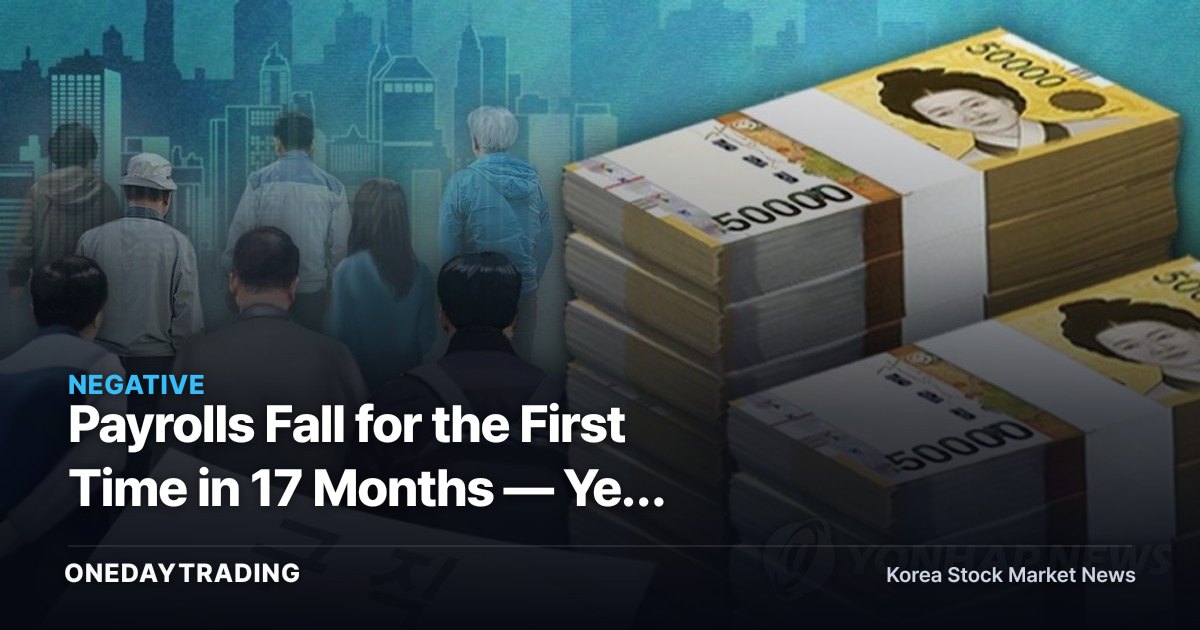
Last month, the number of employed persons turned lower for the first time in 17 months, yet jobless-benefit payouts actually declined. Typically, when employment deteriorates, jobless benefits rise — and the breakdown of that usual pattern is the key point here. This is not mere statistical noise; it is a signal that helps gauge the quality of the labor-market weakness and the timing of a domestic-demand recovery, and it directly affects consumer- and domestic-demand-related industry sectors.
Why It Matters Now
Behind the paradox of falling employment and falling jobless benefits occurring at the same time lies a shift in the structure of employment. Jobless benefits are paid when a wage earner enrolled in employment insurance loses their job involuntarily. But if the jobs that disappeared were among small-scale self-employment, short-term and ultra-short-hour work outside the employment-insurance net, or represented an exit into the economically inactive population that has given up looking for work altogether, then the number of employed persons can fall without jobless-benefit claims rising. In other words, there is a strong possibility that the deterioration in employment is not being captured statistically as unemployment but is instead being absorbed as an exit from the labor market.
From an investment standpoint, this distinction matters. If the job losses are a sign of an economic slowdown, they point to a contraction in domestic consumer spending power, which is a burden for the retail, dining, and leisure industry sectors. Conversely, if this is a structural exit centered on older and younger age groups, it could spur the government's fiscal job-creation and domestic-demand stimulus measures, creating policy-beneficiary sectors. Employment data also act as a key variable in the Bank of Korea's rate decisions and in discussions over a government supplementary budget.
In particular, a slowdown in the growth of employment-insurance enrollees may be evidence that quality, regular jobs in manufacturing and construction are wavering — and industry sectors tied to construction activity would feel it first.
Frequently Asked Questions
- Employment fell, so why did jobless benefits decline? It may be because the jobs that disappeared were small-scale or short-term positions not covered by employment insurance, or because job losses led to an exit from the labor market rather than reapplication for benefits.
- Is this a sign of a recession? It is too early to conclude. It could be a temporary base effect or a structural shift driven by aging, so the trend needs to be confirmed over a few more months.
- Is this a direct negative catalyst for the stock market? Employment is a lagging indicator, so rather than an immediate shock, it tends to be reflected indirectly through the earnings outlook for domestic-demand stocks and the path of interest rates.
- How likely is a policy response? If the employment weakness is confirmed, pressure to expand fiscal job creation and stimulate domestic demand will grow, which could generate short-term momentum for related policy-themed stocks.
Affected Stocks and Sectors
- Retail and domestic consumer stocks: Job losses translate directly into slowing household income and spending power, weighing on frontline demand for revenue at hypermarkets, convenience stores, and e-commerce.
- Construction: A contraction in quality, regular jobs is often intertwined with a slowdown in construction activity, so order intake and pre-sale figures should be watched alongside it.
- Financials: Employment weakness affects household delinquency rates and the soundness of consumer lending, acting as a cost variable for the banking and card industry sectors.
- Dining, leisure, and entertainment: With high sensitivity to disposable income, earnings volatility rises during phases of labor-market weakness.
What to Watch When Investing
- Monthly employment data swing widely depending on base effects, weather, and survey timing, so do not read a trend from a single month's figure.
- Employment is a lagging indicator, so stock prices may have already priced in economic expectations. Making trading decisions on a data release alone is risky.
- Note that policy-expectation stocks are highly volatile on expectations alone, before the actual budget and scale of execution are confirmed.
- Domestic-demand stocks are affected not only by employment but by a complex mix of variables including the exchange rate, inflation, and interest rates, so be wary of reading too much into any single indicator.
Overall Outlook
In an optimistic scenario, this decline in employment proves to be a temporary base effect, and with the government's domestic-demand and job-creation measures added on, domestic-demand stocks' earnings could improve gradually alongside a consumption recovery in the second half. Conversely, if the job losses harden into a cumulative exit from the labor market and a contraction in quality jobs, the pullback in household spending would become prolonged, putting downward pressure on the profit outlook across retail, financials, and construction. A reasonable approach is to confirm the direction by monitoring the next employment trends, the trajectory of employment-insurance enrollees, the Bank of Korea's rate decision, and the schedule of supplementary-budget and job-budget discussions together.
This article is auto-summarized and analyzed content based on the original news report. View original (Yonhap News)