
At a Glance
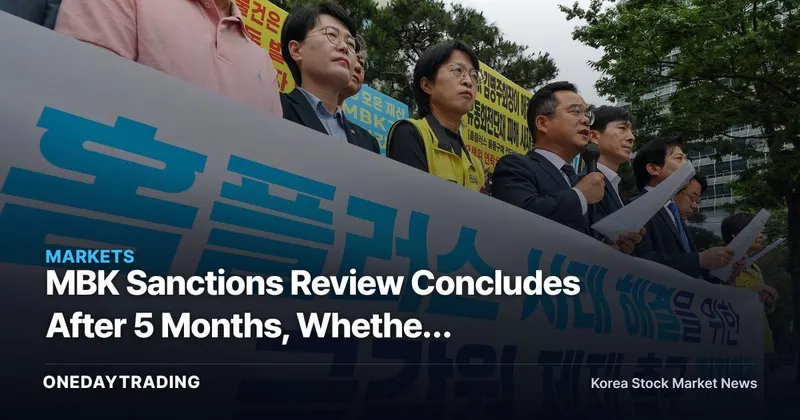
The Financial Supervisory Service has concluded its sanctions review committee deliberations on MBK Partners over the Homeplus case and has recommended a sanctions plan to the Financial Services Commission (FSC). The conclusion comes roughly five months after the agenda was tabled this past January. Whether heavy sanctions including job suspension remain intact has not been disclosed, and the final severity will be decided at the FSC's regular meeting.
Why It Matters Now
At the heart of this case is the question of how far a private equity fund (PEF) manager's responsibility should extend when a company it acquired runs into financial trouble. Homeplus kept issuing asset-backed commercial paper (ABCP) even as the possibility of a credit rating downgrade was raised, and after it subsequently entered corporate rehabilitation proceedings, investors who had bought that paper were left holding the losses. The fact that the FSS sanctions review committee unusually delayed its conclusion for more than five months suggests the issue could set a precedent that touches on PEF governance and disclosure responsibility broadly, not just the distress of a single company.
What the market has already priced in is the confirmed losses for Homeplus bondholders and the rehabilitation proceedings themselves. What has not yet been priced in is whether the severity of this sanction will translate into a real constraint on MBK's future investment and fundraising activity in Korea. If the job suspension is in fact confirmed, MBK will have to shoulder reputational risk when forming new funds or attracting institutional investors domestically. Conversely, if the severity is softened, this case may end up as merely a symbolic example in the debate over tightening PEF regulation, with limited real-world impact.
FAQ
- Q. Does the conclusion of the sanctions review mean the sanction itself is finalized? A. No. The FSS sanctions review committee's recommendation must still be resolved at the FSC's regular meeting before it is finally confirmed.
- Q. Who would the job suspension apply to? A. The specific target and severity remain undisclosed, though in cases like this the suspension of relevant executives is typically the point at issue.
- Q. Why was the case tabled in January and only resumed now? A. The specific reasons have not been disclosed, but the prolonged review is understood to reflect the case's broader ramifications.
- Q. What happens to Homeplus investors' losses? A. Separate from this sanction, whether losses will be compensated is a matter to be determined through the ongoing rehabilitation proceedings and investor lawsuits.
Related Stocks (Tickers) and Sector Impact
- MBK Partners itself is unlisted, so there is no direct share-price impact, but this could lead to tighter disclosure and risk-management regulation across Korea's PEF industry as a whole.
- Securities firms and asset managers that packaged or sold Homeplus's ABCP could face reputational risk if controversy over investor compensation liability flares up.
- Listed companies in which MBK is currently pursuing stakes are indirectly affected, as this sanction's severity could alter MBK's negotiating leverage and fundraising capacity.
- Large retailers may see spillover benefits (store acquisitions, market realignment) from the sale and restructuring process tied to Homeplus's rehabilitation.
Investment Considerations
- Since the severity and target of the sanction remain confidential, it is risky to factor specific figures or disciplinary details into investment decisions before they are finalized.
- If tighter PEF regulation materializes, funding costs across leveraged buyout structures broadly could rise, so credit spreads of companies with similar leveraged buyout structures should be monitored as well.
- Financial institutions with exposure to Homeplus-related bonds or ABCP should separately check whether additional provisioning issues could emerge.
Overall Outlook
If the Financial Services Commission confirms the heavy sanctions including job suspension as they stand, this could establish a precedent that clearly holds PEF managers accountable for disclosure and risk-management responsibilities after taking control of a company. In that case, managers would have greater incentive to take a more conservative approach to credit-rating management and information disclosure in future large leveraged buyout (LBO) deals. Conversely, if the severity is softened, this case is likely to be filed away as an example of one company's financial distress, and the debate over PEF regulation could be pushed back to square one. The next thing to watch is what severity the sanctions plan is actually resolved at during the FSC's regular meeting, and when that meeting is scheduled to take place.
This article was automatically summarized and analyzed based on the original news report. View Original (Maeil Business Newspaper, Securities)