
Summary
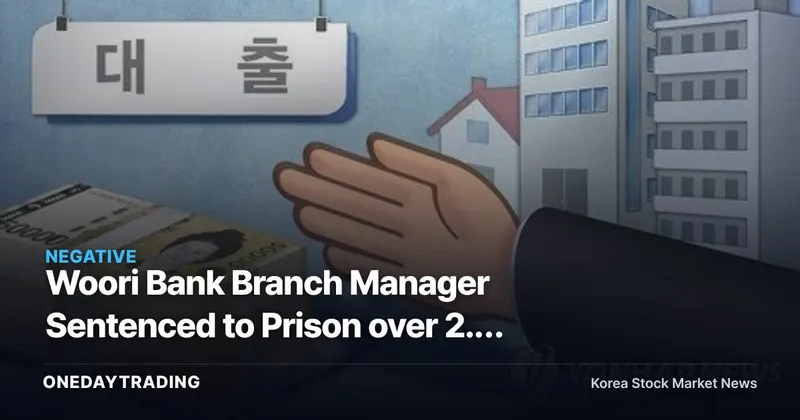
A branch manager at Woori Bank was sentenced to five years in prison at first instance and immediately taken into custody after being charged with accepting bribes and approving approximately 2.4 billion won in bad loans. While the amount is negligible relative to the bank's total assets, what the market is watching is whether the recurring pattern of credit and internal control failures at Woori Financial Group could solidify into a persistent governance discount factor.
Background
According to Yonhap News Agency, the branch manager was indicted on charges of accepting bribes in connection with loan solicitations and disbursing approximately 2.4 billion won in loans without following standard underwriting procedures. The first-instance court found the offense serious, handed down a custodial sentence, and ordered the defendant taken into custody on the spot.
In bank lending operations, branch managers hold discretionary authority to independently approve or expedite loans up to a certain limit. When that discretion is compromised by external solicitation and bribery, inflated collateral valuations or misrepresented borrower creditworthiness can slip through the underwriting net. While this incident reflects one individual's misconduct, it also illustrates how control gaps at the branch level can translate directly into losses.
Structural Context
Woori Financial Group has repeatedly come under regulatory scrutiny in recent years following a series of internal control incidents, including large-scale embezzlement and improper lending. The share price of a financial holding company reflects not only return on equity (ROE) and dividend policy, but also confidence in its loss-absorption capacity and reputational risk profile. Consequently, whether incidents appear structural and recurring matters more to valuation multiples than the size of any individual event.
Stock (Ticker) and Industry Sector Implications
- Woori Financial Group: The listed holding company whose subsidiary Woori Bank is directly involved in this incident. While direct financial losses are limited, the accumulation of internal control-related news risks delaying the recovery of a governance premium and could invite additional regulatory examination burden.
- KB Financial Group, Shinhan Financial Group, Hana Financial Group: Competing financial holding companies. A control incident at one bank can generate a spillover effect, redirecting capital and investor confidence toward peers with stronger internal control reputations.
- Banking industry sector overall: If regulators tighten branch-level underwriting standards and internal control requirements, loan disbursement speed and branch-level discretionary authority may contract in the short term, posing a modest headwind to growth.
Bull vs. Bear Scenarios
On the bull side, the 2.4 billion won amount has a virtually negligible impact on Woori Financial's earnings relative to its asset base, and the legal proceedings and custody order can actually be read as a signal that the control system is functioning retroactively. If the stock's high-dividend, low-PBR appeal remains intact, this incident may not emerge as a significant variable in the share price trajectory.
On the bear side, if similar credit and control incidents continue to accumulate, the risk grows that regulatory sanctions, fines, and executive accountability debates will escalate, widening the governance discount. This could prolong a valuation discount relative to sector peers over the long term.
Investor Action Points
- Monitor whether the Financial Supervisory Service (FSS) or Financial Services Commission (FSC) announces additional examinations or sanctions targeting Woori Financial Group.
- In quarterly earnings releases, track the loan loss provision coverage ratio and non-performing loan (NPL) ratio to assess changes in asset quality.
- Compare whether the PBR and dividend yield gap between Woori Financial and competing financial holding companies is widening, as a gauge of deepening governance discount.
- Follow subsequent disclosures on the company's internal control improvement plans and accountability structure implementation progress.
Woori Financial Group — Live Data Snapshot
Woori Financial Group's most recent closing price was KRW 28,150 (−3.10% vs. prior day). The composite signal — integrating foreign investor and institutional investor supply-demand (order flow) alongside news and momentum — reads 🟡 neutral · wait-and-see. With bullish and bearish signals mixed, this is a zone to monitor.
- ▼ Trend alignment — Short- to medium-term downward alignment (day: −3.1% · 1 week: −9.3% · 1 month: −8.2%)
Recent related news shows 2 positive catalysts · 0 negative catalysts, a favorable read.
※ Price and foreign investor / institutional investor supply-demand (order flow) data are provided by Korea Investment & Securities (KIS) and are current as of the time of publication.
This content is an automatically summarized and analyzed article based on the original news report. View original article (Yonhap News Agency)