
Samsung Electronics and SK Hynix Weakness Exposes Market Cracks
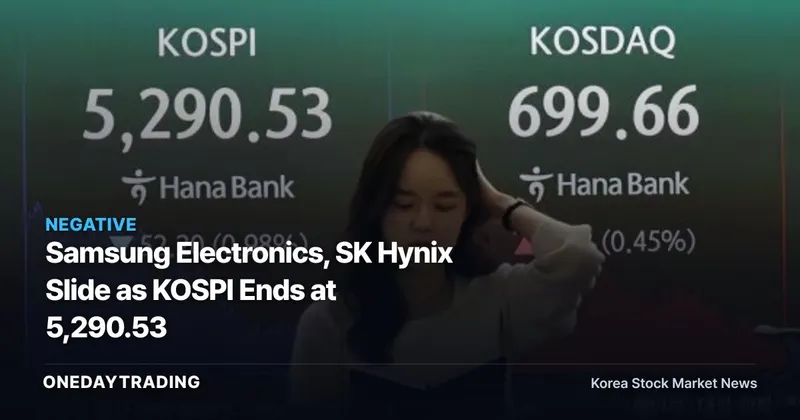
The KOSPI closed at 5,290.53 on Nov. 13, 2026, down 0.98% from the previous session, as Samsung Electronics and SK Hynix declined. The session reported by Asia Economy Securities points to more than a routine index correction. Weakness in semiconductor heavyweights and foreign net selling moved in the same direction, preventing the KOSPI from holding its intraday gains.
Foreign net selling means that foreign investors sold more than they bought. When semiconductor stocks with large index weightings decline while foreign investors are also net sellers, as they were on this day, pressure on the KOSPI intensifies regardless of moves in other stocks. The burden currently evident is concentrated in semiconductors, while the specific reason foreign investors shifted to selling has not been confirmed.
KOSPI Swings From 5,504.44 to 5,259.09
The KOSPI opened at 5,452.41 on Nov. 13, 2026, and climbed as high as 5,504.44 intraday, but fell to a low of 5,259.09. The gap between the intraday high and low reached 245.35 points. Although the closing price reflected a 0.98% decline, the intraday path showed expectations of further gains and selling pressure alternating rapidly throughout the session.
These figures say more about the market's ability to hold prices than about its direction. The intraday high did not carry through to the close, and the KOSPI finished at 5,290.53. Investors should consider both that the closing price remained above the session low amid wide fluctuations and that it ended below the opening price.
Foreign Net Selling Reaches 705.7 Billion Won, Outweighing Retail Buying
As Samsung Electronics and SK Hynix weakened, foreign investors recorded net selling of 705.7 billion won in the KOSPI market. Institutional investors also sold a net 39.9 billion won, while retail investors bought a net 195.7 billion won. Retail investors were the only group with a net buying position, yet the index declined, showing that the KOSPI could not escape the direction set by foreign and institutional selling.
If foreign net selling subsides, the supply-demand (order flow) pressure on the KOSPI could also ease. Conversely, if net selling continues, a rebound in Samsung Electronics and SK Hynix alone may not be enough to judge whether the market has stabilized. Because the data do not identify what prompted foreign investors to shift to selling, there is still insufficient basis to extrapolate a single day's supply-demand (order flow) into a long-term trend.
Nvidia's Decline and Jensen Huang's Resignation: What Is Confirmed
Nvidia fell 4.34% in overnight New York trading, while the Philadelphia Semiconductor Index declined 0.54%. The article explicitly states that Jensen Huang resigned as Nvidia's chief executive. In South Korea, semiconductor heavyweights including Samsung Electronics and SK Hynix declined.
However, neither the reason for Jensen Huang's resignation nor the specific cause of foreign net selling has been confirmed. His resignation, South Korean semiconductor share prices, and foreign selling therefore should not be linked as a proven causal chain. The confirmed facts are the declines in Nvidia and the Philadelphia Semiconductor Index, weakness in South Korean semiconductor heavyweights, and foreign net selling in the KOSPI.
KOSDAQ Closes at 699.66, Diverging From the KOSPI
The KOSDAQ closed at 699.66 on Nov. 13, 2026, up 3.13 points, or 0.45%, from the previous session. The KOSDAQ posted a modest gain on a day when the KOSPI fell, leaving the two markets with opposite closing directions. This made it difficult to characterize the overall market as uniformly risk-on or risk-off.
In the KOSDAQ market, foreign investors and retail investors recorded net selling of 61.2 billion won and 74.9 billion won, respectively, while institutional investors posted net buying of 127.2 billion won. Unlike in the KOSPI, where foreign and institutional investors were both net sellers, institutional investors held a net buying position in the KOSDAQ. This highlights the need to assess supply-demand (order flow) separately for the two markets.
Indicators for Samsung Electronics and SK Hynix Investors to Watch
- Direction of semiconductor heavyweights: Investors should first monitor whether weakness in Samsung Electronics and SK Hynix continues or reverses.
- Foreign supply-demand (order flow) in the KOSPI: Whether selling expands or contracts after 705.7 billion won of foreign net selling will determine the degree of pressure on the index.
- U.S. semiconductor trend: Investors should compare moves in South Korean semiconductor stocks with whether Nvidia and the Philadelphia Semiconductor Index continue falling or recover.
- Institutional supply-demand (order flow) in the KOSDAQ: Investors should monitor whether institutional net buying of 127.2 billion won continues to assess whether the KOSDAQ can maintain its relative strength.
Where Rebound Conditions and Downside Risks Diverge
The bullish scenario would involve a recovery in Samsung Electronics and SK Hynix alongside a reduction in foreign net selling in the KOSPI. Under these conditions, semiconductor heavyweights and supply-demand (order flow) would improve in tandem, increasing the potential for intraday gains to hold. If institutional net buying continues in the KOSDAQ, investors would also have a basis for separately assessing its trajectory after the 699.66 close.
Continued semiconductor weakness and persistent foreign selling would create downside risk. In particular, if foreign net selling expands, investors will need to reassess whether retail net buying alone can absorb the pressure on the index. In the next session, it would be more informative to monitor the direction of Samsung Electronics and SK Hynix, whether foreign investors shift to net buying, and institutional supply-demand (order flow) in the KOSDAQ, rather than focusing solely on the KOSPI's closing price.
Samsung Electronics Key MetricsAs of 2026-11-13
| Period Return | 1 Week +9.70% 1 Month -1.43% |
|---|---|
| Trading Value · Trading Volume | 9.8 billion won · 19,866,977 shares |
| Supply-Demand (Order Flow) | Foreign Investors 9.5 billion won in net buying (4 consecutive days) Institutional Investors 65.6 billion won in net selling |
| Recent News Tone | 5 positive catalysts · 1 negative catalyst |
Price and supply-demand (order flow) data are real-time figures from Korea Investment & Securities (KIS), while supply-demand (order flow) and news-tone totals are calculated independently by One Day Trading.
Supply-Demand (Order Flow) and Momentum Assessment🟡 Neutral · Wait and See
Mixed positive and negative signals suggest a period of watchful waiting.
- ▲Supply-Demand (Order Flow) ContinuityForeign net buying for 4 consecutive days (+9.5 billion won)
- ▲News Trend5 positive catalysts vs. 1 negative catalyst — positive catalysts prevail
Upcoming Events to Watch
- 11.26Bank of Korea Monetary Policy BoardHighBenchmark interest rate decision meeting
- 12.09FOMC Policy Rate DecisionHighU.S. Federal Reserve monetary policy announcement — direction of interest rates and the dollar
- 12.10Simultaneous Futures and Options ExpirationMediumQuadruple witching — watch for volatility and supply-demand (order flow) disruptions
- 01.14Index Options Expiration DateLowKOSPI200 options expiration
This article was automatically summarized and analyzed based on the original news report. View the original article (Asia Economy Securities)