
Three-Line Briefing
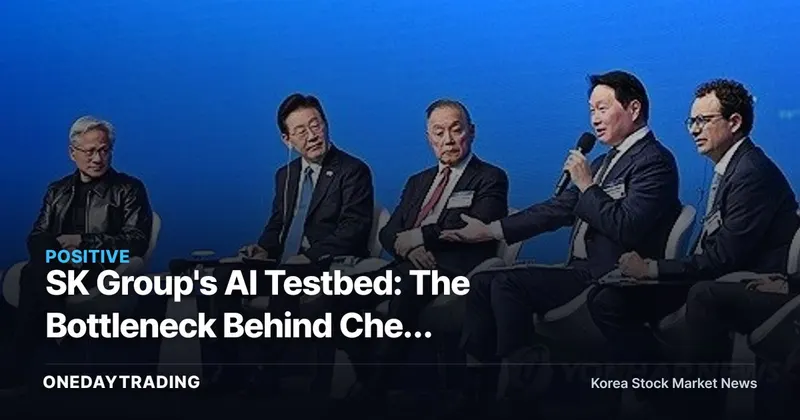
- SK Group Chairman Chey Tae-won said Korea could become an AI testbed. The key issue is not the speed of AI agent adoption, but unit cost and safety.
- The vision of at least one AI agent per citizen is a statement that simultaneously opens up demand across semiconductors, cloud computing, telecom, security, and platforms.
- However, the winners of this testbed will be determined not by rhetoric but by traffic volume, inference costs, data governance, and client adoption rates.
What Changes
An AI agent is not simply the next iteration of chatbots. It is a software layer that goes beyond answering user queries to perform tasks on a person's behalf — scheduling, payments, document handling, search, and customer service. This is precisely why Chairman Chey's remarks matter to investors. For Korea to become an AI testbed means the emergence of a proving-ground market where domestic companies use the technology first, refine it, and then export it.
SK Group's stake in this picture is not straightforward. SK Hynix sits at the base of AI server expansion as a memory supplier, SK Telecom serves as the touchpoint for personal AI services, and SK C&C is the execution arm carrying out enterprise AI transformation projects. As agent usage rises, inference computing demand increases first, followed by data center investment and greater memory content per server. In the end, the technology narrative comes down to power consumption inside server racks, memory bandwidth, and cloud billing.
What matters more is that Chairman Chey linked cost and side effects together. For AI agents to become a market where every citizen uses at least one, monthly subscription fees need to come down, and the costs tied to faulty execution or personal-data leaks need to be kept in check. As a result, the benefits are not confined to model developers alone. Demand spreads to low-power semiconductors, security, on-device AI, network quality, and enterprise data-cleansing providers as well.
Numbers in Context
The strongest figure in the source is "at least one per person." Since this covers the entire Korean population, the market in question is far larger than a handful of enterprise pilots. Still, investors should focus less on total user counts and more on daily calls per agent, inference cost per call, and the paid-conversion rate. Even with a large user base, if unit costs fail to fall, platforms will generate revenue while infrastructure providers absorb the costs.
Additional context comes from the San Francisco AI Summit, where the chairmen of Samsung, SK, and Hyundai Motor jointly referenced an AI hub vision. Samsung Electronics could take on production and memory, SK could handle HBM and telecom/services, and Hyundai Motor could cover physical AI and manufacturing sites. Broken down by supply chain, materials and equipment, memory, servers, cloud, and end-product application form a single connected line. Whether this line actually converts into revenue will need to be confirmed through next quarter's shipments and client orders.
Stocks (Tickers) to Watch: Winners and Losers
- SK: The entity driving the group-wide AI testbed discussion. Through its semiconductor, telecom, and IT-service subsidiaries, it has exposure to multiple points along the agent-adoption chain.
- SK Hynix: Rising AI agent usage boosts demand for inference servers. If memory bandwidth and power efficiency become the bottleneck, HBM and high-performance DRAM should retain their pricing power.
- Samsung Electronics: If Korea becomes an AI supply-chain testbed, opportunities expand for proving out memory, foundry, and on-device AI chips. The key variable is client yield verification.
- NAVER: Holds Korean-language service and search/commerce data touchpoints. If personal AI agents become part of everyday tasks, the platform could redesign user dwell time along with its advertising and subscription models.
- Hyundai Motor: Becomes the ultimate application site for the testbed as physical AI extends into manufacturing and mobility. However, there is a time lag between the auto cycle and software monetization.
Risk Check
- Cost risk: If inference unit costs don't fall enough, AI agents will remain a premium feature rather than a mass-market service.
- Regulatory risk: If issues around personal data, copyright, and faulty automated execution grow, building safeguards will be required before testing speed can be prioritized.
- Valuation risk: For stocks (tickers) where AI-infrastructure expectations are already priced in, multiples can adjust quickly if actual orders are delayed.
- Competitive risk: If global Big Tech dominates models and cloud infrastructure, domestic companies may end up supplying the testbed's traffic while capturing only thin margins.
Bottom Line
Chairman Chey Tae-won's AI testbed remarks are a positive catalyst for SK Group and Korea's AI infrastructure, but share prices will hold up longer only when agent call volumes, inference costs, and client orders move in the same direction — not on declarations alone.
SK by the Numbers: Real-Time Data
SK's most recent closing price was 630,000 won (-3.82% versus the previous session), and the traffic-light indicator combining foreign-investor and institutional-investor supply-demand (order flow) with news and momentum reads 🟡 Neutral / Wait-and-See. With positive and negative signals mixed, this is a period worth watching closely.
Recent related news shows 1 positive catalyst and 0 negative catalysts, a favorable mix.
※ Price and foreign-investor/institutional-investor supply-demand (order flow) data are provided by Korea Investment & Securities (KIS) and reflect figures as of publication time.
This article is automatically summarized and analyzed based on the original news report. View original article (Yonhap News Agency, Industry)