
3-Line Briefing
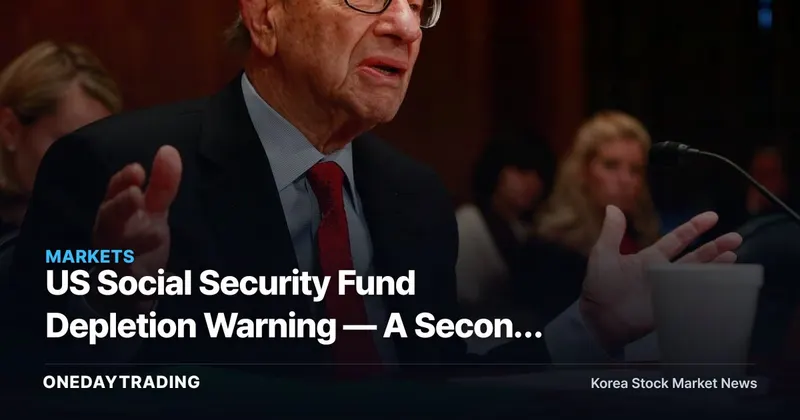
- The US Social Security fund (OASDI) is entering a path toward exhausting its reserves in the early 2030s, reviving the case for a bipartisan structural overhaul like the 1983 Greenspan Commission.
- At its core, this is not simply a welfare issue but a macro chain running through the US fiscal balance, government bond issuance, and long-term yields — an indirect variable even for Korean investors holding dollar assets.
- Delaying reform deepens long-term fiscal uncertainty, which can weigh on the government bond term premium and dollar volatility.
What Changes
Interpreting this issue first from an investment standpoint: Social Security reform is directly tied to the size of the structural deficit in US federal finances, and the deficit in turn determines the US Treasury's net issuance of government bonds. As issuance rises, supply-demand (order flow) in long-dated paper loosens, exerting upward pressure on yields, and this propagates across all asset classes through the US 10-year yield — the benchmark for global bond and equity valuations. The US Treasury ETFs, US growth stocks, and currency-hedged and currency-exposed funds held by Korean investors all sit at the tail end of this chain.
The 1983 Greenspan Commission effectively extended the fund's life by a generation by gradually raising the retirement age to 67, lifting payroll tax rates, and taxing the benefits of higher-income recipients. The significance of that reform was that it removed market uncertainty quickly by handling tax hikes and benefit cuts simultaneously through bipartisan consensus. The reason such a mechanism is being discussed again now is that the longer reform is delayed by political gridlock, the steeper the required adjustment becomes, and the larger the fiscal risk premium the market prices in ahead of time.
By the Numbers and Context
The US Social Security trust fund is structured so that, once reserves are exhausted, incoming payroll taxes alone can fund only a portion of promised benefits. That forces a choice among an abrupt benefit cut, a tax hike, or a transfer from general revenue — any of which feeds directly into the US fiscal balance. The key variable is that the sooner reform comes, the smaller the adjustment that can be spread out and the milder the market shock, while the later it comes, the heavier the burden that must be absorbed all at once.
Beneficiary and Casualty Stocks
- US long-term Treasuries and government bond ETFs: Fiscal uncertainty and rising issuance are upward factors for long-dated yields, pressuring the prices of long-duration bonds. Conversely, if reform consensus arrives sooner, a narrowing term premium could drive a relief rebound.
- Insurance and annuities (life insurers and annuity providers): Greater uncertainty around public pensions could channel demand toward private retirement savings and annuities, though investment gains and losses from rate swings are an offsetting variable.
- Korean export stocks (autos, semiconductors, etc.): An indirect impact via the exchange rate channel through US yields and the dollar. A stronger dollar is favorable for won-translated earnings, but risk aversion driven by a yield spike is a drag.
- Gold and commodities: Hedge assets that can stir demand for stores of value if concerns over fiscal sustainability persist over the long run.
Risk Check
- Policy issues carry a long lag before actual legislation, and if they drift without consensus, the market impact is not immediate — making them a weak basis for short-term trading.
- Government bond yields are determined simultaneously by Fed policy, inflation, and growth, not by Social Security alone, so a single causal link is hard to assert.
- Depending on the reform approach (tax hikes vs. benefit cuts vs. fiscal transfers), the direction of beneficiary and casualty assets could reverse, leaving a wide range of scenario branches.
- For Korean investors, the exchange rate adds an extra layer, so the direction of gains and losses may diverge from the impact on the US mainland.
Bottom Line in One Sentence
The Social Security reform debate itself is not an immediate buy or sell signal, but the speed and method of reform seep into the overseas-asset gains and losses of Korean investors through US government bond yields and the dollar. If bipartisan consensus is brought forward, a narrowing fiscal risk premium offers reassurance; if gridlock drags on, wider long-term yield volatility looms as a burden.
This article is content automatically summarized and analyzed based on the original news report. View Original (MarketWatch)