
Summary
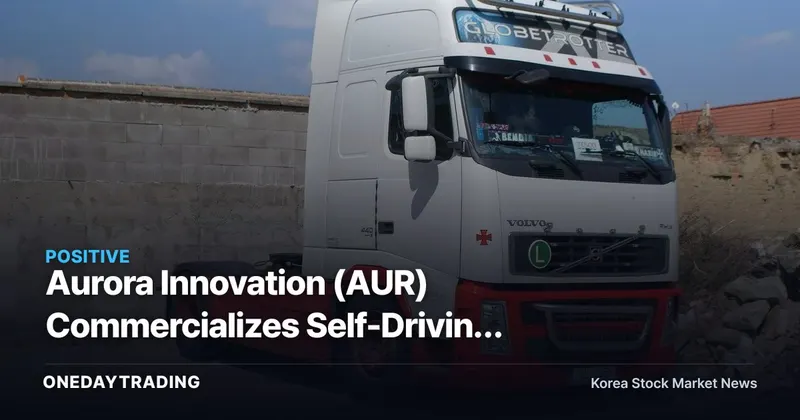
Aurora Innovation is now running real freight hauls with driverless heavy-duty trucks on commercial routes, positioning it as a leading candidate in the autonomous freight (robotruck) space. The key point is that the company has moved beyond technology demonstrations and begun generating real revenue from paid freight; the decisive factors for any investment call are how fast it expands its routes and when its losses start to narrow.
What Happened
When a Korean investor looks at this stock (ticker), the first thing to assess is not simply the autonomous-driving theme, but the business structure: unlike robotaxis that carry passengers, freight trucks that repeatedly run fixed highway segments are relatively easier to commercialize. Driverless trucks capable of overnight, long-haul operation can lower logistics costs by easing the burden of driver labor expenses and rest-break regulations, giving shippers and carriers a clear incentive to adopt them.
Aurora has launched driverless operations on the corridor linking Dallas and Houston — a major logistics axis in the southern United States — and is now in the phase of extending this to other highway routes. The truck chassis is supplied by a global commercial-vehicle maker, while high-performance AI semiconductors power the computing that serves as the autonomous-driving "brain." In other words, Aurora is not a company that builds vehicles itself; its model layers autonomous-driving software and systems onto freight transport to pursue fare-based revenue.
Structural Background
While the robotaxi camp wrestles with environments full of variables such as urban pedestrians and traffic signals, freight trucks operate mainly on highways with limited entry and exit, making their driving scenarios far simpler. In the United States, a chronic shortage of long-haul truck drivers and high labor costs mean there is structural demand for automation. That said, the company still carries the weaknesses common to all autonomous-driving firms — enormous R&D spending and accumulated losses — along with the safety risk that a single accident could shake confidence in the entire business.
Impact on Stocks and Industry Sectors
- Aurora Innovation (AUR): The central subject of this article; the direct driver of its share price is whether it can expand driverless truck routes and ramp up freight revenue in earnest. Still pre-profit, it is evaluated more on operating metrics and cash-burn rate than on earnings.
- NVIDIA (NVDA): A supplier of high-performance computing platforms for autonomous vehicles, it stands to benefit upstream as wider robotruck commercialization increases demand for the expensive semiconductors installed per vehicle.
- Hyundai Motor: An automaker that has invested directly and indirectly in autonomous-driving solutions; accelerating global commercialization of self-driving serves as market validation of its mobility strategy.
- LG Innotek and HL Mando: Korean firms supplying core autonomous-driving components such as camera modules, radar, and braking/steering systems; they are potential beneficiaries of expanded component adoption as self-driving vehicles proliferate.
- Samsung Electronics (005930): On the demand side for automotive memory and system semiconductors, it could benefit indirectly from the rising computing load of autonomous driving.
Bull vs. Bear Scenarios
The bull scenario is one in which additional driverless truck routes open, contracts with large carriers and shippers accumulate, and freight revenue becomes visible. In that case, the unit economics of autonomous freight would be proven, potentially leading to a re-rating of the theme as a whole. Conversely, the bear scenario is one in which a safety accident, tighter regulation, or delayed route expansion pushes back the full ramp-up of revenue, losses drag on, and pressure for additional fundraising (a capital increase) builds. The current share price sits in high-valuation territory that already prices in much of the future growth expectation, so even a single setback could produce sharp volatility.
Action Points for Investors
- At quarterly earnings releases, check the number of driverless routes, miles driven, freight-revenue trends, and cash-burn rate together.
- Examine whether new contracts with large carriers and shippers, and disclosures of additional route openings, are leading signals of actual monetization.
- Monitor safety-related accidents and regulatory developments, along with the possibility of additional fundraising (a paid-in capital increase), as risk variables.
- For Korean component and semiconductor stocks, distinguish between short-term moves driven by theme correlation and the actual booking of autonomous-driving orders and revenue.
This article is content automatically summarized and analyzed based on the original news source. View original (Yahoo Finance)