
Key Takeaways
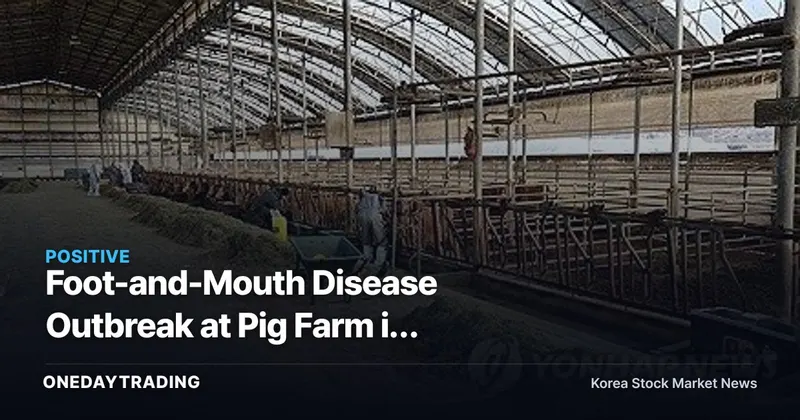
A foot-and-mouth disease (FMD) outbreak has been confirmed at a pig farm in Yecheon, North Gyeongsang Province, prompting quarantine authorities to raise the livestock disease crisis alert to its highest level — "Critical." Historical precedent shows that outbreaks of this kind place a heavy burden on pig farmers through culling and movement restrictions, while simultaneously acting as a near-term demand catalyst for listed companies involved in animal vaccines and bio-defense materials.
For investors, the key question is whether this outbreak remains isolated or spreads nationwide. The trajectory will determine vaccination volumes and the number of animals culled — and by extension, the actual earnings impact on related stocks.
What Happened
The Central FMD Incident Management Headquarters announced on June 27 that FMD had been detected at a pig farm in Yecheon County, North Gyeongsang Province. As a result, the livestock disease crisis alert has been elevated to the "Critical" level — the highest of the four-tier system (Attention → Caution → Alert → Critical) — at which point nationwide quarantine measures are activated.
When FMD is confirmed, standard protocol calls for the simultaneous culling of livestock at the affected farm and neighboring operations, movement restrictions within a defined radius, checkpoint disinfection, and emergency vaccination. Unlike cattle, pigs present greater challenges in managing vaccination efficacy and antibody formation, which means the intensity of early containment measures is a significant variable for market sentiment.
Background and Context
South Korea experienced a massive FMD outbreak in 2010–2011 that resulted in millions of animals being culled, after which a mandatory vaccination program was established. While outbreak frequency and severity have since declined, sporadic cases have continued. In the market, a well-established pattern has emerged whereby news of livestock diseases — including FMD, African Swine Fever (ASF), and Avian Influenza (AI) — consistently triggers theme-driven moves in animal vaccine, bio-defense, and diagnostics stocks.
Market and Stock Impact
- Chungang Vaccine: The leading domestic animal vaccine company and the central name in FMD-related themes. The expected increase in emergency vaccination volumes is the primary channel driving near-term supply-demand (order flow).
- Komipharm, Daesung Microbiological Labs, and Woojin B&G: Companies with product lines spanning animal pharmaceuticals, vaccines, and bio-defense supplies. They tend to come into focus alongside Chungang Vaccine during livestock disease events; the higher their revenue exposure to the livestock sector, the more concentrated the expectations.
- Eaglevet and Jeil Bio: Operating in veterinary pharmaceuticals, disinfectants, and feed additives, these stocks benefit from expected demand for disinfectants and management products during periods of heightened quarantine activity.
- Pork production and distribution (Harim Holdings and other livestock value-chain names): Culling and movement restrictions can cause short-term supply disruptions, increasing pork price volatility. While supply contraction is a price-positive factor, weakening consumer demand and rising quarantine costs cut the other way — the net direction is mixed.
Investor Checklist
- Additional outbreaks: Monitor the Central Incident Management Headquarters' daily case updates to see whether the disease spreads beyond Yecheon to other regions or farms.
- Culling numbers and movement restriction scope: The scale of quarantine measures directly feeds into vaccine demand and pork supply-demand (order flow).
- Pork wholesale prices (Korea Institute for Animal Products Quality Evaluation auction prices): Watch whether supply disruptions are translating into actual price moves.
- Earnings follow-through in related stocks: After any theme-driven sharp gain (surge), verify in the following quarter whether actual vaccine order volumes are reflected in revenue and order books.
Outlook
If the outbreak is contained within Yecheon and suppressed quickly, the strength in related stocks is likely to prove a short-lived event. Conversely, if the disease spreads to adjacent areas, structural growth in vaccine and bio-defense demand could meaningfully feed through to the earnings of relevant companies. That said, these theme plays tend to price in news immediately after headlines break, which means profit-taking can materialize rapidly once the spread is brought under control — and that remains the most significant risk. Chasing these stocks on the outbreak headline alone, without an earnings basis, could leave investors exposed to considerable volatility.
Chungang Vaccine — Real-Time Data Snapshot
Chungang Vaccine's most recent closing price is ₩9,150 (−1.19% vs. prior day). The signal derived from a composite of foreign investors and institutional investors supply-demand (order flow) alongside news and momentum reads 🟡 neutral — wait and see. Positive and negative signals are mixed, suggesting a monitoring stance is warranted.
- ▲ Supply-Demand (Order Flow) Continuity — Foreign investors have been net buyers for three consecutive sessions (+₩0 billion)
- ▼ Trend Alignment — Short- and medium-term downtrend in place (day: −1.2% · 1 week: −3.6% · 1 month: −6.6%)
※ Price and foreign investors/institutional investors supply-demand (order flow) data are sourced from Korea Investment & Securities (KIS) and reflect the time of publication.
This article is auto-summarized and analyzed content based on the original news report. View original article (Yonhap News — Industry)