
Hyundai Engineering’s U.S. SMR Partnerships Remain Pre-Contract
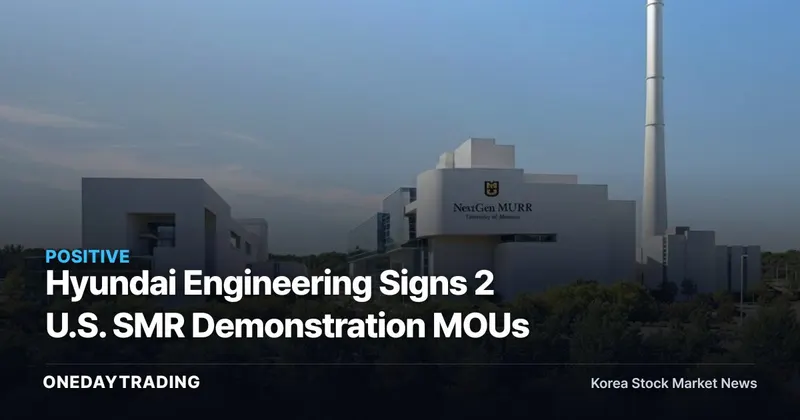
Hyundai Engineering’s memorandums of understanding with two U.S. small modular reactor developers are not contracts that immediately add to its order backlog, but an entry point for securing engineering, procurement and construction (EPC) roles in demonstration projects. According to Maeil Business Newspaper’s corporate coverage, the company announced on the 27th that it had signed separate agreements with Nano Nuclear Energy (NNE) and ARC Clean Technology (ARC). For investors, what matters is not the number of partner companies but whether the MOUs translate into defined scopes of work and binding contracts.
Small modular reactors (SMRs) are nuclear reactors whose power-generation facilities are designed and built as modules. Nano Nuclear Energy (NNE) and ARC Clean Technology (ARC) are both developing Generation IV reactors, but they use different reactor technologies and are pursuing different projects. By participating in both tracks, Hyundai Engineering aims to expand its role from designing reactor ancillary facilities and reviewing modularization to building supply chains and carrying out EPC work.
NNE’s KRONOS MMR and ARC-100 Offer Different Partnership Paths
Nano Nuclear Energy (NNE), which signed its agreement on the 23rd, is developing the KRONOS MMR, a high-temperature gas-cooled micro modular reactor. The two companies agreed to collaborate on a first-of-a-kind project that will supply heat to the University of Illinois Urbana-Champaign (UIUC) campus in the U.S. Hyundai Engineering plans to participate in EPC work for reactor ancillary facilities, modular design reviews and supply-chain development.
ARC Clean Technology (ARC), which signed its agreement on the 27th, is developing the ARC-100, a 100㎿e-class sodium-cooled fast reactor that uses liquid sodium as its coolant. ARC Clean Technology (ARC) is currently pursuing an approximately 200㎿e commercial demonstration plant at the U.S. Idaho National Laboratory site and is also considering expanding its generation capacity to 600㎿e in the future. Hyundai Engineering plans to pursue EPC cooperation and jointly identify new business opportunities as the project progresses.
The differences between the two agreements also matter for investment decisions. The NNE partnership outlines a relatively specific scope for the first-of-a-kind campus heat-supply project, while the ARC partnership depends on progress in the commercial demonstration plant. In either case, the point at which the agreements affect earnings is not their signing, but the process through which design reviews lead to actual EPC work and supply-chain participation.
Experience Across 254 Nuclear Projects; Converting Demonstrations Into Contracts Is Key
Since establishing its nuclear power division in 1985, Hyundai Engineering has completed 254 nuclear projects spanning nuclear power plant design, nuclear fuel facilities, research reactors and radioactive waste treatment facilities. In the competitive market for engineering service contracts commissioned by Korea Hydro & Nuclear Power, it recorded an approximately 31% share by contract value from 2021 through this year. It has also secured consulting and preliminary design contracts for the University of Missouri’s next-generation research reactor project in the U.S.
The value of this track record in the U.S. SMR market lies in turning design experience into specific work during the demonstration stage. If preliminary design and modularization reviews progress, Hyundai Engineering could secure a broader EPC role. If it also handles supply-chain development, its scope would extend beyond a standalone design service contract. A company representative said its accumulated nuclear design capabilities and experience with large-scale plants had led to partnerships with global SMR companies, adding that participation in the demonstration projects would help strengthen its capabilities from design through EPC.
However, neither agreement disclosed a contract value or validity period, and no start or completion dates were provided for the demonstration projects. The final scope assigned to Hyundai Engineering and the targets and schedules of any new joint projects also cannot be considered finalized. This is why there is insufficient basis to immediately translate the agreements into revenue or orders.
Three Signs That Investors Should Watch for Contract Conversion
- Scope of work: Investors should confirm which roles—EPC for ancillary facilities, modular design reviews or supply-chain development—are included in the final contract for the first-of-a-kind KRONOS MMR project.
- Project schedule: The first key indicator of execution will be when construction start and completion schedules are announced for the University of Illinois Urbana-Champaign (UIUC) project and the demonstration plant at the U.S. Idaho National Laboratory.
- Contract terms: If contract values and validity periods are disclosed and the partnerships convert into actual orders, investors will have a basis for assessing the expansion of the company’s nuclear business.
- Expansion potential: Investors should watch whether the generation-capacity expansion under consideration by ARC Clean Technology (ARC) and efforts to identify new joint business opportunities lead to concrete projects.
In an optimistic scenario, design and EPC contracts would follow sequentially across the two demonstration projects. Conversely, if project schedules remain unset or Hyundai Engineering’s final scope is reduced, the commercial value of the agreements will be limited. What is confirmed for now is that the company has secured entry points into U.S. Generation IV reactor demonstration projects; the next assessment will depend on order disclosures and finalized scopes of work.
This article was automatically summarized and analyzed based on the original news report. View the original article (Maeil Business Newspaper—Companies)