
After 120 Hours, Negotiation Uncertainty Outweighs Production Risk
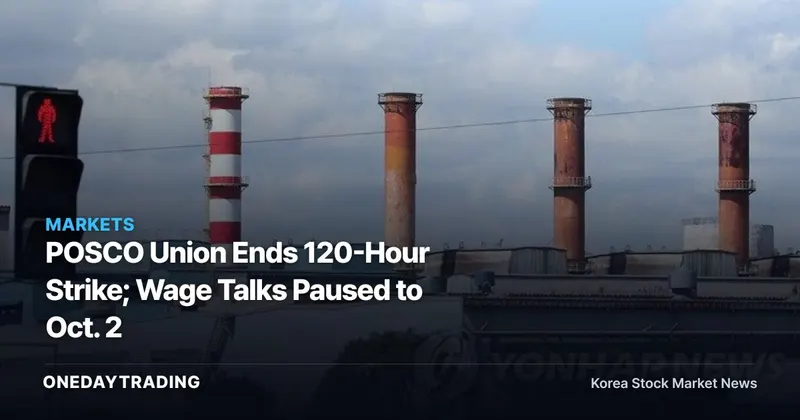
The POSCO union ended its second partial strike at 7 a.m. on September 21, 120 hours after it began at 7 a.m. on September 16, 2026. For POSCO Holdings investors, the more immediate concern is not a confirmed disruption to steel production, but a standoff over bargaining power while wage negotiations remain suspended. In an industry report by Yonhap News Agency, the company said available personnel and emergency response measures had prevented operational disruptions. The impact on production and finances has yet to be confirmed.
The strike affected certain operations at the Pohang and Gwangyang steelworks. The union estimated average participation at 92% but said the actual headcount could only be tallied after the strike ended. The company estimated that employees in the 100s participated at each of the Pohang and Gwangyang sites. Given the conflicting estimates of participation, the only confirmed information that can currently be factored into the share price is the strike’s duration and the timetable for suspending negotiations.
Gap Between Union Demands and the Company’s Offer
The union is demanding a 7.1% increase in base pay, a 600% incentive payment, 50 employee stock ownership shares, and a 200% holiday bonus. POSCO’s offer includes a 2.0% increase in base pay, a 3.5 million won performance incentive, and 500,000 won in local gift certificates. The differences go beyond a simple comparison of pay-raise percentages. Base-pay increases create recurring labor costs, while incentive payments and gift certificates are largely one-off expenses, meaning the final agreement could affect profit and loss in different ways.
Labor-management negotiations were suspended on September 15 and did not resume during the second partial strike. The strike’s conclusion therefore does not signal the start of an agreement. The union will wait until the morning of September 22 for a change in the company’s position and a proposal to resume negotiations. If no progress is made, it plans to suspend both strike action and negotiations until October 2.
Key Issue: High Participation, but Actual Impact Remains Unconfirmed
- Strike period: The strike lasted 120 hours, or five days, from 7 a.m. on September 16 to 7 a.m. on September 21.
- Participation: The union reported average participation of 92%, while the company estimated that employees in the 100s participated at each of the Pohang and Gwangyang sites. The actual number of participants in the second strike has not been confirmed.
- Production status: POSCO said its emergency response measures prevented operational disruptions. No decline in production or financial impact from the strike has been confirmed.
- Negotiation schedule: The union plans to suspend strike action and negotiations from September 22 through October 2 while holding its leadership election.
Timeline Shaped by the First Strike and Union Leadership Election
The union previously held its first 48-hour partial strike from September 9 to 11. A total of 120 employees participated, including 20 workers on certain lines at Pohang Works’ No. 2 electrical steel plant and 100 workers at Gwangyang Works’ pickling plant. The second strike expanded to additional operations, but no data is available on the combined production losses or costs from the two walkouts.
The union leadership election will be the next turning point in negotiations. Candidate registration for the 21st leadership election runs from September 18 to 21, with voting scheduled for October 2. The terms adopted by the new leadership as its negotiating position could determine whether the strike resumes and how quickly talks proceed.
Potential Impact on POSCO Holdings and the Steel Industry Sector
- Short-term operations: If production continued without disruption as the company stated, the immediate impact on sales volume and fixed-cost absorption should be limited. However, this is the company’s account of its response, and actual production data has not been disclosed.
- Costs: The union’s demand for a 7.1% base-pay increase and the company’s 2.0% offer illustrate the range under negotiation for labor costs. A final agreement above the company’s offer would increase its cost burden, while a settlement weighted toward one-off payments would have a different impact on recurring costs.
- Steel industry sector sentiment: Labor risk would ease if the strike does not become prolonged and negotiations resume after October 2. Conversely, if further strikes follow the resumption of talks, investors may focus first on costs and supply stability rather than production.
Four Things Investors Should Monitor
- Check whether POSCO presents a new wage-negotiation offer by 7 a.m. on September 22.
- Monitor when negotiations resume after the October 2 leadership election and review the new leadership’s demands.
- Watch whether POSCO separately discloses the actual number of participants in the second strike and its impact on production and finances.
- Once negotiations resume, distinguish between base-pay increases and one-off payments in the final settlement.
Until an Agreement Is Reached, the Terms Matter More Than Direction
The end of this strike alone is not enough to conclude that the earnings outlook for POSCO Holdings has changed. If the company maintains its emergency response measures and no further strikes occur, short-term production risk should remain limited. However, if negotiations are delayed or strikes continue after October 2, the market may apply a larger discount for wage costs and supply-stability risks.
The key turning point is not the end of the strike but the resumption of negotiations and the terms of any agreement. Investors need to see whether a proposal is made on September 22, the outcome of the October 2 leadership election, and the payment components confirmed in subsequent formal negotiations before the cost impact can be calculated. Until then, there is insufficient basis either to equate the high participation rate with weaker earnings or to conclude that the risk has disappeared solely because the company reported no operational disruption.
POSCO Holdings Key MetricsAs of 2026-09-21
| Period Return | 1 Week -2.69% 1 Month +1.09% |
|---|---|
| Trading Value · Trading Volume | 900 million won · 369,404 shares |
| Supply-Demand (Order Flow) | Foreign Investors Net selling of 13.2 billion won Institutional Investors Net buying of 3.7 billion won |
Price and supply-demand (order flow) data are real-time figures from Korea Investment & Securities (KIS), while supply-demand (order flow) and news-tone assessments are calculated independently by One Day Trading.
Supply-Demand (Order Flow) and Momentum Assessment🔴 Caution
Foreign-investor and momentum indicators are showing negative signals.
Upcoming Dates to Watch
- 10.08Index Options ExpirationLowKOSPI 200 options expiration
- 10.22Bank of Korea Monetary Policy BoardHighBenchmark interest rate decision meeting
- 10.28FOMC Policy Rate DecisionHighU.S. Federal Reserve monetary policy announcement — direction of interest rates and the dollar
- 11.12Index Options ExpirationLowKOSPI 200 options expiration
This article was automatically summarized and analyzed from the original news report. View original article (Yonhap News Agency, Industry)