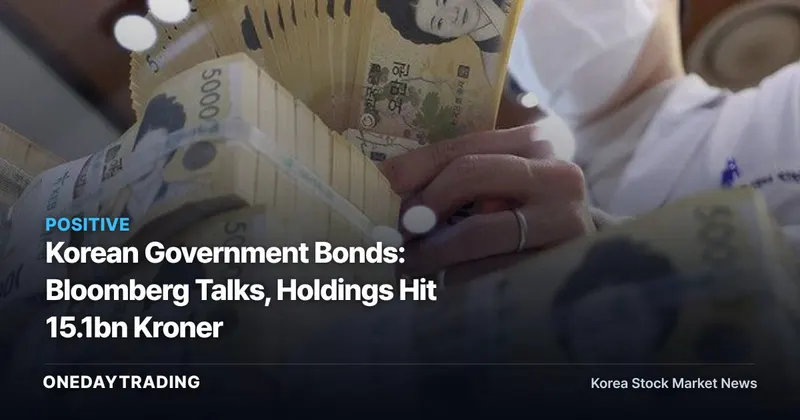

Korean Government Bond Reclassification Talks: What Could Change?
The key investment issue for Korean government bonds is not inclusion in a new index, but a change in investor eligibility. According to economic reporting by Maeil Business Newspaper, the Ministry of Finance and Economy said on the 28th that the government is discussing developed-market reclassification with Bloomberg. For domestic bond investors, the most direct implication is that reclassification could lower barriers to purchases by overseas institutional investors that have restricted investment in emerging-market bonds.
Bloomberg’s country reclassification is not a process for newly adding Korean government bonds to an existing index. It would change the country status of bonds already included from emerging market to developed market. The market must therefore distinguish between ‘index inclusion’ and the ‘eligible investment universe.’ The former has already been achieved, while the current talks could broaden the latter.
Bloomberg Index Inclusion and Country Classification Are Separate
The Bloomberg Global Aggregate Bond Index is cited as one of the three major bond indexes, alongside the Financial Times Stock Exchange (FTSE) Russell WGBI and JPMorgan’s emerging-market government bond index. Korean bonds are included in the Bloomberg Global Aggregate Bond Index, but Korea retains emerging-market status under Bloomberg’s country classification. This is why Korean government bonds are also included in Bloomberg’s emerging-market bond index.
Bloomberg has been reviewing whether to change Korea’s classification since 2024. In February last year, it specifically named Korea, the Czech Republic, Israel, and Taiwan as countries under review. After gathering feedback from market participants in April this year, it retained the existing classifications. At the same time, it acknowledged that these countries are high-income economies under World Bank (WB) criteria and advanced economies under International Monetary Fund (IMF) criteria.
Norway’s Sovereign Wealth Fund Holdings Highlight Investment Constraints
Norway’s sovereign wealth fund (GPFG·Government Pension Fund Global) removed emerging-market bonds from its fixed-income investment benchmark in 2019. Its holdings of Korean government bonds fell from 49 billion kroner, approximately 7 trillion won, at the end of 2019 to zero at the end of 2024. The case shows how country classification can affect the investment universe of major institutional investors.
The trend has since reversed. The Norwegian sovereign wealth fund’s holdings stood at 240 million kroner, approximately 36 billion won, at the end of last year, but expanded to 15.1 billion kroner, approximately 2.3 trillion won, in the first half of this year. Purchases resumed even without reclassification, suggesting that developed-market status alone should not be used to predict future demand.
Korea’s Weight in Bloomberg’s Emerging-Market Index
A report published by State Street in February showed that the Bloomberg Emerging Markets Local Currency Government Bond Index had a yield to worst (YTW) of 5.91% as of the end of January this year. That was 0.16 percentage points below the 6.07% yield of JPMorgan’s emerging-market government bond index. State Street identified the inclusion of AA-rated Korea and A-rated Israel in the Bloomberg index as one of the main reasons for the yield gap.
Korean government bonds accounted for 9.66% of the Bloomberg Emerging Markets Local Currency Liquid Government Bond Index, ranking second behind China’s 10.02%. Korea, by contrast, was not included in the JPMorgan index. What is currently known is that Korean government bonds already carry substantial weight in Bloomberg’s emerging-market index. What remains unknown is the scale of fund flows following any classification change.
How the Impact Could Flow Through to Korean Government Bonds and Financial Markets
- Korean government bonds: Reclassification as a developed market could make them eligible for new purchases by institutional investors that have restricted investment in emerging-market bonds. A Ministry of Finance and Economy official also said the government expects purchases by overseas institutional investors such as Norway’s sovereign wealth fund.
- Bloomberg emerging-market bond index: Because Korean government bonds are currently included, any successful reclassification would require confirmation of how their position within the existing emerging-market index would change. The available materials do not specify the adjustment method.
- Domestically listed stocks (tickers): The materials did not identify any direct benefit or earnings impact for specific companies. It is more accurate to view this development as a potential change in the investment universe for Korean government bonds and institutional capital, rather than extending it into a catalyst for an individual stock (ticker).
Overinterpretations to Avoid When Assessing Developed-Market Reclassification
- Bloomberg has not decided whether to reclassify Korean government bonds as developed-market assets. Its regular country-classification review is expected early next year, but no exact date has been announced.
- Korean bonds are already included in the Bloomberg Global Aggregate Bond Index. Treating this development as equivalent to new index inclusion could inflate expectations for capital inflows.
- A Ministry of Finance and Economy official said it is difficult to estimate the specific amount of additional capital that could flow in. Removing institutional investment restrictions and confirming actual purchase volumes are separate stages.
- The Norwegian sovereign wealth fund’s increased holdings in the first half of this year have been confirmed, but no causal link has been established between that increase and the reclassification talks.
Bloomberg’s Decision to Watch Early Next Year
Under the optimistic scenario, Bloomberg would move Korea to developed-market status in its regular review, prompting new purchases by institutional investors that have restricted emerging-market bond exposure. Even then, investors would need to distinguish existing demand arising from inclusion in the Global Aggregate Bond Index from additional demand generated by the classification change.
The trigger for the opposing scenario would be a decision to retain emerging-market status, as Bloomberg did in April this year. In that case, the current argument for broadening the investor base would be unlikely to gain traction until the next review. The next indicators to watch are Bloomberg’s country-classification decision early next year, the treatment of Korean government bonds within its emerging-market index, and changes in the Norwegian sovereign wealth fund’s holdings.
This article was automatically summarized and analyzed based on the original news report. View the original article (Maeil Business Newspaper Economy)