
What the KOSPI’s Break Below 7,000 Means
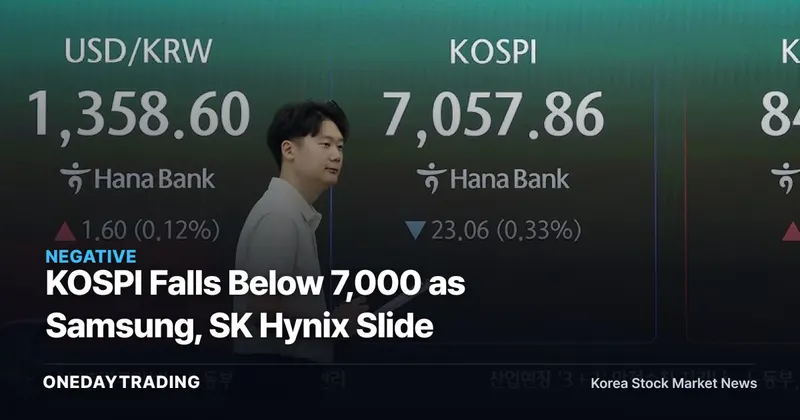
The KOSPI fell below 7,000 intraday on the 28th as trading resumed after the Chuseok holiday. According to Korea Exchange (KRX) data reported by Daum, the index stood at 6,998.62 as of 9:49 a.m., down 82.30 points, or 1.16%, from the previous session. This represents more than the loss of a numerical threshold. It reflects a supply-demand (order flow) structure in which selling by foreign investors drove weakness in Samsung Electronics and SK Hynix, weighing on the broader index.
The intraday break below 7,000 simply means that the KOSPI traded beneath a specific level; it does not confirm a trend reversal. Investors should distinguish between the already evident selling in large-cap stocks and the closing price on the 28th, which had yet to be determined.
Intraday Pressure Intensifies After the Open
The KOSPI opened at 7,057.86 on the 28th, down 23.06 points, or 0.33%, from the previous session, before falling as low as 6,989.34 intraday. The widening decline after a weak start indicates that selling pressure during trading was stronger than the opening price suggested.
As of 9:49 a.m. on the main board, foreign investors had sold a net 382.5 billion won and institutional investors a net 21.7 billion won. Retail investors bought a net 171 billion won but were unable to reverse the index’s decline. Continued net selling by foreign and institutional investors would sustain pressure on the large-cap-heavy KOSPI.
From Interest Rates to Multiples and Back to Semiconductors
While the Korean market was closed from the 23rd through the 25th, the Dow Jones Industrial Average fell 0.1%, the Standard & Poor’s (S&P) 500 declined 0.3%, and the Nasdaq dropped 0.6%. The rise in the U.S. 10-year government bond yield to as high as 5.2% intraday on the 24th illustrates the backdrop investors had to digest before the Korean market opened.
Higher interest rates increase the discount rate applied to future profits, pressuring the multiples of stocks priced for strong expectations. Against this backdrop, Samsung Electronics traded at 279,500 won on the 28th, down 6,000 won, or 2.10%, from the previous session. SK Hynix also fell 50,000 won, or 2.69%, to 1,812,000 won.
However, the available data do not establish a definitive cause for the intraday decline. On the 25th, the Dow Jones rose 0.93%, the S&P 500 gained 0.51%, the Nasdaq advanced 0.48%, and the Philadelphia Semiconductor Index climbed 1.41%. What can be confirmed is that the final rebound in overseas indexes was insufficient to offset selling in Korea’s major semiconductor stocks.
KOSPI and KOSDAQ See Diverging Supply-Demand (Order Flow)
- KOSPI: Net selling of 382.5 billion won by foreign investors and 21.7 billion won by institutional investors was met by net buying of 171 billion won from retail investors.
- KOSDAQ: As of 9:49 a.m., the index stood at 860.39, up 15.91 points, or 1.88%, from the previous session. Foreign and institutional investors bought a net 85.5 billion won and 1.5 billion won, respectively, while retail investors sold a net 83.6 billion won.
- Intraday Performance: The KOSDAQ opened at 845.48 on the 28th and climbed to 860.39. This is why the KOSPI’s weakness should not be interpreted as a uniform decline across the entire Korean equity market.
Stock Moves Point to Selective Trading
- Decliners: Samsung Electronics preferred shares fell 3.98%, SK Square dropped 5.21%, and KB Financial Group slipped 0.06%.
- Gainers: Samsung Electro-Mechanics rose 1.59%, LG Energy Solution gained 4.55%, Hyundai Motor advanced 0.99%, and Samsung Biologics climbed 1.46%.
- KOSDAQ Gainers: Alteogen rose 2.80%, EcoPro 2.87%, EcoPro BM 3.81%, Jusung Engineering 0.24%, and Simmtech 0.94%.
- KOSDAQ Decliners: Rainbow Robotics fell 0.58%, Wonik IPS dropped 3.89%, and EO Technics declined 0.93%. Price direction varied even within the same market and industry sector.
What Investors Should Watch Next
- Closing Price: The supplied data do not include the KOSPI or KOSDAQ closing price for the 28th. Investors assessing whether the KOSPI recovered 7,000 should distinguish intraday readings from the closing price.
- Supply-Demand (Order Flow): The index’s next move will depend on whether foreign and institutional investors maintain the net-selling trend seen at the open and whether retail investors can absorb that supply.
- Semiconductors: The subsequent closing prices of Samsung Electronics and SK Hynix were not available. Micron’s earnings will provide the next additional data point for evaluating semiconductor stocks.
- Major Events: Han Ji-young, an analyst at Kiwoom Securities, said, “Volatility may emerge as the market digests a cluster of major domestic and overseas events later in the week, including Micron’s earnings, exports and employment data. A strategy of treating such volatility as an opportunity to increase equity exposure is likely to remain effective.”
At a Crossroads Between Reclaiming 7,000 and Further Pressure
In the bullish scenario, selling by foreign and institutional investors eases, Samsung Electronics and SK Hynix recover, and the KOSPI reclaims 7,000. In the opposing scenario, net selling persists and weakness in semiconductor heavyweights continues, leaving the index under pressure.
The KOSDAQ’s advance suggests that risk appetite has not disappeared across the broader market. However, there is not yet enough evidence to conclude that the KOSPI’s weakness has ended. The next assessment should come after reviewing the closing price on the 28th, supply-demand (order flow) by investor category, and how Micron’s earnings and export and employment indicators are reflected in actual prices.
KOSPI Index MetricsAs of 2026-09-28
| Performance by Period | 1 Week +3.10% 1 Month +1.69% |
|---|
Index, commodity and exchange rate figures are based on global markets and reflect values at the time of publication.
Samsung Electronics Key MetricsAs of 2026-09-28
| Returns by Period | 1 Week +7.92% 1 Month +4.21% |
|---|---|
| Trading Value · Trading Volume | 326.2 billion won · 22,502,201 shares |
| Supply-Demand (Order Flow) | Foreign Investors Net selling of 581.3 billion won Institutional Investors Net selling of 127.7 billion won |
| Recent News Tone | 5 positive catalysts · 2 negative catalysts |
Price and supply-demand (order flow) data are real-time figures from Korea Investment & Securities (KIS), while supply-demand (order flow) and news-tone counts are calculated independently by One Day Trading.
Upcoming Events to Watch
- 10.08Index Options ExpirationLowKOSPI 200 options expiration
- 10.22Bank of Korea Monetary Policy BoardHighBenchmark interest rate decision meeting
- 10.28FOMC Policy Rate DecisionHighU.S. Federal Reserve monetary policy announcement — direction of interest rates and the dollar
- 11.12Index Options ExpirationLowKOSPI 200 options expiration
This article was automatically summarized and analyzed based on the original news report. View original article (Daum)