
Key Takeaways
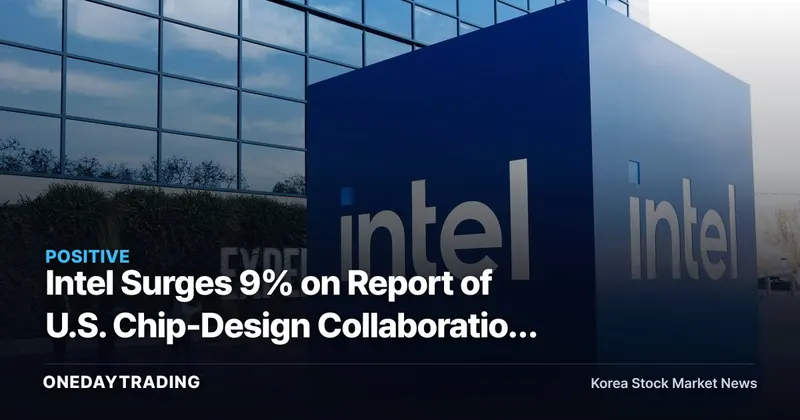
Intel shares jumped nearly 9% in a single day after President Trump remarked that Intel would collaborate with Apple on semiconductor design and manufacturing within the United States. For Intel, which has spent years grappling with declining market share and foundry losses, the prospect of landing a marquee customer was enough to move the stock sharply. Still, since the scope of any partnership and a production timeline remain unconfirmed at this stage, the rally looks heavily driven by anticipation rather than concrete details.
What Happened
The rally was sparked by President Trump's remarks hinting at a possible partnership between Intel and Apple. The market read this as a signal that Apple could tap Intel's U.S.-based manufacturing capacity for its own chip design and production. Since Apple has largely relied on TSMC to manufacture its self-designed M-series and A-series chips, shifting even a portion of that U.S. production to Intel could reshape the competitive landscape among foundry customers.
This surge is not an isolated event but an extension of Intel's recent rebound. Intel has made ramping up its 18A process and winning external foundry customers central to its turnaround strategy, and expectations of policy tailwinds have been building alongside the U.S. government's push to expand domestic semiconductor production. The mere mention of a symbolic customer like Apple was enough to significantly stir investor sentiment.
Background and Context
Intel has been squeezed on both revenue and margins as it loses ground to AMD and Nvidia in the PC and server CPU markets, while its foundry business has continued to post losses despite massive capital investment, hampered by slow progress in winning external customers. The key issue is that foundry is a scale-driven business. Landing a high-volume anchor customer like Apple is what lifts utilization rates and brings down unit costs, making the acquisition of a major customer a pivotal moment for turning the foundry business profitable.
Market and Stock Impact
- Intel (INTC): The most direct beneficiary. Securing an Apple-caliber customer would boost foundry utilization and lend credibility to the 18A process, potentially prompting a re-rating of a manufacturing business the market has long undervalued.
- Apple (AAPL): Expanding U.S.-based production could help diversify tariff and supply-chain risk, but cost and quality concerns remain a variable until yields become as stable as those at proven partner TSMC.
- Samsung Electronics (005930): As the challenger chasing TSMC in foundry, competition for non-TSMC business could intensify further if Intel absorbs a major customer in the U.S. market.
- SK Hynix: The connection here is less about direct competition and more about memory demand for AI and servers. Expanded investment in the U.S. semiconductor ecosystem would be a tailwind for demand for high-bandwidth memory further down the line.
- Korean semiconductor materials and equipment stocks (stocks/tickers): If advanced-process capacity expansion in the U.S. materializes, some supply-chain companies could see indirect spillover benefits, though the magnitude may be limited given Intel's heavy reliance on its own in-house sourcing.
Investor Checkpoints
- Watch for whether the remarks are followed by a formal agreement or disclosure of volume and timelines between Intel and Apple. Absent a concrete contract, volatility could increase.
- Track foundry revenue from external customers and 18A production progress in Intel's next quarterly earnings report.
- Compare this against Samsung Electronics' progress in winning major foundry customers and the ramp-up schedule at its Taylor, Texas plant.
- Monitor further announcements on U.S. domestic chip production support policy and which companies stand to benefit.
Outlook
In the optimistic scenario, landing an anchor customer like Apple could boost confidence in Intel foundry's production capability, setting off a virtuous cycle that attracts further customers. But the downside case is equally clear. So far, this remains at the level of a political statement, with the scope, scale, and timing of any deal unconfirmed — and if production yields fail to reach TSMC-level standards, the partnership risks being limited to modest volumes. With expectations already largely priced in following the sharp near-term gain (surge), this is a stretch where profit-taking pressure and volatility could follow depending on whether an actual contract materializes.
This article is auto-summarized and analyzed based on the original news report. Read the original (CNBC)