
At a Glance
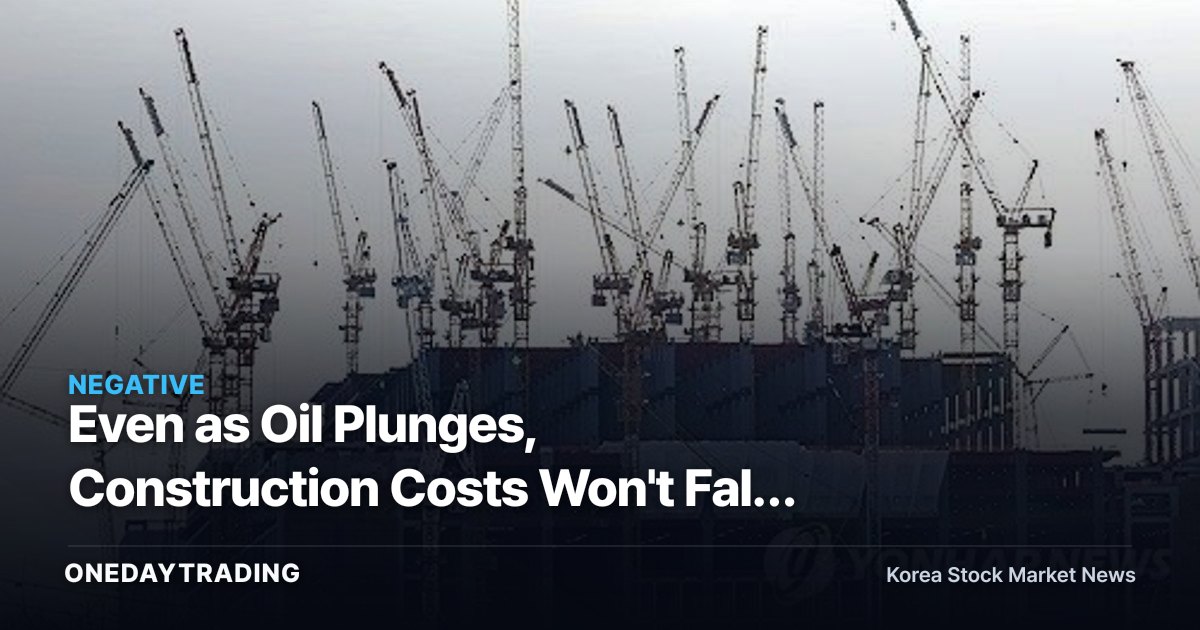
Global oil prices are sliding quickly on the back of a U.S.-Iran ceasefire memorandum of understanding, but the key point is that construction-site costs do not come down right away. Oil is only one part of building-material costs, and once labor costs rise and cement and rebar prices climb, they tend to have structural downward rigidity that keeps them from falling easily. As a result, builders' cost burden and the pressure on presale prices are unlikely to ease in the short term.
Why It Matters Now
A drop in oil prices is typically reflected immediately in directly linked industry sectors such as refining and airlines, but construction costs are different. The main driver pushing construction costs higher was not oil itself, but the prices of core materials like cement and aggregate and the rise in labor costs stemming from a shortage of skilled workers. These items do not retreat at the same pace just because oil prices fall.
In particular, material prices show strong price rigidity once raised, as suppliers are reluctant to bring them back down. From a builder's perspective, when the gap between the contract construction cost set at the time of groundbreaking and the actual costs incurred accumulates, profitability at the individual site level is eroded. If negotiations to raise contract amounts are delayed, this burden spills over into higher presale prices or conflicts with redevelopment cooperatives, and is directly tied to the risk of unsold units.
From an investment standpoint, the important thing is that the headline of falling oil prices should not be simply equated with a signal of improving construction costs. Whether costs stabilize must be confirmed not by oil prices, but by cement price negotiations, the trend in labor costs, and the pace of recovery in groundbreaking volumes.
Frequently Asked Questions
- If oil falls, do construction costs fall too? Oil affects only transport costs and some materials, while labor costs and cement and rebar prices — the major pillars of construction costs — move separately, making an immediate decline unlikely.
- Why don't prices that have risen come back down? It is the combined effect of price rigidity among material suppliers, entrenched labor costs due to a shortage of skilled workers, and higher management costs from tighter safety and environmental regulations.
- So is this a positive catalyst or a negative catalyst for builders? Falling oil prices are a marginal cost-relief factor, but entrenched construction costs remain a source of margin pressure, so in the short term the weight leans toward the burden side.
- What is the impact on presale prices? If construction costs stay high, the downward rigidity of new presale prices also increases, which can simultaneously stoke the burden on genuine buyers and the risk of unsold units.
Impact on Related Stocks and Sectors
- Large Builders The gap between contract construction costs and actual costs pressures margins. The greater a company's housing exposure, the more directly it is hit by entrenched construction costs.
- Cement and Building Materials Material price rigidity is favorable for suppliers' revenue, but if shipment volumes shrink amid sluggish groundbreaking, the effect of firm prices may be offset.
- Refining Sector A sharp drop (plunge) in oil prices is a short-term burden in terms of refining margins and inventory valuation, so the direction of impact is opposite to that of construction.
- Airlines and Transport Airlines, where fuel costs make up a large share, directly benefit from falling oil prices, showing a trend that contrasts with construction.
- Construction Equipment and Interiors If the recovery in groundbreaking volumes is delayed, downstream demand will continue to weaken, potentially pushing back the timing of recovery.
Points to Watch When Investing
- Reading falling oil prices as a direct improvement in construction costs is excessive. The real variables are cement prices and labor costs.
- It is necessary to check the progress of contract-increase negotiations and site-by-site cost-ratio disclosures in quarterly earnings.
- The trend in unsold units and the pace of recovery in groundbreaking and presale volumes are key leading indicators of the direction of construction stocks.
- With the implementation of the ceasefire MOU uncertain, the volatility of oil prices themselves could widen again.
Overall Outlook
The optimistic scenario is one in which material prices stabilize heading into the second half, the interest-rate and presale environment improves, groundbreaking recovers, and the burden of the cost ratio gradually eases. Conversely, if entrenched labor costs and material price rigidity persist over the long term, builders' profitability may be slow to recover even if oil prices fall further. Ultimately, an approach that tracks the combination of materials, labor costs, and volumes together is more reasonable than focusing on the single variable of oil prices.
Hyundai E&C by Real-Time Data
Hyundai E&C's latest closing price is 128,600 won (-3.45% versus the previous day), and the signal light combining foreign and institutional investor supply-demand (order flow) with news and momentum is 🟡 Neutral · Wait-and-See. With positive and negative signals mixed, it is a zone to watch.
- ▼ Trend Alignment — Short- and mid-term downward alignment (intraday -3.5% · 1 week -18.3% · 1 month -7.7%)
- ▲ News Flow — 4 positive catalysts vs 2 negative catalysts — positive catalysts in the lead
Recent related news is favorable, with 4 positive catalysts and 2 negative catalysts.
※ Price and foreign/institutional investor supply-demand (order flow) data are provided by Korea Investment & Securities (KIS) and are as of the time of publication.
This article is content automatically summarized and analyzed based on the original news. View Original (Yonhap News Securities)