
Key Takeaways
A labor-side proposal to gradually raise the retirement age to 65 has resurfaced in public debate. It is still at the discussion stage, ahead of any legislation, but if it materializes it would directly affect the labor-cost structure and collective-bargaining dynamics of large seniority-pay-based manufacturers. For investors, that means starting with a close look at each company's wage system and workforce composition.
What Happened
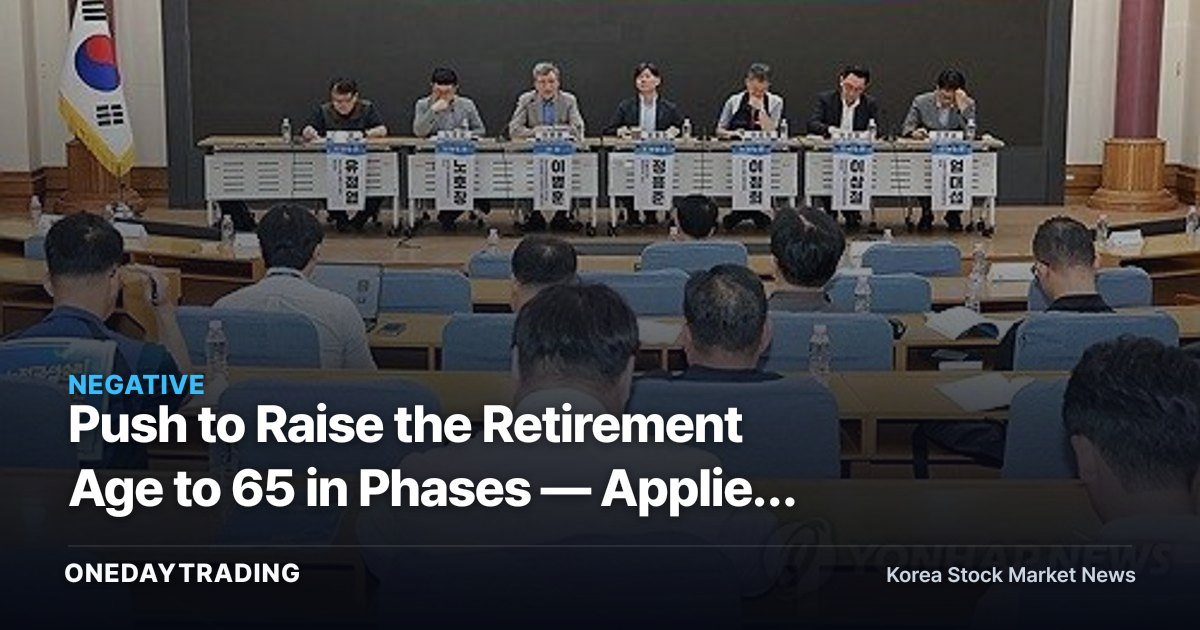
At a forum hosted by Korea's two major labor federations, a proposal was presented to extend the retirement age in phases from 2028 through 2032, applying a 65-year retirement age to workers born in 1972 and after. The core rationale is to narrow the post-retirement income gap — the so-called "income crevasse" — created as the age at which National Pension benefits begin is pushed back in stages.
The current statutory retirement age is 60. The pension eligibility age is being deferred from 63 to 65 depending on birth year, leaving a gap of up to several years between retirement and the start of pension payments. The labor side argues that extending the retirement age would fill this stretch in which wage income is cut off.
Background and Context
Raising the retirement age is a structural agenda item tied to an aging population and pension reform. That said, the business community has repeatedly voiced concern that, at workplaces where seniority pay still prevails, extending the retirement age automatically increases labor costs in proportion to tenure, leaving less room to hire young new employees. Ultimately, whether the change goes hand in hand with wage-system reform (a shift to job- and performance-based pay) is the variable that determines how strongly corporate earnings are affected.
Impact on the Market and Individual Stocks
- Large seniority-pay manufacturers (Hyundai Motor, Kia): With strong unions and a high share of tenure-linked pay, a longer retirement age means accumulating labor costs from high-wage, long-tenured workers. This is the headline industry sector where operating margins could come under pressure.
- Capital-intensive industries such as steel and shipbuilding (POSCO Holdings, HD Hyundai affiliates): These are workplaces where the workforce has aged, so a longer retirement age would strengthen the fixed-cost nature of labor expenses, potentially reducing cost flexibility during economic slowdowns.
- Senior employment and staffing services: As demand for retraining and redeployment of older workers grows, there is room for a favorable environment to form for HR and education-related businesses.
- Domestic demand and consumption: A longer span of wage income in the early-to-mid 60s broadens the disposable-income base, which also has a positive side for medium-to-long-term consumer spending power.
Checkpoints for Investors
- Whether the forum proposal is elevated into a government roadmap or a legislative bill — keep an eye on the discussion timelines at the Ministry of Employment and Labor and the National Assembly's Environment and Labor Committee.
- Whether the retirement-age extension is bundled as a package with wage-system reform (job-based pay, a wage-peak system) — this is the key condition that determines the scale of labor-cost increases.
- How the retirement-age agenda is handled in wage-and-collective-bargaining talks at unionized workplaces such as Hyundai Motor and Kia, watched together with changes in the cost-of-goods and SG&A lines of quarterly earnings.
- Given that the application date falls after 2028, approach this as a medium-term cost-structure issue rather than a near-term earnings story.
Outlook
If the measure proceeds alongside wage-system reform, the cost shock to companies would be cushioned, and the positive effect of tapping the skills of older workers could come to the fore. Conversely, if the retirement age is extended while the seniority-pay system is left intact, unit labor costs at labor-intensive, strongly unionized manufacturers would rise, bringing to the fore side effects such as margin pressure and a contraction in youth hiring. At this stage the idea remains closer to a labor-side proposal, and with business pushback, legislative uncertainty, and the application date (after 2028) all still some distance away, it is reasonable to treat this as a watch-and-wait phase — focusing on whether wage-system reform accompanies the change rather than on its directional outcome.
This article is content automatically summarized and analyzed based on an original news report. View the original (Yonhap News)