
Key Takeaways
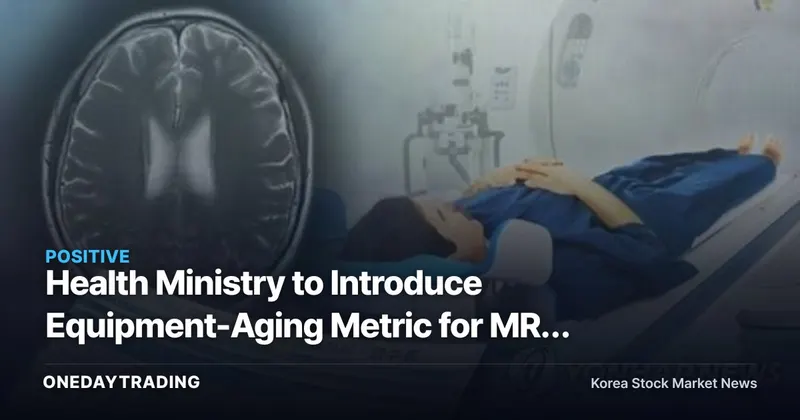
South Korea's Ministry of Health and Welfare is introducing a new equipment-aging assessment metric into the quality-control inspections for specialized medical equipment such as MRI and CT scanners. While it may look like a simple administrative procedure, the framework is designed so that once underperformance in aging equipment shows up in the numbers, the burden on healthcare institutions to replace or upgrade their machines grows. For domestic medical imaging detector and diagnostic equipment makers, this could become a gradual, gentle demand tailwind over the long term.
What Happened
The Ministry has decided to strengthen oversight by establishing a new metric that quantitatively assesses the degree of equipment aging within the quality-control inspection criteria for specialized medical equipment used in imaging diagnostics, such as MRI and CT scanners. Until now, quality inspections have focused mainly on imaging accuracy and safety; the aim is to tighten the inspection framework by adding aging criteria that reflect years in service and performance degradation.
The key point is that once aging equipment exceeds a certain threshold, the likelihood of facing quality-control penalties or being subject to re-inspection increases. Because imaging quality is directly tied to the accuracy of patient diagnosis, healthcare institutions that have continued operating older equipment now have an incentive to step up inspections and move up their timeline for considering replacements.
Background and Context
South Korea is known to have a relatively high number of MRI and CT scanners per capita, and a significant share of that equipment is more than 10 years old. Because reading accuracy in medical imaging is directly linked to patient safety, the government's move to elevate equipment aging itself into a management metric can be read as part of a broader trend toward tighter quality control.
Impact on the Market and Stocks
- Medical imaging detector makers: Companies such as Vieworks that supply X-ray and imaging detectors to global equipment manufacturers have an upstream demand structure in which component demand rises as the cycle of equipment replacement and upgrades accelerates.
- Domestic diagnostic equipment and component makers: Detector and X-ray solution providers such as Rayence and DRTECH may find new adoption opportunities in the process of replacing aging equipment.
- AI imaging analysis companies: Lunit and VUNO operate in the reading-software space rather than the equipment itself, so direct benefits are limited; however, if tighter quality control raises the demand for imaging-data consistency, it could become an indirect positive factor.
- Equipment distribution and maintenance: Stronger aging inspections come with demand for inspections and re-inspections, which could work favorably for medical equipment service and maintenance revenue.
Investor Checkpoints
- Whether the new metric actually translates into real equipment replacement by healthcare institutions — it is worth checking the detailed criteria in the Ministry's official notice, along with the timing of implementation and any grace periods.
- Monitor whether the share of domestic revenue and the flow of new orders improve in the quarterly earnings of detector makers such as Vieworks and Rayence.
- Since MRI and CT scanners are largely dominated by foreign-made complete systems, distinguish the supply-chain structure to see whether policy benefits flow down to the component and service layers.
- Track follow-up data on whether the next regular quality-inspection season and related bids or replacement disclosures actually lead to real orders.
Outlook
On an optimistic view, the equipment-aging assessment metric could structurally accelerate the equipment replacement cycle, providing domestic detector and diagnostic equipment makers with a modest but sustained demand base. The risk, however, is that the policy effect is not immediate, and replacement timelines could be pushed back depending on healthcare institutions' budgets and the reimbursement environment. It should also be considered that the MRI and CT main-system market is dominated by large global players, so domestic companies' benefits may be confined to components and services.
Vieworks Through Real-Time Data
Vieworks' latest closing price is 22,800 won (+0.22% from the previous day), and the signal light — which combines foreign and institutional investor order flow with news and momentum — reads 🟢 Buy-leaning. With foreign and institutional investors positive, the stock is worth watching.
- ▲ Order-flow continuity — foreign investors net buyers for 4 consecutive days (+200 million won)
- ▲ Dual-engine buying — foreign investors +200 million won and institutional investors +0 won buying together
※ Price and foreign/institutional investor order-flow data are provided by Korea Investment & Securities (KIS), as of the time of publication.
This article is content automatically summarized and analyzed based on the original news report. View original (Yonhap News, Industry)