
KOSPI Decline Signals Cracks in Semiconductor Order Flow
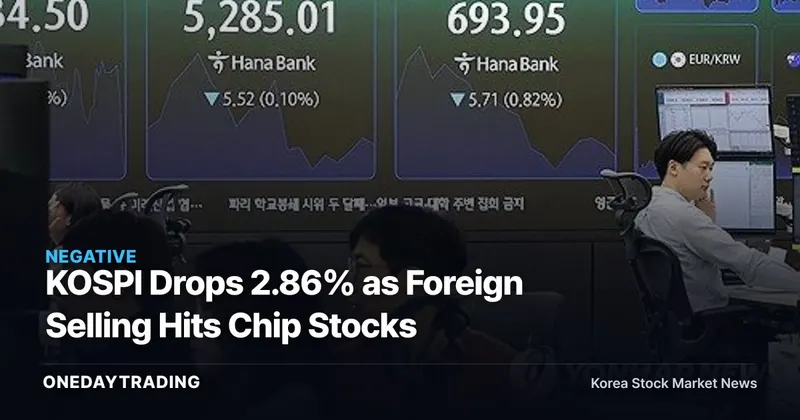
The KOSPI and KOSDAQ opened higher on November 16, 2026, before reversing into negative territory, a move that reflected a broad retreat in semiconductor investor sentiment more than a routine index correction. Foreign selling reported by Yonhap News Agency spread from Samsung Electronics and SK Hynix to KOSDAQ-listed semiconductor equipment stocks. Investors should distinguish between weakness across the broader market and losses concentrated in the semiconductor value chain.
The semiconductor value chain is the industrial network linking materials, components and equipment suppliers to chipmakers. This session's declines were not confined to a single company, with related stocks across multiple stages falling together. Uncertainty surrounding Nvidia spilled over into risk aversion toward South Korean semiconductor stocks.
KOSPI Falls to 5,139.42 After Opening Higher
At 10:48 a.m. on November 16, the KOSPI stood at 5,139.42, down 151.11 points, or 2.86%, from the previous session. The reversal after a higher open showed that early buying failed to support the index. Because the closing price after the article's publication was not available, this figure should not be interpreted as the full-day result.
Foreign investors recorded net sales of 852 billion won on the KOSPI on the morning of November 16. Over the same period, institutional investors and retail investors were net buyers of 140 billion won and 566 billion won, respectively. The index's decline despite institutional and retail buying underscores the need to consider both foreign selling and the index weight of declining stocks.
On the KOSDAQ that morning, foreign investors and institutional investors recorded net sales of 158 billion won and 52.5 billion won, respectively, while retail investors recorded net purchases of 230 billion won. The common pattern across both markets was a standoff between foreign selling and retail buying. If foreign selling persists, losses in semiconductor stocks could continue to amplify index volatility.
How Nvidia Uncertainty Spread to South Korean Chip Stocks
Kim Seok-hwan, an analyst at Mirae Asset Securities, said Nvidia-related uncertainty had weakened semiconductor investor sentiment, with losses widening primarily among materials, components and equipment stocks. He added that foreign selling had deepened declines across the semiconductor value chain. Actual share-price moves were consistent with that assessment.
The Financial Times reported on November 15 local time that Jensen Huang had discussed returning as Nvidia's chief executive with close associates. Whether he will return has not been confirmed. Current prices reflect caution over uncertainty rather than a finalized management outcome, and the market's interpretation could change once the facts are confirmed.
Selloff Spreads From Samsung Electronics and SK Hynix to Equipment Stocks
- Samsung Electronics and SK Hynix: On the morning of November 16, Samsung Electronics was down 3.6%, while SK Hynix had fallen more than 5%. The simultaneous declines in South Korea's leading semiconductor stocks increased downward pressure on the KOSPI.
- Jusung Engineering and Simmtech: Over the same period, Jusung Engineering fell 9.04% and Simmtech dropped 10.26%. These moves illustrated the steeper losses across semiconductor materials, components and equipment stocks.
- EO Technics, Wonik IPS and HPSP: EO Technics declined 7.69%, Wonik IPS fell 7.34% and HPSP lost 7.62%. Selling was evident across several equipment stocks rather than in a single name.
- Other major stocks: LG Energy Solution fell 1.54%, Hyundai Motor declined 1.67% and Samsung C&T lost 1.58%. SK Square and Samsung Electro-Mechanics also traded lower, but their exact price change rates were not provided in the FACT_SHEET.
Conditions That Could Determine a Rebound or Further Weakness
In the bullish scenario, uncertainty eases around scheduled events and foreign selling subsides. Federal Reserve Chair Kevin Warsh is scheduled to speak on November 16 U.S. local time, followed by Nvidia's earnings release on November 17, publication of the Federal Reserve's Federal Open Market Committee minutes on November 18 and Anthropic's Nasdaq listing on November 19. The actual outcomes of these events are not yet known.
In the bearish scenario, foreign net selling persists and the downturn that spread to semiconductor equipment stocks continues. If only Samsung Electronics and SK Hynix rebound while equipment stocks remain weak, it would be difficult to conclude that investor sentiment across the value chain has recovered. Conversely, a recovery in equipment stocks would offer a clue as to whether the breadth of selling is narrowing.
What Investors Should Monitor Next
- Supply-demand (order flow): Monitor whether foreign selling continues on the KOSPI and KOSDAQ and whether net buying by institutional investors and retail investors can absorb it.
- Breadth of the semiconductor move: Assess separately whether Samsung Electronics and SK Hynix are moving in tandem with Jusung Engineering, Simmtech, EO Technics, Wonik IPS and HPSP.
- Scheduled events: Review the actual outcomes as they are released for Kevin Warsh's speech, Nvidia's earnings, the Federal Reserve minutes and Anthropic's listing.
- Data limitations: The KOSPI and KOSDAQ closing prices and final net trading totals by investor group after the article's publication were unavailable. Intraday figures alone are insufficient to confirm a trend reversal.
KOSPI Index MetricsAs of 2026-11-16
| Performance by Period | 1 Week +2.97% 1 Month -8.83% |
|---|
Index, commodity and exchange rate figures are based on global markets and reflect values at the time of publication.
Samsung Electronics Key MetricsAs of 2026-11-16
| Returns by Period | 1 Week +5.85% 1 Month -6.73% |
|---|---|
| Trading Value · Trading Volume | 237.1 billion won · 11,158,264 shares |
| Supply-Demand (Order Flow) | Foreign Investors −341.7 billion won net selling Institutional Investors +56.3 billion won net buying |
| Recent News Tone | positive catalyst 0 · negative catalyst 4 |
Price and supply-demand (order flow) data are real-time figures from Korea Investment & Securities (KIS), while supply-demand (order flow) and news-tone tallies are calculated independently by OneDay Trading.
Upcoming Events to Monitor
- 11.26Bank of Korea Monetary Policy BoardHighBenchmark interest rate decision meeting
- 12.09FOMC Policy Rate DecisionHighU.S. Federal Reserve monetary policy announcement — direction of rates and the dollar
- 12.10Futures and Options ExpirationMediumQuadruple witching — watch for volatility and supply-demand (order flow) disruptions
- 01.14Index Options ExpirationLowKOSPI200 options expiration
This article was automatically summarized and analyzed from the original news report. View the original article (Yonhap News Agency Securities Desk)