
3-Line Briefing
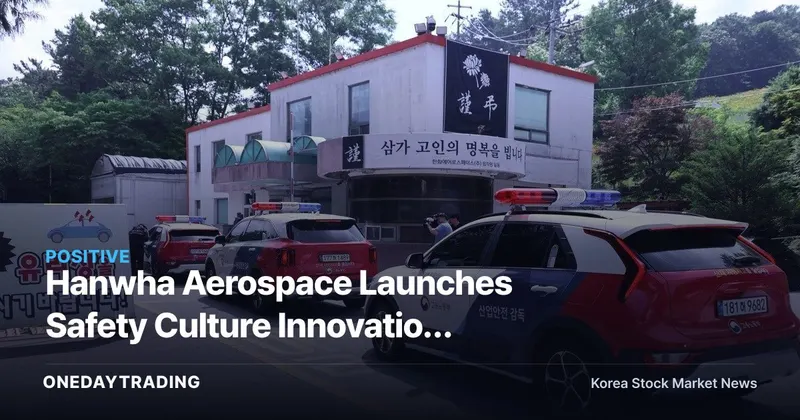
- Hanwha Aerospace (012450) has launched the Safety Culture Innovation Committee, an independent body led by outside experts.
- The move, prompted by the recent accident at its Daejeon plant, aims to shift safety management toward an externally verified structure.
- With safety and quality trust directly tied to the continuity of orders amid the K-defense boom, this carries significant weight as a matter of mid-to-long-term risk management.
What Changes
The heart of this move is that safety management has been elevated from in-house discretion to an independent body driven by outside experts. Internal organizations tend to push safety issues down the priority list under the pressure of production schedules and earnings. When outsiders take the lead, recommendations and oversight independent of management become possible, and it becomes easier to secure objectivity in diagnosing the causes of accidents.
The Daejeon plant is one of Hanwha Aerospace's key production hubs, and given the nature of the defense business—handling hazardous materials such as explosives and propellants—a safety accident can lead not only to casualties but also to halted operations and delivery delays. The Safety Culture Innovation Committee will be tasked with establishing measures to prevent recurrence, as well as reviewing work procedures, equipment, and the broader organizational culture.
By the Numbers and Context
Hanwha Aerospace has established itself as the K-defense sector bellwether, securing a string of large orders bound for Europe and the Middle East, including exports of K9 self-propelled howitzers and Chunmoo multiple rocket launchers to Poland. With its order backlog piled up in the tens of trillions of won, stable production and on-time delivery form the very foundation of earnings credibility. If safety accidents recur, lower utilization rates and reputational damage could weigh on its bargaining power for follow-on orders—so the launch of this independent body has less the character of a short-term cost and more that of an investment to protect mid-to-long-term order competitiveness.
Stocks to Benefit or Suffer
- Hanwha Aerospace (012450): The central stock (ticker) of this story. Strengthening the safety framework is a short-term cost factor, but positive over the mid-to-long term in terms of order continuity and reputation.
- Hanwha Systems: As the group's defense electronics and communications affiliate, it could benefit alongside any boost to the group's defense credibility.
- Hyundai Rotem: A competitor in ground-equipment exports such as the K2 tank, linked to the broader trend of safety and quality trust across K-defense.
- LIG Nex1: A guided-missile-focused defense stock, moving in step with the industry-wide push to strengthen reputation management.
- Defense parts and materials suppliers: A potential downside factor, as tighter safety and quality standards could raise costs in the short term.
Risk Check
- Expanded investment in safety equipment and personnel could increase short-term costs, putting some pressure on profitability.
- The possibility of additional operational halts or delivery delays remains during the process of identifying the accident's causes.
- If the committee ends up as a formality without real authority, the effect on restoring trust could be limited.
- Defense stock prices are more sensitive to export momentum, exchange rates, and geopolitical variables, so direction is not determined by safety issues alone.
Bottom Line in One Sentence
The launch of the Safety Culture Innovation Committee is a preemptive move to protect the core defense values of order continuity and reputation, even at the expense of short-term costs—positive in terms of mid-to-long-term trust, though the challenges of cost burden and proving effectiveness must be watched alongside it.
This article is content automatically summarized and analyzed based on the original news report. View original (Yonhap News, Industry)