
Key Summary
The fact that the brokerage community has raised the target price-to-earnings ratio (PER) applied to the department-store sector to 12x is not merely a target-price upgrade — it signals that the market has begun to structurally reassess department stores' earnings power. The direct benefits of the department-store boom are concentrated in the three major players, which carry a high weighting of luxury and high-margin categories, and some stocks have already more than doubled in the short term.
What Happened
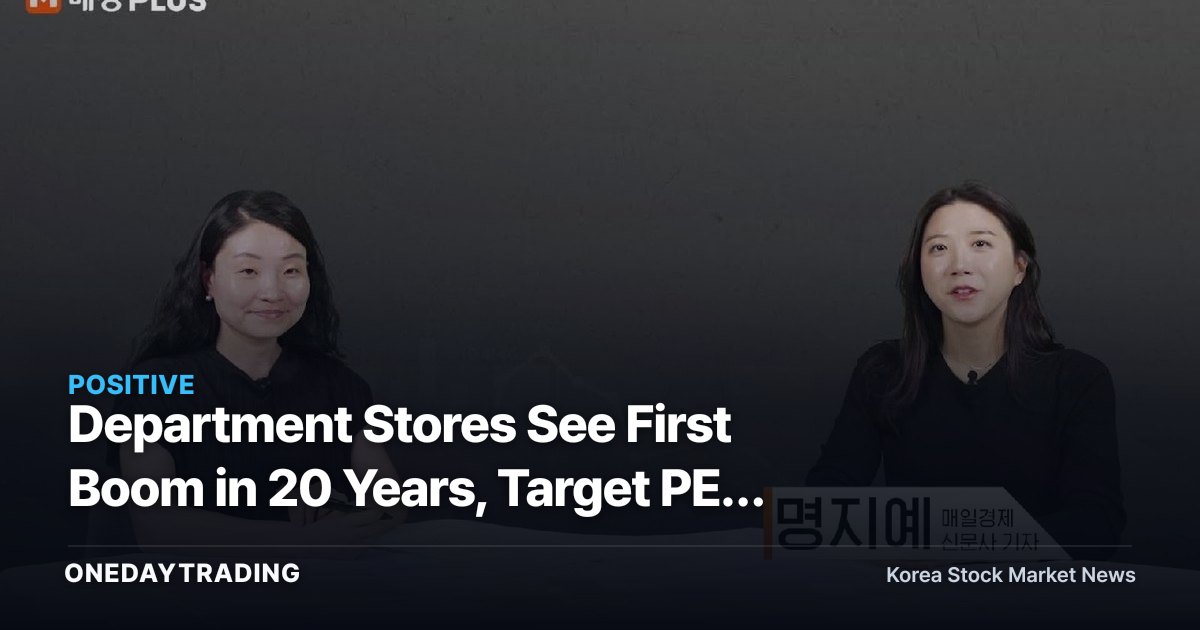
Shinyoung Securities analyst Seo Jung-yeon diagnosed the department-store sector as enjoying its first boom in 20 years and raised the sector's target valuation metric, PER, to around 12x. Lifting the PER means assigning a higher price to the same earnings — in other words, the view is that the quality and durability of earnings have improved, rather than this being a temporary earnings rebound.
Indeed, among the related stocks, there have been cases where share prices have surged more than twofold in a short period. This shows that the market has re-rated department stores not as mere consumer-cyclical names but as channels that house high-end consumption, carrying significant margin leverage.
Background and Context
Department stores carry a high weighting of high-margin goods such as luxury items, fashion, and accessories within their revenue, so when the average transaction value rises, operating profit grows faster than costs increase. Because rent and labor costs are largely fixed in nature, once revenue clears the break-even point, operating leverage kicks in such that most additional revenue falls through to profit. The phrase "first boom in 20 years" implies that the sector has re-entered this kind of structural earnings-improvement phase.
Impact on the Market and Stocks
- Shinsegae: With strong luxury foot traffic at flagship stores such as the Gangnam branch, it is classified as the bellwether where the profit leverage from rising average transaction value appears most directly.
- Hyundai Department Store: The foot-traffic effect from new and renovated stores such as The Hyundai Seoul translates into revenue growth, and the recovery in the department-store division's profit contribution provides the basis for a valuation re-rating.
- Lotte Shopping: The department-store division is the core axis of the group's retail earnings, and the more store-efficiency improvements and high-margin category strengthening progress, the wider the benefit.
- Retail/REIT links: Retail assets based on store rental income, as well as duty-free and fashion companies tied to luxury consumption, also fall within the indirect-beneficiary zone of the consumption recovery.
Investor Checkpoints
- Check in the next quarter's earnings release whether the department-store division's same-store revenue growth rate and operating margin meet market expectations.
- Examine the trend in the revenue share of high-margin categories such as luxury and fashion to gauge the durability of profit leverage.
- For stocks that have already surged in the short term, compare valuations to determine whether the current share price has already priced in the upgraded 12x PER, or whether further upside remains.
- Also watch the direction of macro indicators that drive high-end consumption, such as consumer sentiment, real household income, and interest-rate trends.
Outlook
If earnings power is confirmed in actual results, the target-PER upgrade could serve as grounds for further share-price re-rating. However, since stocks that have surged in the short term have already priced in expectations, should earnings fall short of expectations or the pace of consumption recovery slow, the valuation burden could quickly translate into volatility. The variable that determines durability rather than the intensity of the boom is the firmness of high-end consumption demand, and until results confirm this point, it is reasonable to view the situation as a phase where optimism and caution coexist.
Shinsegae Through Real-Time Data
Shinsegae's latest closing price is 720,000 won (+1.27% vs. the previous day), and the traffic-light signal — combining foreign and institutional supply-demand (order flow) with news and momentum — is 🟢 Buy-leaning. With foreign investors, news, and momentum positive, it is worth watching.
- ▲ Order-flow continuity — foreign investors net buyers for 3 straight days (+13.4 billion won)
- ▲ Trend alignment — short- and mid-term aligned to the upside (intraday +1.3% · 1 week +3.6% · 1 month +42.3%)
- ▲ 52-week position — 89% in the upper 52-week range — new-high territory
Recent related news is favorable, with 1 positive catalyst · 0 negative catalysts.
※ Price and foreign/institutional supply-demand (order flow) data are provided by Korea Investment & Securities (KIS), as of the time of publication.
This article is content automatically summarized and analyzed based on an original news report. View original (Maeil Business Newspaper, Securities)