
Summary
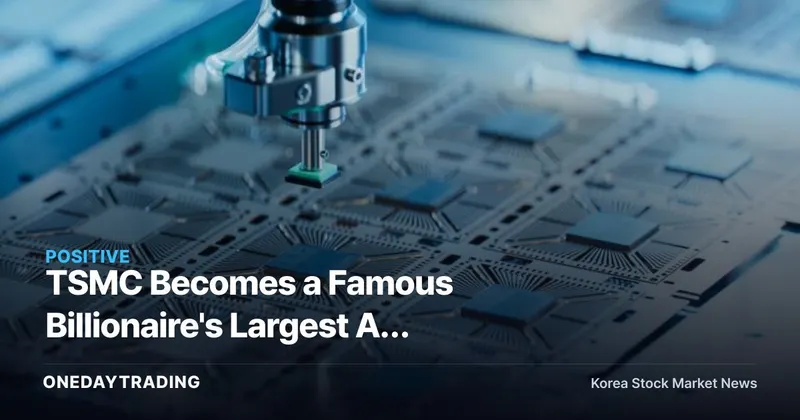
In the portfolio of a world-renowned billionaire investor, Taiwan's top foundry company TSMC (ticker TSM) has been identified as the largest AI-related holding. This is a signal that once again underscores TSMC's dominant position in the artificial intelligence chip supply chain. Direct and indirect ripple effects are expected for the Korean semiconductor ecosystem as well.
What Happened
In recently disclosed investment trends, attention turned to the fact that a prominent billionaire investor holds TSMC as the largest weighting among his AI-themed holdings. While chip designers like Nvidia stand at the forefront of the AI boom, it is TSMC that actually manufactures those chips — leading to the interpretation that investors are betting on a critical chokepoint in the supply chain.
TSMC holds a virtually unrivaled share in advanced process nodes, and most high-performance AI accelerators and data center chips are produced on this company's lines. It is a case that shows the AI investment cycle is spreading beyond chip designers to the manufacturing stage as well.
The very fact that a billionaire-class investor holds a particular stock (ticker) as his largest position influences market sentiment, and this is read as a signal of confidence in the global semiconductor value chain as a whole.
Structural Background
Demand for AI semiconductors is rising structurally, tied to expanding data center investment, large language model training, and the buildout of inference infrastructure. In the fabless–foundry division of labor, where chip design and manufacturing are separated, TSMC dominates both advanced processes and advanced packaging (CoWoS, etc.), giving it strong bargaining power.
This division of labor carries significant meaning for Korean companies as well. Memory powerhouses Samsung Electronics and SK Hynix lead the market for high-bandwidth memory (HBM), which is essential for AI accelerators, while in foundry, Samsung Electronics is in the position of chasing TSMC. In other words, it is a structure in which the trickle-down effect of the AI semiconductor boom flows into memory and back-end processes as well.
Stock and Sector Ripple Effects
- Samsung Electronics: Potential direct beneficiary in terms of expanded HBM supply and foundry orders. However, the gap with TSMC in advanced processes remains a burden.
- SK Hynix: As a key HBM supplier for AI accelerators, the most direct memory beneficiary of expanding AI investment.
- Hanmi Semiconductor: A representative equipment stock linked to demand for back-end equipment such as TC bonders for HBM.
- Semiconductor materials, parts, and equipment (SMPE) sector: A co-beneficiary of the foundry and packaging expansion cycle.
- AI and data center themes broadly: Related infrastructure stocks (tickers) could rally together as chip demand spreads.
Bull vs. Bear Scenarios
In the bull scenario, the AI investment cycle continues, driving TSMC's utilization rates and unit prices higher together, while HBM and back-end demand spreads to Korean companies, improving earnings across the semiconductor sector. Upward revisions to Big Tech's capital expenditure guidance support this trend.
In the bear scenario, the variables are concerns about overheated AI investment, chip inventory adjustments, geopolitical risk (tensions in the Taiwan Strait), and exchange rate and interest rate volatility. It should also be noted that overreacting to a single investor's holdings could amplify short-term volatility.
Investor Action Points
- Monitor TSMC's quarterly earnings and utilization rates, along with Big Tech's capex guidance, as leading indicators of AI demand.
- Assess the differentiated benefits to Korean memory stocks (tickers) through the HBM supply competition landscape (SK Hynix, Samsung Electronics) and unit price trends.
- Track order disclosures for SMPE and back-end equipment stocks, as they are linked to the expansion cycle.
- Given geopolitical and exchange rate risks, consider a diversified approach across the value chain rather than concentrating in a single stock (ticker).
This article is content automatically summarized and analyzed based on the original news report. View Original (Yahoo Finance)