
Summary
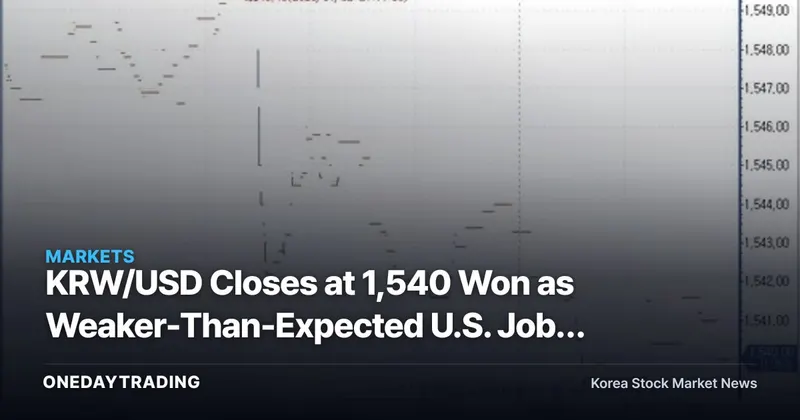
The KRW/USD exchange rate extended its decline in overnight offshore trading after U.S. employment data came in below expectations, closing at 1,540.00 won. On the surface, this looks like won strength — but what actually moved was not the won's fundamentals, rather the market's probability estimate for an early Federal Reserve rate cut. Whether this reversal develops into a sustained trend will depend on the next U.S. jobs and inflation readings, as well as how domestic monetary authorities respond.
What Happened
The KRW/USD rate extended its decline in overnight non-deliverable forward (NDF) trading, finishing the session at 1,540.00 won. The direct trigger was U.S. employment data that came in below consensus. The market read the numbers as a sign of a cooling labor market, reviving expectations for an early Fed rate cut. As a result, the dollar index turned weaker, and the won benefited as a byproduct, widening the exchange rate's decline.
What stands out is that this move was driven entirely by an external event rather than domestic factors. It's not that the won's own fundamentals — trade balance or foreign investor order flow — suddenly improved; rather, the dollar simply lost momentum. Moves built on this kind of foundation tend to reverse just as quickly. If the next data point comes in the opposite direction, the exchange rate could snap back up within a single day.
Structural Backdrop
Over the past several months, the KRW/USD rate has repeatedly swung sharply around each release of U.S. jobs and inflation data. This reflects how little conviction the market holds regarding the Fed's rate path, relative to domestic variables. Each time rate-cut expectations revive, risk appetite comes back, and the won tends to strengthen along with it — a pattern that is becoming increasingly entrenched.
Stock (Ticker) and Sector Impact
- Airlines (Korean Air, etc.): Lower dollar-denominated costs for jet fuel and aircraft leasing should ease cost pressure, a net positive.
- Refining/chemicals (S-Oil, SK Innovation, etc.): Crude import costs fall in won terms, helping defend refining margins.
- Large-cap exporters (Samsung Electronics, Hyundai Motor, etc.): Won-converted dollar revenue shrinks, raising concerns over FX translation losses and increasing the exchange-rate sensitivity of quarterly earnings.
- Banks/financial holding companies (KB Financial, Shinhan Financial, etc.): The firmer the Fed's rate-cut expectations become, the more room domestic monetary policy has to maneuver, which could ease valuation pressure.
- KOSPI large-caps broadly sensitive to foreign investor order flow: A weaker dollar typically acts as an incentive for capital inflows into emerging markets.
Bullish vs. Bearish Scenarios
The bullish (continued won-strength) scenario plays out if the U.S. labor slowdown is confirmed as a trend and the Fed actually proceeds with a rate cut. In that case, dollar weakness and won strength would persist, and the domestic stock market could benefit from valuation expansion driven by a lower discount rate. The bearish (reversal) scenario is that this jobs miss turns out to be temporary noise, with the next inflation reading signaling a rebound in price pressures. In that case, the dollar would recover and KRW/USD could break back above the 1,540 level. The key question is whether this decline reflects a genuine trend or an overreaction to a single data point.
Investor Action Points
- Track the release date of the next U.S. jobs report (nonfarm payrolls, unemployment rate) and how the result compares with consensus.
- Monitor the domestic Monetary Policy Board's schedule and whether it holds or cuts the benchmark interest rate.
- Watch whether KRW/USD holds the 1,540 level as support or breaks through it.
- Check the exchange-rate assumptions and FX-hedge ratios embedded in large-cap exporters' earnings releases.
This article is automatically summarized and analyzed content based on the original news report. View Original (Yonhap News Securities)