
At a Glance
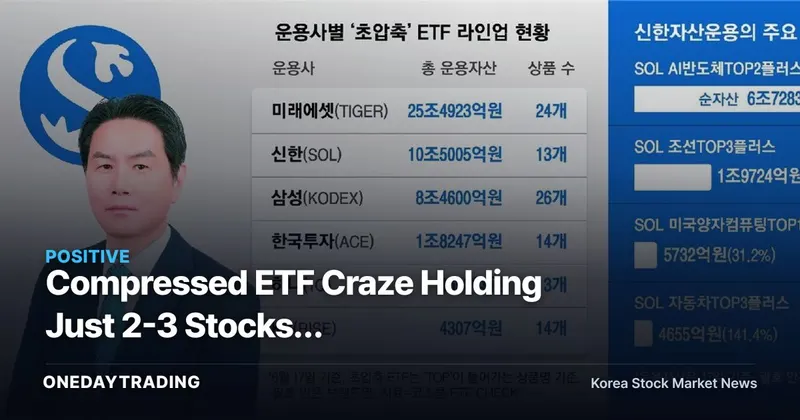
Compressed ETFs that funnel capital into as few as two, or at most three or four, sector bellwethers are proliferating rapidly, becoming a new battleground in the fight for market share among asset managers. For investors, despite the "ETF" label, this effectively means buying a theme-concentrated product with almost no diversification benefit — so it's essential to first recognize that the volatility of the underlying semiconductor and shipbuilding bellwethers directly becomes your own return.
Why It Matters Now
The core of this trend isn't simply the launch of new products — it reflects a simultaneous shift in both the asset management industry's revenue structure and the pathways of capital concentration. The fact that products holding only two or three stocks, such as Semiconductor TOP2 or Shipbuilding TOP3, are selling well signals stronger investor demand to bet on the proven top one or two names rather than an entire industry sector. Because this capital flows straight through to the underlying stocks via the ETF, it adds extra buying pressure to the supply-demand (order flow) of those sector bellwethers.
From asset managers' perspective, compressed ETFs — which have a relatively low barrier to entry — have become a tool for late movers to catch up. The fact that Shinhan overtook larger rivals to climb the rankings, and that its average net assets per product stand at roughly 2.5 times those of industry leader Samsung, shows a structure where capital concentrates into a handful of hit products. In other words, the game has shifted to one where a single, clearly conceived product — rather than the size of the lineup — determines market share.
That said, while a compressed strategy amplifies excess returns in a bull market, it also magnifies losses in a downturn. The rapid proliferation of products with a weakened version of the ETF's inherent safety net — diversification — is also a structural weakness that could turn into redemption pressure when market volatility rises.
Frequently Asked Questions
- How does a compressed ETF differ from a regular ETF? Unlike typical ETFs that diversify across dozens of stocks, these concentrate on just two or three sector bellwethers, making them more a directional bet on a specific theme than a diversification tool.
- Why are asset managers racing to launch them? Because a clear-cut concept makes marketing easy, and even with only a few products, net assets can be grown quickly, allowing managers to climb the market-share rankings in a short period.
- Which stocks (tickers) are typically included? The focus is on the leading names within an industry sector by market capitalization and earnings, such as the top two semiconductor stocks or the top three shipbuilding stocks.
- What happens to the diversification benefit? With so few holdings, it's effectively a bundle of individual stocks, and a sharp drop (plunge) in a single name can significantly shake the overall return.
Related Stocks (Tickers) and Sector Impact
- Brokerage stocks with asset management affiliates, such as Mirae Asset Securities and Samsung Securities Growth in ETF net assets increases fee-based revenue from asset management, which is a positive for the earnings of brokerages that own asset managers.
- Shinhan Financial Group Shinhan Asset Management's rise in the rankings through compressed ETFs is meaningful for the group's diversification of non-banking fee income.
- Samsung Electronics (005930) and SK Hynix As capital flows into Semiconductor TOP2-style products, both sector bellwethers gain additional ETF-driven buying flow.
- Large shipbuilding stocks such as HD Hyundai Heavy Industries and Hanwha Ocean The popularity of Shipbuilding TOP compressed products, combined with order-win expectations, is concentrating capital into large shipbuilders.
- The passive/index management ecosystem As product diversification boosts trading value, it is favorable for exchanges and brokerage infrastructure broadly.
Investment Considerations
- Although these products are called ETFs, diversification is weak, so position sizing should account for the fact that a sharp drop (plunge) in the two or three underlying stocks translates directly into losses.
- Theme-concentrated products can see rapid redemptions and shrinking net assets once the trend cools, so caution is warranted when chasing a rally.
- When similar-concept products are launched simultaneously, differences in total expense ratios, tracking (premium/discount) spreads, and liquidity can widen significantly between products, so a careful comparison is needed.
- If the underlying stocks' valuations are already elevated, the risk-reward asymmetry of concentrated investing increases.
Overall Outlook
On the optimistic side, compressed ETFs with a clear concept can absorb investors' demand for theme selection, spur product competition and trading activity across the asset management industry, and serve as a channel for additional supply-demand (order flow) into earnings-momentum sectors like semiconductors and shipbuilding. Conversely, the growing structural reliance on just a handful of stocks is a weak link that can amplify volatility and redemption shocks when the market wobbles. Ultimately, the indicators to watch are the net asset trends and redemption flows of compressed ETFs, the earnings and order-win disclosures of the underlying semiconductor and shipbuilding bellwethers, and shifts in market share among asset managers. Next quarter's asset management rankings and ETF net inflow data will be the turning point that determines whether this craze is a lasting trend or a passing fad.
Mirae Asset Securities: A Real-Time Data Snapshot
Mirae Asset Securities's most recent closing price is 50,400 won (0.00% versus the prior day), and the signal indicator combining foreign investor/institutional investor supply-demand (order flow) with news and momentum reads 🟡 Neutral / Wait-and-see. With positive and negative signals mixed, this is a stock to watch.
- ▼ Trend Alignment — Short- and medium-term downward alignment (today +0.0% · 1 week -1.6% · 1 month -27.9%)
- ▲ News Flow — 7 positive catalysts vs. 2 negative catalysts — positive catalysts prevail
Recent related news skews favorable, with 7 positive catalysts versus 2 negative catalysts.
※ Price and foreign/institutional investor supply-demand (order flow) data are provided by Korea Investment & Securities (KIS) and are as of the time of publication.
This article is automatically summarized and analyzed content based on the original news report. View original (Maeil Business Newspaper, Securities)