
At a Glance
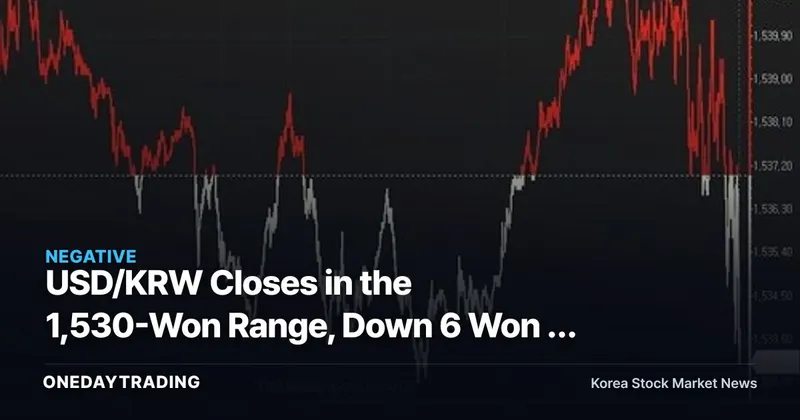
The dollar-won exchange rate turned lower in overnight trading and finished the session in the low 1,530-won range. While it fell 6.00 won from the prior level, the level itself—just shy of the 1,550 line—remains elevated, leaving the market caught between relief and caution. As long as the absolute level of the exchange rate hovers near historic highs, it is the trend rather than short-term swings that drives equity fund flow.
Why It Matters Now
The exchange rate is a macro variable that directly touches individual companies' earnings. The weaker the won, the more exporters with large overseas revenue see their profits inflated when the same dollar revenue is converted into won. Conversely, import-dependent firms that buy raw materials, components, and jet fuel in dollars see their costs swell by the same measure. The 1,530–1,550 won range is a rare zone of elevated exchange rates outside of the foreign-currency crisis and financial-crisis periods, and at the same exchange rate the profit outcomes for exporters and importers diverge in opposite directions.
This 6-won decline is less a trend reversal than a kind of pause just ahead of the 1,550 resistance line. The longer a high exchange rate persists, the greater the incentive for foreign investors to trim their holdings of Korean stocks due to the burden of currency losses, while domestic consumption also comes under pressure through import-driven inflation. In other words, it serves as a short-term earnings buttress for large-cap exporters, but for the KOSPI as a whole it carries the dual nature of capital outflows and cost pass-through at the same time.
The key is not the 6-won decline but at what level the exchange rate settles. If it trends below 1,500 won, importers and domestic-demand stocks get some breathing room; if it breaks back above 1,550 won, the prospect of official intervention and foreign-investor supply-demand (order flow) moves to the forefront.
Frequently Asked Questions
- The exchange rate fell, so why isn't that purely good news? The short-term 6-won decline is a signal of easing volatility, but with an absolute level in the 1,530-won range still high, the burden of import costs and inflation remains in place.
- Which stocks (tickers) benefit from a high exchange rate? Large-cap exporters such as semiconductors and autos, which earn a substantial portion of their revenue in dollars, benefit in terms of conversion gains.
- And which are disadvantaged? Airlines, refiners, and some materials firms that settle jet fuel and raw materials in dollars, along with the broader market where concerns over foreign-investor currency losses run high.
- Why is 1,550 won a turning point? It is both a psychological resistance line and a zone where the foreign-exchange authorities' response intensifies, so whether it is breached determines the direction of future volatility.
Impact on Related Stocks and Sectors
- Samsung Electronics (005930) and SK hynix As semiconductor exporters with most of their revenue denominated in dollars, their won-converted earnings are recorded favorably during a high-exchange-rate phase.
- Hyundai Motor and Kia With a high share of overseas sales, they are flagship exporters for which a weak won boosts both price competitiveness and conversion gains at the same time.
- Korean Air Bearing jet fuel and aircraft lease costs in dollars, it is a representative exchange-rate casualty sector where a high exchange rate translates directly into higher costs.
- Refining and Chemicals Sector Given its structure of importing crude in dollars, a weak won pushes up input costs and must be viewed alongside refining-margin variables.
- The Broader Market A prolonged high exchange rate can dampen foreign-investor supply-demand (order flow), acting as a discount factor on the valuations of the KOSPI and KOSDAQ.
Points to Watch When Investing
- Even among exporters, actual sensitivity to the exchange rate varies depending on currency-hedging policies and the share of overseas production, so it is essential to check each company's currency-exposure structure.
- Earnings inflated by a high exchange rate can work in reverse once the rate normalizes, so it is necessary to strip out currency gains and separately examine underlying demand.
- The possibility of verbal and actual intervention by the foreign-exchange authorities, along with the direction of U.S. monetary policy, can amplify short-term volatility.
- The contraction of domestic demand through import-driven inflation remains a burden on consumer and retail stocks, separate from the positive catalyst for exporters.
Overall Outlook
If the won stabilizes on a trend basis below 1,500 won, the burden of import costs eases, cost pressure on airlines, refiners, and domestic-demand stocks lightens, and concerns over foreign capital's currency losses may recede. Conversely, if it breaks back above the 1,550-won line, there is room for the burden of foreign-investor outflows and upward inflation pressure to come to the fore over the positive catalyst of conversion gains for large-cap exporters. A reasonable approach is to adjust the weighting of exporters versus importers while watching, in the next quarter's earnings releases, the operating trend excluding exchange-rate effects, comments from the foreign-exchange authorities, the U.S. interest-rate path, and whether the 1,550-won level is breached.
This article is auto-summarized and analyzed content based on the original news report. View Original (Yonhap News)