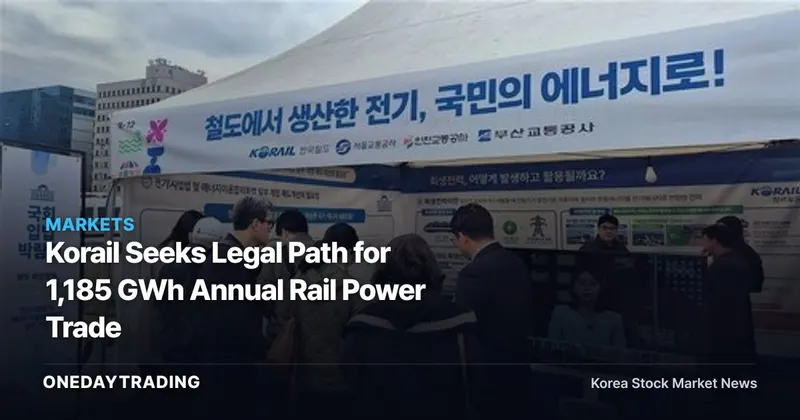

The roughly 1,185 GWh of rail regenerative power generated annually, as highlighted by Korea Railroad Corporation (Korail), is not a figure that will immediately change earnings. Investors should focus less on the amount of power generated and more on whether institutional channels will open for trading that power and supporting infrastructure investment. The key issue reported by Yonhap News Agency’s industry desk on 2026-11-06 is not energy production but pending legislative amendments in the National Assembly.
The Bottlenecks Targeted by Korail’s Two Legislative Proposals
Rail regenerative power is electricity produced by converting the kinetic energy generated when a train brakes into electrical energy. Korea’s electric railways generate roughly 1,185 GWh of rail regenerative power annually, according to Yonhap News Agency’s industry desk. Korail said this is equivalent to the annual electricity consumption of 320,000 households.
The figure indicates the scale of the potential resource. Actual utilization, however, depends on the conditions governing trading and support. Korea Railroad Corporation (Korail) will present two legislative proposals at the “2026 National Assembly Legislative Expo.” One would amend the Electric Utility Act to provide a legal basis for directly trading regenerative power with electricity retailers. The other would bring related facilities and projects within the scope of policy support under the Energy Use Rationalization Act.
A Legal Path Must Come Before the Power Volume
The industry relevance of this development lies not in the production of regenerative power itself, but in the framework for recovering, storing, and using it. Establishing a legal basis for direct trading would broaden the channels through which the electricity can be used. Bringing related facilities and projects within the scope of policy support would also place the infrastructure needed to handle regenerative power inside an institutional framework. The two proposals target separate bottlenecks: trading rules and support for facilities and projects.
Distinguishing what is known from what remains unknown makes the investment picture clearer. The annual generation volume and the details of the legislative proposals have been disclosed, but the data provide no figures for actual trading volume, utilization, implementation costs, or reductions in greenhouse gas emissions. There is therefore no basis for immediately treating the full 1,185 GWh as saleable electricity or converting it into an economic return.
Conditional Scenarios Hinged on a National Assembly Subcommittee
- Optimistic scenario: If the relevant laws are amended, an explicit institutional foundation would be created for discussing direct trading and policy support for regenerative power. The actual utilization channels and scope of support could then be assessed in detail.
- Stalled scenario: If the bills remain pending in a National Assembly subcommittee, the proposals will remain legislative initiatives. Even with a large annual generation volume, the investment impact will be difficult to calculate until the conditions for trading and infrastructure support are finalized.
- Limits of interpretation: Neither whether nor when the amendments will pass is known. Even if the laws change, profitability or benefits to related companies cannot be determined until actual trading volume, utilization, and required costs are disclosed.
One of the related amendments was introduced in November last year and the other in February this year. Both are currently pending in a National Assembly subcommittee. Introducing a bill and implementing it are not the same stage. Any factor that can be priced in today extends only to the possibility of institutional change, not to confirmed results.
What Investors Should Check in Korail’s Regenerative Power Initiative
- First, whether the laws are amended: Establishing a basis for direct trading under the Electric Utility Act is the starting point that will determine the trading structure.
- Second, the scope of policy support: Investors should determine which facilities and projects will qualify for support under the Energy Use Rationalization Act.
- Third, actual utilization metrics: Once the legal foundation is in place, the key question will be whether trading volume and utilization figures are disclosed. Generation and consumption are not the same concept.
- Fourth, economic viability and environmental impact: Implementation costs and reductions in greenhouse gas emissions must be disclosed before the policy’s effects can be compared quantitatively.
Park Yong-jung, head of Korail’s Carbon Neutrality Promotion Task Force, described rail regenerative power as a resource that can contribute to energy efficiency and carbon neutrality, and said the company would work to secure the legislative amendments. The decisive factor for investors is not this statement but the outcome of the National Assembly subcommittee’s review. If actual trading volume and utilization subsequently increase, investors would then have grounds to conclude that institutional change is translating into tangible results.
This article was automatically summarized and analyzed from the original news report. View the original article (Yonhap News Agency Industry)