
Investment Implications of Samsung Electronics’ Shareholder-Return Debate
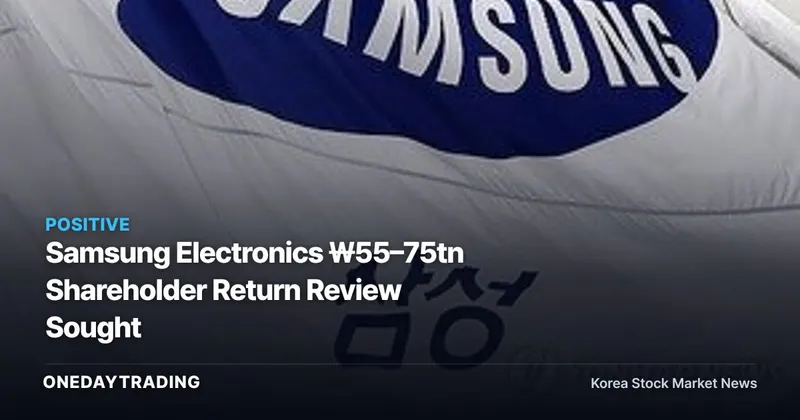
The key issue surrounding Samsung Electronics’ remaining 55 trillion–75 trillion won in shareholder-return funds is not the amount itself, but when its capital-allocation timetable will begin moving. Life Asset Management said on the 5th that it had sent a shareholder letter the previous day to Samsung Electronics’ Board Special Committee and the Samsung Compliance Committee, requesting an independent review of the decision to defer deciding how to use the funds. For investors, the significance of the request reported by Yonhap Infomax is that it reframes shareholder-return expectations as a question of execution feasibility and due process.
Shareholder returns are capital-allocation decisions through which a company returns available funds to shareholders via measures such as share buybacks and cancellations. At this stage, only the request for a review has been confirmed. Responses from Samsung Electronics and the two committees, as well as the final amount, timing, and method of execution, remain unconfirmed.
What Life Asset Management Asked the Two Committees to Examine
Life Asset Management asked Samsung Electronics’ Board Special Committee to examine the economic rationale and procedural appropriateness of deferring until the end of January next year a decision on how to use the remaining shareholder-return funds. It also requested that the findings of both committees be submitted to the board and reflected in subsequent decisions.
It asked the Samsung Compliance Committee to determine whether the process of setting the timing and method of shareholder returns involved any potential conflicts arising from the personal interests of senior management. This is not an allegation that a conflict of interest actually existed, but a request to verify the procedures used to identify and manage any such conflict. The Samsung Compliance Committee is an independent body that monitors and oversees potential compliance violations by senior executives at Samsung affiliates.
Why Timing Matters More Than 55 Trillion–75 Trillion Won
According to Yonhap Infomax, Samsung Electronics has 55 trillion–75 trillion won in remaining shareholder-return funds. Because this is a range and the final amount has not been confirmed, there is no basis for prejudging how the entire sum will be used or what effect it will have. In September, Life Asset Management proposed bringing the decision forward and conducting share buybacks and cancellations within the year.
Kang Dae-kwon told Yonhap Infomax, “The benefits shareholders receive from shareholder returns vary not only with the amount, but also with the timing and method.” Early execution could help reduce some uncertainty over capital allocation. If the decision remains deferred until the end of January next year, investors will need to assess not only the amount but also whether the rationale and process behind the deferral are adequately explained.
Questions Raised by the Share-Price Reaction and Valuation
According to figures presented by Life Asset Management, Samsung Electronics fell 8.70% on the first regular trading day after its August earnings announcement. Following its October earnings announcement, the shares also declined 4.13% on the first day and 3.02% on the second. These moves alone cannot establish that the deferred shareholder-return decision caused the declines, but they provide context for the concern that the earnings announcements did not restore the market’s assessment of the company.
Life Asset Management noted that Samsung Electronics traded at approximately 5 times projected 2026 earnings. It also said Samsung Electronics’ preferred stock traded at a discount of more than 20% to its common stock. A low multiple and a discount do not in themselves prove undervaluation; the letter should instead be read as a request for capital-allocation principles and an explanation that could help narrow the valuation gap.
How the Issue Could Affect Samsung Electronics Shareholders
- Common stock: If share buybacks and cancellations within the year become an actual decision, shareholder-return expectations that had remained on hold would move into the execution phase. For now, this is only a proposal from Life Asset Management, and implementation has not been confirmed.
- Preferred stock: The concern that the preferred stock trades at a discount of more than 20% to the common stock raises the question of whether common and preferred shareholders could be treated differently depending on the execution method. A narrowing of the discount cannot be assumed before the final allocation method is announced.
- Corporate-governance assessment: If the independent review findings and the board’s explanation are disclosed, investors will gain information with which to assess the decision’s economic rationale, fairness, and process.
Scope of Review by the Five Independent Directors
Samsung Electronics’ Board Special Committee was formed in April with all five of the company’s independent directors. Its role is to review the legitimacy of decisions, the fairness of terms, and the appropriateness of procedures in matters requiring protection of shareholders’ collective interests and equitable treatment of all shareholders. The latest request asks whether that function also applies to the decision to defer deciding how to use the shareholder-return funds.
Life Asset Management recently sent a shareholder letter to Hanmi Pharmaceutical as well. That fact alone, however, offers no basis for predicting the outcome of Samsung Electronics’ review or the direction of execution.
Milestones to Watch Through the End of January Next Year
- Committee responses: Investors should determine whether Samsung Electronics’ Board Special Committee and the Samsung Compliance Committee accept the request and what they agree to examine.
- Board consideration: Whether the review findings are submitted to the board and actually reflected in shareholder-return decisions will determine the process’s effectiveness.
- Execution within the year: The first milestone is whether the share buybacks and cancellations proposed by Life Asset Management are implemented within the year or remain merely a proposal.
- Final structure: Investors should watch whether the confirmed amount of remaining funds, execution timing, and implementation method—including the treatment of common and preferred stock—are presented by the end of January next year.
Diverging Scenarios: Early Execution or Continued Deferral
In the optimistic scenario, an independent review is completed promptly and the portion available for early execution is converted into share buybacks and cancellations within the year. In that case, the market’s renewed assessment would focus less on the 55 trillion–75 trillion won range than on the execution principles and timetable presented by the board.
Conversely, if the decision remains deferred until the end of January next year without an adequate explanation, a gap will persist between expectations for the scale of shareholder returns and actual execution. The next indicators to watch are whether any portion can be deployed before the final amount is confirmed, as Kang Dae-kwon requested, and whether the decision to defer serves the interests of all shareholders.
Samsung Electronics Key MetricsAs of 2026-11-06
| Period Returns | 1 Week -17.87% 1 Month -31.17% |
|---|---|
| Trading Value · Trading Volume | 993.1 billion won · 19,967,266 shares |
| Supply-Demand (Order Flow) | Foreign Investors Net sold 2.8 billion won (4 consecutive days) Institutional Investors Net bought 17.1 billion won |
| Recent News Tone | 3 Positive Catalysts · 6 Negative Catalysts |
Price and supply-demand (order flow) data are real-time figures from Korea Investment & Securities (KIS), while supply-demand (order flow) and news-tone aggregates are calculated independently by One Day Trading.
Supply-Demand (Order Flow) and Momentum Assessment🔴 Caution
Foreign-investor, news, and momentum indicators are showing negative signals.
- ▼Order-Flow ContinuityForeign Investors net sold for 4 consecutive days (2.8 billion won)
- ▼Trend AlignmentShort- and medium-term bearish alignment (Today -8.3% · 1 Week -17.9% · 1 Month -31.2%)
- ▼News Flow3 Positive Catalysts vs. 6 Negative Catalysts — Negative Catalysts prevail
Upcoming Dates to Watch
- 11.12Index Options ExpirationLowKOSPI 200 options expiration
- 11.26Bank of Korea Monetary Policy BoardHighBenchmark interest rate decision meeting
- 12.09FOMC Policy Rate DecisionHighU.S. Federal Reserve monetary-policy announcement — direction of interest rates and the dollar
- 12.10Futures and Options ExpirationMediumQuadruple witching — watch for volatility and supply-demand (order flow) disruptions
This article was automatically summarized and analyzed from the original news report. View Original Article (Yonhap Infomax)