
Summary
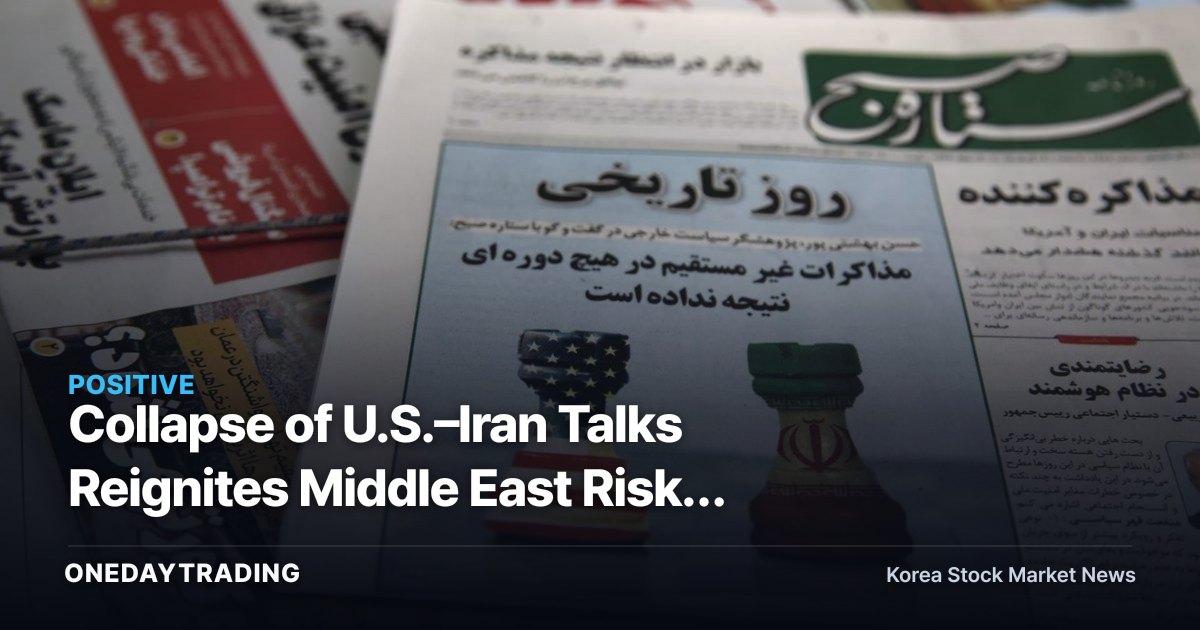
With the U.S.–Iran agreement attempt under way in Switzerland failing to advance to the next stage as scheduled, hopes for a short-term resolution of the Middle East conflict have weakened. The longer a diplomatic solution drags on, the more a risk premium lingers in oil prices on fears of crude supply disruption. In Korean equities, refining and energy stocks and airline and transport stocks could react in exactly opposite directions.
What Happened
The U.S.–Iran mediation talks held in Switzerland stalled at an early stage, while the framework of an agreement was still being shaped. The fact that the two sides failed to proceed with the follow-up steps on schedule is read as more than a simple scheduling delay—it signals that the gap between their positions on core issues remains wide.
Experts tracking the situation on the ground believe a lasting resolution of the Middle East conflict is unlikely to be achieved in the near term. This means uncertainty over the crude oil and LNG shipping routes through the Strait of Hormuz will remain a constant in the market for some time. Since a substantial share of global seaborne crude volumes passes through this strait, a deadlock in the talks translates directly into a supply-side variable.
That said, no actual supply disruption has occurred; at this stage it is closer to a hitch in the diplomatic schedule. It is worth distinguishing that what the market is reacting to is the persistence of uncertainty rather than the fact itself.
Structural Background
Korea depends on imports for nearly all of its crude oil, and the share sourced from the Middle East is overwhelming. Middle East geopolitical risk is therefore not merely overseas news but a structural factor that ripples through domestic refiners' costs and refining margins, the fuel bills of airlines and shipping lines, and ultimately even the trade balance and the value of the won.
When oil prices rise carrying a risk premium, refiners that buy, process, and sell crude can expect inventory valuation gains and wider margins, whereas airlines that burn fuel as a cost see operating expenses rise directly. This is why the same event splits into a positive catalyst and a negative catalyst depending on the industry sector.
Stock and Sector Impact
- S-Oil, SK Innovation, GS, HD Hyundai Oilbank (energy divisions) — In a phase of firm oil prices, expectations of inventory-related gains and improved refining margins. However, if demand softens at the same time, the margin benefit is limited.
- Korea Gas Corporation — Instability in LNG shipping routes increases volatility in import unit costs, but given the cost-linked tariff structure, the impact on earnings is limited and it is more sensitive to policy variables.
- Airline stocks such as Korean Air and Asiana Airlines — With fuel costs forming a large pillar of operating expenses, rising oil prices are direct cost pressure. Some of this is passed on through fuel surcharges, but the time lag and demand elasticity are variables.
- Shipping stocks such as HMM — Higher bunker fuel costs and route-detour risk act simultaneously. That said, there is room for partial offset from rising freight rates.
- Export stocks such as Hyundai Motor and Samsung Electronics — If geopolitical anxiety leads to safe-haven demand and a weaker won, this can be favorable for translated revenue, but at the same time risk-averse sentiment weighs on the broader market.
Bullish vs. Bearish Scenarios
The bullish case is clear. The longer the talks remain deadlocked, the more the risk premium stays embedded in oil prices, keeping the short-term profit momentum of the refining and energy sector alive. If supply disruption materializes, the magnitude grows larger.
The opposite scenario is just as clear. This episode is closer to a hitch in the diplomatic schedule than an actual supply halt, and any news of resumed talks or a partial agreement could swiftly unwind the risk premium. If crude demand itself is weak amid a global economic slowdown, it is difficult to lift refining margins on geopolitical good news alone, and if high oil prices spill over into inflation and a contraction in consumption, it is a headwind for the broader market. This is a stretch with too many variables to bet on a single direction.
Investor Action Points
- First check intraday moves in international oil prices (WTI and Brent) and the extent to which a risk premium is being priced in, and interpret by distinguishing whether a supply disruption is real from a mere scheduling delay.
- At earnings releases, examine refiners' next-quarter refining margins and inventory valuation gains or losses, along with airlines' share of fuel costs and fuel-surcharge trends.
- Watch the won–dollar exchange rate level alongside safe-haven flows to gauge the offsetting effects between export stocks and risk-averse sentiment.
- Use follow-up coverage of the resumption or breakdown of U.S.–Iran talks—including via the Swiss channel—as a trigger, while guarding against an overreaction to one-off news.
This article is content automatically summarized and analyzed based on the original news. View original (CNBC)