
Key Takeaways
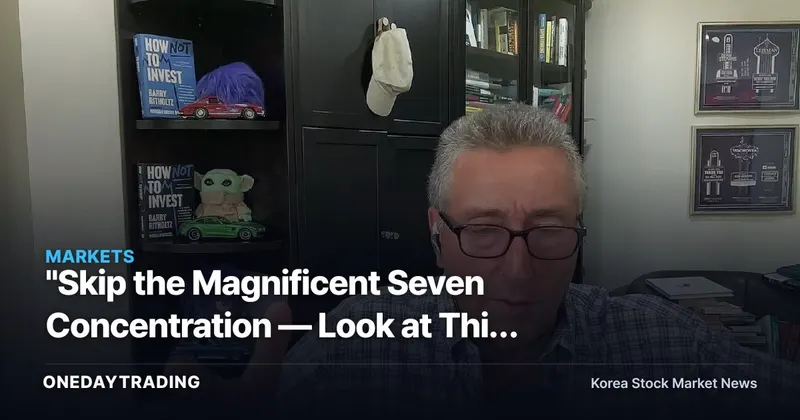
Barry Ritholtz, chairman of Ritholtz Wealth Management, which manages roughly 11 trillion won in assets, delivered a simple message in an interview with Maeil Business Newspaper: only a tiny fraction of investors consistently beat the market, and it's time to reassess the Magnificent Seven concentration strategy that has driven index returns over the past three years. This is not a positive catalyst or negative catalyst tied to any single stock (ticker) — it's a warning about portfolio structure itself.
What Happened
Ritholtz argues that in an era overflowing with financial advice, guiding principles should be simpler, not more complex. His central point is a fact that numerous studies have repeatedly confirmed: most active managers fail to beat their benchmark index over the long run. Even so, his diagnosis is that the past several years, in which investors were able to generate excess returns over the index by concentrating in a handful of mega-cap tech stocks within the Magnificent Seven, represented an exceptional phase.
In the interview, he advises that it's now time to move away from this concentrated strategy in a small number of stocks (tickers) and look elsewhere — broadening one's view to different types of assets or overlooked stock (ticker) groups. This is a different kind of advice than simply pointing to the next big winning stock.
Background and Context
Riding the artificial intelligence investment boom, the Magnificent Seven has been responsible for a substantial share of U.S. stock market gains for several years. The problem is that both the market capitalization weight and the valuation burden of this small group of stocks (tickers) have swelled in tandem. When index returns are driven by a handful of mega-caps, simply tracking the index amounts, in effect, to betting on just a few stocks (tickers) — and the longer this structure persists, the sharper the pullback tends to be once the concentration unwinds.
Impact on the Market and Stocks (Tickers)
- Magnificent Seven names such as Nvidia (NVDA), Microsoft (MSFT), and Apple (AAPL) — a structural risk group whose valuation multiples could compress first in a concentration-unwind phase, regardless of earnings
- U.S. big-tech ETFs (Nasdaq 100 and tech-tracking products) held by Korean retail investors in overseas stocks — given how heavily flows have concentrated here, these are exposed to outflow pressure if a rotation occurs
- SK Hynix (000660) and Samsung Electronics (005930) — since their moves have been linked to the Magnificent Seven's valuation cycle and global semiconductor supply-demand (order flow), they fall within the indirect impact zone of any concentration reversal
- Value stocks, small- and mid-cap stocks, and non-U.S. markets — potential beneficiaries of relative inflows if concentrated capital diversifies
Investor Checkpoints
- Next-quarter earnings and capital expenditure (capex) guidance from individual Magnificent Seven companies — whether the profit growth needed to support current valuations continues
- The return spread between the market-capitalization-weighted index and the equal-weighted index — a gauge of whether the concentration is actually unwinding
- U.S. government bond yield trends — if yields rise again, high-valuation growth stocks (tickers) will be the first to feel pressure from higher discount rates
- Korean retail investors' outstanding balance of overseas stock purchase settlements — changes in the scale of domestic capital flowing into big-tech concentration
Outlook
In the optimistic scenario, continued AI-related capital expenditure and earnings improvement would let actual profit growth catch up with today's elevated valuation multiples. Conversely, if earnings fall short of expectations or interest rates rise again, the valuation burden carried by the handful of stocks (tickers) that have driven the index higher could be the first to face a correction. With the market having already priced in a substantial share of the Magnificent Seven's growth, the next earnings season and the path of interest rates will be the turning point that decides which way this concentration unwinds.
This content was automatically summarized and analyzed based on the original news article. View original (Maeil Business Newspaper - Securities)