
At a Glance
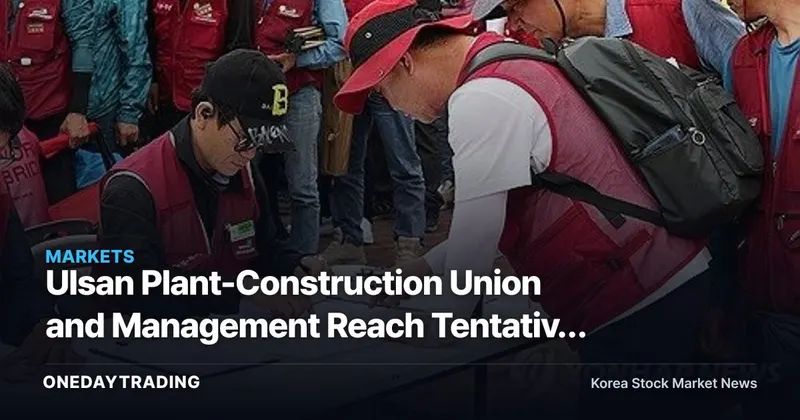
With labor and management in Ulsan's plant-construction sector reaching a tentative agreement on a 7,500-won daily-wage increase, the strike risk stemming from a year of difficult wage negotiations has eased for now. Ulsan is home to a dense cluster of large-scale refining, petrochemical, and heavy-industry facilities, so this agreement goes beyond a simple labor-relations issue — it directly affects the operational stability and cost structure of companies that commission plant maintenance and construction.
Why It Matters Now
Plant-construction workers handle not only the new construction and expansion of refining and petrochemical plants but also scheduled turnaround maintenance and routine upkeep. If negotiations had fallen into a prolonged deadlock and escalated into work refusals or partial strikes, disruptions to turnaround schedules could have led to lower utilization rates and lost product output. In that sense, the fact that the tentative agreement has reduced this uncertainty is a factor that eases the operational burden for the refiners and petrochemical firms placing the orders.
That said, the 7,500-won daily-wage hike means higher labor costs. It represents a direct cost burden for the construction and EPC firms carrying out plant construction and maintenance, and there is room for it to be passed on to clients through higher maintenance rates. Given that plant construction is highly labor-cost intensive, daily-wage changes feed sensitively into contracting margins.
It is also important that this remains only a tentative agreement. Ratification steps such as a union membership vote are still pending, so variables remain before a final settlement. The possibility of reverting to a conflict phase cannot be ruled out if the agreement falls through.
Frequently Asked Questions
- What is the core of this agreement — Ulsan's plant-construction labor and management, who had struggled amid disagreements over the size of the wage hike, have drawn up a tentative agreement centered on a 7,500-won daily-wage increase.
- Why is this linked to refiners and petrochemical firms — Ulsan plant workers carry out the plant maintenance and expansion work for these companies, so labor stability is directly tied to operational continuity.
- Does it have an immediate impact on share prices — a single regional labor-relations issue is unlikely to move share prices significantly; rather, it is a matter that will be reflected slowly through the indirect channels of operational stability and maintenance costs.
- Is this a final settlement — it is at the tentative-agreement stage with ratification steps still pending, so the outcome bears further watching.
Impact on Related Stocks and Sectors
- S-Oil — a leading company with core refining and petrochemical facilities in Ulsan; stable labor relations among maintenance workers are favorable for maintaining utilization rates.
- SK Innovation — one operational variable eases, as the risk of disruption to the turnaround schedule at the Ulsan complex is reduced.
- Lotte Chemical and Hanwha Solutions — with a presence in petrochemical facilities in the Ulsan area, they are within the sphere of influence of stable labor supply for maintenance and expansion.
- Plant EPC and maintenance contractors — the daily-wage hike is a factor raising labor costs and could weigh on contracting margins and order-price negotiations.
- Construction and plant sector overall — if upward pressure on on-site labor costs accumulates, it could dovetail with a future trend of rising construction costs.
Points to Watch When Investing
- As a single regional labor-relations issue, investors should bear in mind that the direct effect on individual companies' earnings is limited.
- It is necessary to confirm whether the tentative agreement is ratified and when a final settlement is reached — there is a possibility of conflict reigniting if it falls through.
- The real variables for refiners and petrochemical firms — refining margins, oil prices, and the exchange rate — carry far greater weight, so the labor-relations issue should not be over-interpreted.
- Whether the higher labor costs are passed on can be checked through next quarter's maintenance costs and the trend in contractors' margins.
Overall Outlook
If the agreement is finalized through ratification, maintenance and expansion schedules at Ulsan's industrial complex will become more predictable, which is positive for the operational stability of the ordering companies. Conversely, the daily-wage hike is a variable that gradually pushes up costs in the construction and maintenance contracting structure, and the uncertainty of pending ratification steps also remains. Investors would be wise to view this matter as a supplementary indicator for gauging the cost and operating environment of the refining, petrochemical, and plant sectors — rather than a short-term share-price catalyst — and to judge it comprehensively alongside key variables such as refining margins and oil prices.
S-Oil in Real-Time Data
S-Oil's latest closing price is 101,500 won (-5.14% versus the previous day), and the signal light combining foreign and institutional investor order flow with news and momentum is 🟡 neutral — wait-and-see. With positive and negative signals mixed, it is a zone to watch.
- ▲ Order-flow continuity — foreign investors net buyers for 8 straight days (+5.8 billion won)
- ▼ Trend alignment — short- and mid-term downward alignment (today -5.1% · 1 week -10.7% · 1 month -8.4%)
- ▲ News flow — 8 positive catalysts vs 1 negative catalyst — positive catalysts dominate
Recent related news is favorable, with 8 positive catalysts and 1 negative catalyst.
※ Price and foreign/institutional investor order-flow data are provided by Korea Investment & Securities (KIS) and are as of the time of publication.
This article is content automatically summarized and analyzed based on the original news. View original (Yonhap News)