
At a Glance
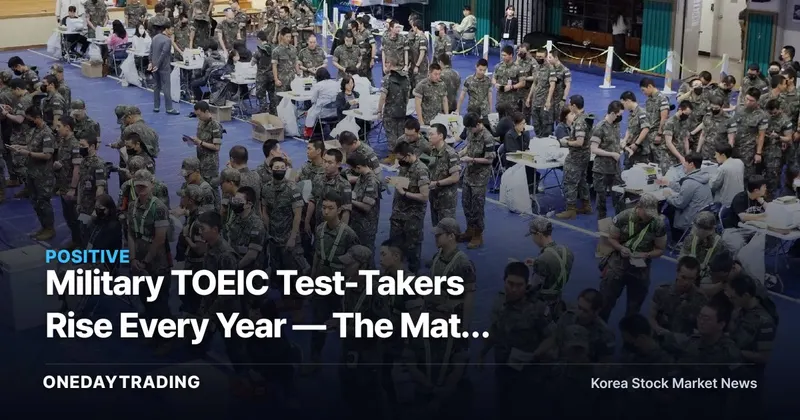
The news that military service members' TOEIC applications are rising every year is not merely a social phenomenon — it is demand data directly tied to the test-fee revenue of the Korea TOEIC Committee, operated under YBM, the sole TOEIC administrator in Korea. With genuine demand ahead of promotion reviews overlapping with post-discharge job-preparation demand, and a half-price test-fee benefit for service members layered on top, there is considerable room for the number of test-takers itself to keep growing. However, because the structure is such that a larger discount lowers revenue per test, it remains to be separately confirmed how much of this growth actually converts into real profit.
Why It Matters Now
The announcement itself is plain. It states simply that the number of military test-takers has increased every year, and cites promotion-exam and job-preparation purposes along with discount benefits such as half-price test fees as the background. However, one should not overlook that the entity issuing this material is the Korea TOEIC Committee — that is, the TOEIC-administering body under YBM. The phrase "increasing every year," stated by the administrator itself, reads as meaning the test-fee revenue base is widening, but this material alone makes it difficult to gauge exactly what percentage the increase represents, or what share of total test-takers are service members. The gap between the narrative and its actual contribution to revenue needs to be examined first.
For officers and non-commissioned officers facing promotion exams, taking the test is effectively mandatory at the organizational level, while soldiers preparing for discharge take it voluntarily to build their job-market résumé. Both sources of demand remain steady regardless of economic conditions, making them more stable than the general test-taker market. The issue is the discount rate. A half-price test fee effectively cuts revenue per test in half, so even as the number of test-takers rises, revenue growth is bound to be more modest by comparison. Whether this discount benefit is a standing policy or a promotion for a specific period also changes the calculus of its contribution to revenue.
What should be examined here is not the headline of rising test-taker numbers, but the product of revenue per test-taker and volume. It is the same logic as traffic increasing while revenue stays flat if the average revenue per user falls by a corresponding amount. Market sentiment is already leaning favorable, but until it is confirmed through earnings, this remains in the realm of hypothesis.
Frequently Asked Questions
- Does the rise in military TOEIC test-takers actually affect YBM Net's earnings?: The direction is positive, but the magnitude is unconfirmed. The half-price discount lowers revenue per test, which could limit the net gain.
- Did this material disclose specific test-taker numbers or growth rates?: The disclosed content presented only the trend of annual increase, with no detailed figures. The precise scale needs to be confirmed through YBM Net's quarterly earnings or separate statistics.
- Is the half-price discount something YBM Net provides on its own?: This material mentioned the discount benefit only as a contributing factor, without specifying who provides it or its application period.
- Is this news a signal of a change in TOEIC test-fee policy?: No. This material is a tally of test-taker trends, not an announcement of a change in test-fee policy.
Related Stocks (Tickers) and Sector Impact
- YBM Net: A listed company that administers TOEIC in Korea through the Korea TOEIC Committee, where an expanding base of test-takers is directly linked to a wider test-fee revenue base. However, this is offset by the discount policy's effect of lowering revenue per test-taker.
- Education services industry sector overall: Worth watching together, given that structural growth in test-taking demand from a specific demographic can serve as a stabilizer for earnings.
- Online language education and e-learning platforms: The spread of TOEIC test-taking demand targeting soon-to-be-discharged service members could translate into incremental revenue.
Investment Considerations
- This announcement lacks quantitative data such as the precise number of test-takers, the growth rate, and the share of military test-takers, so the trend should not be over-interpreted.
- If the half-price test fee is a standing policy, the decline in revenue per test-taker could be structurally fixed, making the net revenue contribution lower than expected.
- Test-taking demand itself could fluctuate depending on promotion-exam schedules and changes in the Ministry of National Defense's job-support and credit-recognition policies.
- Since there is a time lag before test-fee revenue is actually reflected in quarterly earnings, it is premature to expect an immediate stock-price reaction.
Overall Outlook
Because the structural demand from promotion and job preparation persists regardless of economic conditions, the gradual widening of the test-taker base could itself be a favorable backdrop for YBM Net's test-administration revenue. However, the possibility cannot be ruled out that if the expansion of discount benefits continues to erode revenue per test-taker, the increase in volume may only go so far as to offset revenue stagnation. Until the next quarterly earnings release confirms how much test-fee-related revenue has actually grown, this news remains no more — and no less — than a favorable catalyst.
This article is automated content summarized and analyzed based on the original news. View original (Maeil Business Newspaper, Corporate)