
Key Takeaways
News that the SEC has placed three core rules covering the broader crypto market on its official 2026 regulatory agenda has immediately sparked talk of tokenization beneficiary stocks. But the fund flow worth watching lies elsewhere — being placed on the agenda doesn't mean the rules are finalized; it merely signals that the Notice of Proposed Rulemaking (NPRM) process is just getting underway. For publicly traded companies like Coinbase and Circle that need to grow their business under U.S. regulation, the direction is a positive catalyst, but the timing remains wide open.
What Happened
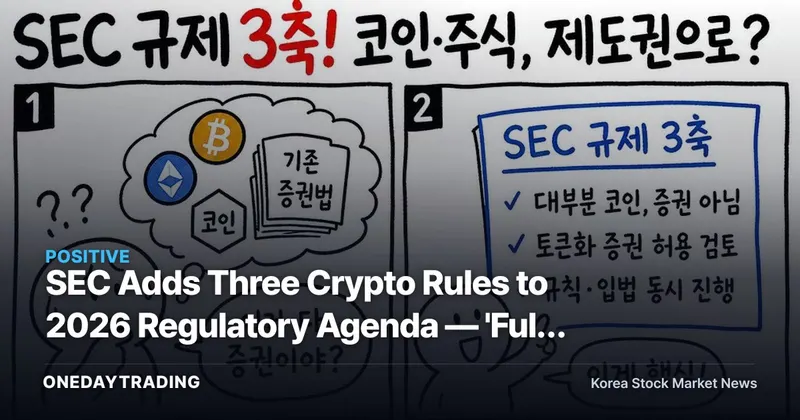
The SEC has newly added three digital-asset-related rules to its Unified Agenda, the regulatory calendar it publishes twice a year. These are understood to cover crypto custody standards, trading rules for digital assets on exchanges and ATSs (alternative trading systems), and a disclosure and registration framework for tokenized securities. Under the Administrative Procedure Act (APA), this process runs through at least several stages — publication of a draft rule, a roughly 60- to 90-day public comment period, and final rule adoption.
In other words, what has been finalized at this point is the list of what will be regulated — not how or when. If the market immediately treated this news as a rally catalyst, it likely bought into the SEC's shift in attitude — that it will no longer leave the crypto market unattended — rather than the substance of the rules themselves.
Background and Context
This agenda confirmation looks very much like a follow-up step after SEC leadership pivoted toward a more crypto-friendly stance. Until now, the U.S. crypto industry has been criticized for being shaped through "regulation by enforcement" — rules effectively set case by case through individual lawsuits and enforcement actions — and both exchanges and issuers have pointed to the lack of a clear registration and disclosure track as the biggest obstacle to attracting institutional funds. The fact that a formal rulemaking process is now actually moving forward is itself the first step toward filling that gap.
Market and Stock (Ticker) Impact
- Coinbase — As essentially the only major publicly traded exchange in the U.S., if custody and asset-listing rules are formally codified, the legal risk around listing new assets and running an institutional custody business would decrease.
- Circle (issuer of USDC) — If stablecoin reserve and disclosure standards are codified, it would create an institutional basis for expanding issuance volume, though stricter capital and audit requirements could also raise compliance costs at the same time.
- BlackRock — Since it already runs a tokenized fund (BUIDL) and a spot Bitcoin ETF, a well-defined registration and disclosure framework for tokenized securities could speed up the launch of tokenized products by traditional asset managers.
- Woori Technology Investment — As a listed company holding a stake in South Korea's largest exchange operator, institutionalization originating from the U.S. could indirectly bolster the case for domestic exchanges to expand overseas and attract institutional funds.
Investor Checkpoints
- When the actual draft rules (NPRM) for items placed on the Unified Agenda will be released — a gap of several months between agenda listing and draft publication is common.
- Net inflows into spot Bitcoin and Ethereum ETFs and trends in exchange holdings — the indicator that distinguishes real fund flow from mere regulatory-expectation hype.
- Changes in the share of custody and trading-fee revenue within next-quarter earnings for listed companies such as Coinbase and Circle.
- Changes in SEC commissioner composition and the political calendar — there is precedent for the agenda itself being pushed back or scaled down when the administration or commissioners change.
Outlook
The optimistic scenario is that this agenda confirmation leads to an actual draft release, with institutional funds flowing in through a registered track. The risk on the other side, as has happened before, is that the item gets carried over to the next agenda without a final rule, or gets watered down from the original proposal during the comment period. What's priced in right now is the direction — that regulation is coming — not any guarantee that the final rules will end up being favorable to the crypto market.
This article was automatically summarized and analyzed based on the original news report. View original (Maeil Business Newspaper – Securities)