
Key Takeaways
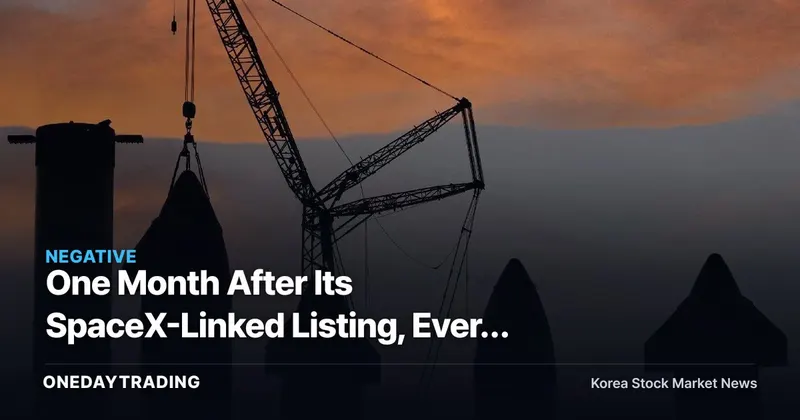
Every domestic retail investor who bought the SpaceX-linked listed stock (ticker) in the early days of its debut has been sitting on losses for a full month. Shares have continued trading below the IPO price, sliding lower regardless of the Mars-exploration narrative, and the lock-up shares set to be released in the future are being flagged as a source of additional selling pressure.
What Happened
The listed stock (ticker) that offers exposure to Elon Musk-led SpaceX has marked one month since its debut, and the results are disappointing. The core issue is that not only investors who participated at the IPO price but also those who entered at lows after the first trading day are, for the most part, sitting on losses. Some interpret this as evidence that the risk lies not in temporary weakness at the individual-stock level, but in the listing structure itself.
The comparison being drawn is with the large-cap tech stocks known as the Magnificent Seven. They too struggled in the early going right after new listings or major events, but later rebounded by around 8%, setting a precedent that the market finds its balance over time. This is the backdrop for the emerging hope that a similar reversal could be in store for SpaceX-linked shares.
Background and Context
The problem is that the two cases start from very different points. The Magnificent Seven were companies with already-proven cash flow and earnings power, and their early weakness was largely a matter of valuation adjustment. SpaceX, by contrast, has most of its enterprise value riding on unproven variables such as Starlink subscriber growth and the Starship launch success rate. On top of that, the float was limited early in the listing, and lock-up shares are set to be released in stages — so if that supply-side selling pressure compounds, both the magnitude and the speed of any rebound are likely to be more modest than what the Magnificent Seven experienced.
Market and Stock Impact
- Hanwha Aerospace - As the leading domestic name in launch vehicles and satellite systems, a valuation adjustment in SpaceX could weigh on market sentiment across the entire domestic aerospace theme. That said, its earnings are driven by domestic orders and production volume, so they are not directly tied to SpaceX's share price.
- Korea Aerospace Industries (KAI) - With a large share of revenue tied to government satellite and launch-vehicle projects, domestic policy procurement schedules matter more here than any valuation logic stemming from SpaceX.
- Intellian Technologies - Having a track record of supplying satellite antennas to Starlink, this stock (ticker) is genuinely linked to the pace of SpaceX's business expansion. Investors should watch order intake and revenue-recognition timing rather than SpaceX's share price.
- AP Satellite - Positioned within the satellite communications component supply chain, it tends to get mentioned alongside SpaceX-related themes, but its actual revenue linkage is limited.
Investor Checkpoints
- Lock-up release schedule and share volume - If sell orders concentrate around the release date, it could add short-term downward pressure.
- Whether the next Starship launch succeeds, and the reuse cycle - The launch success rate is the key variable in the enterprise-value narrative.
- Timing of Starlink subscriber and revenue disclosures - A growth narrative that isn't confirmed by actual earnings raises the risk of a valuation reset.
- Individual order disclosures from domestic aerospace-related stocks - A variable that drives these companies' earnings independently of SpaceX's share price.
Outlook
In the optimistic scenario, much like the Magnificent Seven precedent, once the initial valuation adjustment runs its course, earnings indicators such as a successful Starship launch or rising Starlink subscribers follow through and support the share price. The risk scenario is one where the lock-up release coincides with a delayed Starship launch or slowing Starlink growth — in that case, selling pressure and disappointment could weigh on the market simultaneously, extending the period of losses. For domestic investors, it is safer to gauge the temperature of the aerospace theme through disclosures from individual stocks (tickers) such as Hanwha Aerospace and Intellian Technologies, whose earnings are confirmed by domestic orders and production volumes, rather than through SpaceX itself.
Hanwha Aerospace Through Real-Time Data
Hanwha Aerospace's most recent closing price was 967,000 won (0.00% versus the previous day), and the signal combining foreign/institutional order flow with news and momentum reads 🟢 Buy-leaning. Foreign investor flows and news sentiment are positive, making it worth watching.
- ▲ Order-flow continuity — Foreign investors have been net buyers for 4 straight days (+26.2 billion won)
- ▼ Trend alignment — Short- and medium-term trend skewed downward (today +0.0% · 1 week -17.7% · 1 month -4.6%)
Recent related news skews favorable, with 1 positive catalyst and 0 negative catalysts.
※ Price and foreign/institutional order-flow data are provided by Korea Investment & Securities (KIS) and are as of the time of publication.
This article is automatically summarized and analyzed content based on the original news report. View original (Maeil Business Newspaper – Securities)