
At a Glance
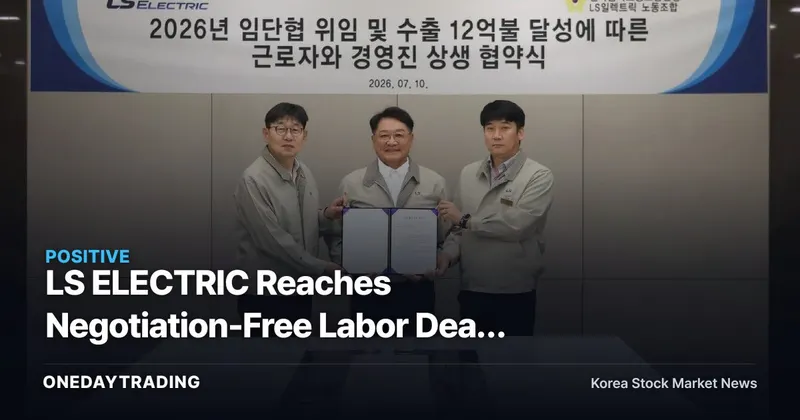
On July 10, LS ELECTRIC reached its wage and collective bargaining agreement without negotiation at LS Yongsan Tower in Yongsan-gu, Seoul — the second consecutive year the deal has been settled this way. The agreement, attended by Chairman Koo Ja-kyun, should not be read as a simple labor-management harmony story; rather, it signals reduced execution risk in converting the power equipment order backlog into revenue.
Why It Matters Now
In heavy-industry sectors, what moves share prices isn't narrative — it's volume. The process of turning secured orders into revenue ultimately hinges on factory utilization rates and on-time delivery, and the most common variable that can derail this is labor-management conflict. A single strike can halt production lines, delay deliveries, and erode margins through penalty payments and inventory costs. The fact that LS ELECTRIC settled its labor agreement without negotiation for a second consecutive year effectively means that, at least for this year's delivery schedule, this particular risk factor has been removed.
The power equipment industry sector is currently in a phase where three separate demand drivers are converging: aging grid replacement in the US and Europe, rising power demand from data centers, and expanding grid connections for renewable energy. Heavy electrical equipment such as transformers and switchgear has a long lead time from order to delivery, so the order backlog building up now typically isn't recognized as actual revenue until one to two years later. If labor relations were to become unstable during that window, the backlog painstakingly secured could fail to convert steadily into revenue and instead get pushed back. This agreement reduces that deferral risk, making it a factor that improves earnings visibility.
That said, labor stability is a necessary condition for revenue conversion, not a sufficient one. Whether actual margins improve will be determined jointly by variables such as raw material prices like copper, the exchange rate, and utilization rates at overseas production bases. Interpreting the negotiation-free settlement itself as a definitive signal of earnings improvement would be excessive.
FAQ
- Q. Is the negotiation-free settlement a direct positive catalyst for earnings? A. It is not a direct driver of higher revenue or profit. However, it removes the risk of production disruptions and delivery delays from strikes, providing stable support for converting the existing order backlog into revenue.
- Q. What is LS ELECTRIC's core business? A. It operates in power equipment such as transformers and switchgear, HVDC (high-voltage direct current) transmission, automation, and ESS/renewable energy grid-connection businesses.
- Q. Why does it matter that this happened for two consecutive years? A. A one-time settlement could be coincidental, but two consecutive years leaves room to interpret it as a sign that the labor-management negotiation structure itself has stabilized.
- Q. Are there any risk factors relative to competitors? A. Labor-management risk has diminished, but intensifying order competition across the industry sector and raw material price volatility remain live variables.
Related Stocks and Sector Impact
- LS ELECTRIC: The direct party to the labor agreement settlement; resolving the risk of production disruption is favorable for the stable conversion of its order backlog into revenue.
- LS: The holding company of LS ELECTRIC; improved earnings visibility at the subsidiary is also indirectly reflected in the holding company's value.
- HD Hyundai Electric: A same-sector competitor that shares in strong transformer export momentum, worth monitoring alongside the industry-wide order cycle.
- Hyosung Heavy Industries: A stock (ticker) that forms a competitive comparison in the ultra-high-voltage transformer market, worth watching alongside the sector's utilization trends.
- Iljin Electric: A small-to-mid-cap power equipment company that can serve as a reference indicator for whether the order cycle at larger players is spreading further.
Investment Considerations
- Labor-management stability only lowers execution risk — it does not guarantee an increase in new orders or higher selling prices.
- Expectations for strong exports in the power equipment industry sector are already largely priced in, so valuation burden should be checked as well.
- Raw material prices such as copper and exchange rate fluctuations directly affect the cost ratio, so this should be confirmed in quarterly earnings releases.
- Utilization rates at overseas production bases and adherence to delivery schedules need to be confirmed in detail in the next quarterly earnings release.
Overall Outlook
The optimistic scenario has labor-management stability holding while grid replacement demand in the US and Europe and data-center-driven power demand overlap, allowing the order backlog to convert smoothly into revenue. Conversely, if a sharp rise in raw material prices, exchange rate headwinds, or intensifying competition push down order prices, top-line growth could continue even as margin improvement lags. The next things to watch are the change in order backlog and utilization rate revealed in quarterly earnings, along with the schedule of policy announcements related to overseas grid investment.
LS ELECTRIC by the Numbers: Real-Time Data
LS ELECTRIC's most recent closing price is 202,500 won (0.00% vs. the previous day), and the signal combining foreign investor/institutional investor supply-demand (order flow) with news and momentum is 🟢 Buy-Leaning. With foreign investors and institutional investors positioned positively, the stock (ticker) may be worth watching.
- ▲ Supply-Demand Continuity — Foreign investors net-bought for 3 consecutive days (+2.5 billion won)
- ▲ Dual Buying — Foreign investors +2.5 billion won and institutional investors +15.1 billion won bought in tandem
- ▼ Trend Alignment — Short- and medium-term trend aligned to the downside (Today +0.0% · 1 Week -11.8% · 1 Month -11.8%)
- ▼ 52-Week Position — Near the 52-week low, at the 4th percentile
※ Price and foreign/institutional investor supply-demand (order flow) data are provided by Korea Investment & Securities (KIS) and reflect the time of publication.
This article is automatically summarized and analyzed content based on the original news report. View Original (Maeil Business Newspaper, Corporate)