
At a Glance
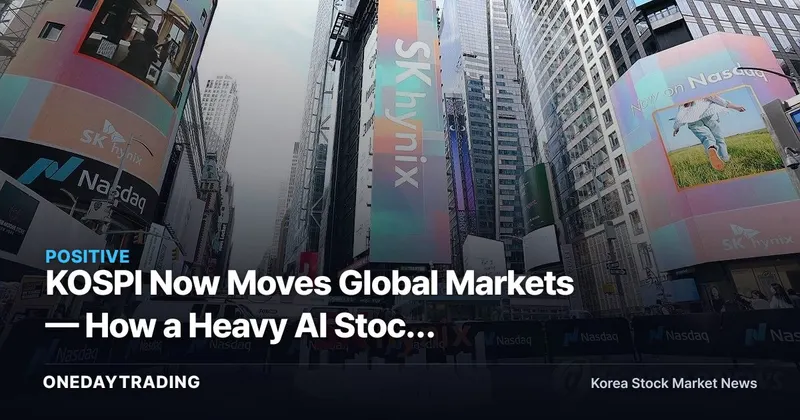
Analysts say South Korea's stock market is shedding its old label as a peripheral Asian market and establishing itself as a reference gauge that previews global market sentiment, thanks to its growing weighting in artificial intelligence (AI)-related stocks. As foreign capital has repeatedly flowed into and out of the KOSPI ahead of other markets, KOSPI moves before the New York market opens have started to serve as a reference point for gauging the direction of US tech stocks that same night. The catch is that this status stems not from KOSPI's fundamentals, but from its heavy concentration in the semiconductor and AI value chain.
Why It Matters Now
The reasoning behind KOSPI's emergence as a leading indicator is simple. Memory, foundry, and equipment stocks led by Samsung Electronics and SK Hynix account for an overwhelmingly larger share of the index's market capitalization than in other emerging markets, and these stocks' earnings and share prices move almost in sync with the US AI value chain, including Nvidia and Micron. The result is a structure in which large-cap semiconductor stocks (tickers) are bought and sold on the KOSPI before the US market opens, previewing that day's AI-related market sentiment.
Peel back this structure, however, and it ultimately comes down to valuation. During the AI rally, KOSPI's large-cap semiconductor stocks have already undergone substantial multiple re-rating. What the market has yet to price in is the trajectory of Fed interest rates and the sustainability of AI capital expenditure. If rate cuts come slower than expected, or if signals emerge that Big Tech's capex growth is decelerating, the very concentration that turned KOSPI into a leading indicator could work in reverse — amplifying declines in a downturn.
In practice, foreign investor order flow has been highly sensitive to the KRW/USD exchange rate. In periods when the exchange rate is stable, foreign net buying centered on large-cap semiconductor stocks has continued; but whenever the won turns weaker, the pattern has repeated of capital exiting first on fears of currency losses. The assessment that KOSPI now acts as a compass for global markets also implies, conversely, that KOSPI is that much more sensitive to shifts in foreign investor supply-demand (order flow).
FAQ
- Why is KOSPI suddenly being cited as a leading indicator for global markets: Because AI-related semiconductor and equipment stocks now make up a markedly larger share of the index, and these stocks move almost in lockstep with US tech-stock market sentiment.
- Is this phenomenon always favorable for KOSPI: No. It brings capital inflows sooner in rallies, but it is a two-way structure — selling also tends to arrive first during corrections.
- What indicators should retail investors watch right now: Three things together — the scale of foreign net buying, the KRW/USD exchange rate level, and the direction of the US Philadelphia Semiconductor Index (SOX).
- What would signal this trend is breaking down: When large-cap semiconductor earnings fall short of market expectations, or when the US Federal Reserve signals it will slow the pace of rate cuts.
Related Stocks and Sector Impact
- Samsung Electronics: The single largest-weighted stock (ticker), whose memory semiconductor and foundry earnings drive the index's direction and serve as the primary channel for foreign order flow.
- SK Hynix: With a large share of revenue coming from AI-server memory such as HBM, it is the stock (ticker) that reacts first within the KOSPI to Nvidia-driven demand signals.
- Hanmi Semiconductor: A back-end semiconductor equipment supplier whose order flow shows high volatility around news of HBM capacity-expansion orders.
- Semiconductor ETFs and KOSPI index products: More directly exposed to inflows and outflows from foreign investors' country-allocation strategy shifts than individual stocks are.
Investment Considerations
- KOSPI's status as a leading indicator is a byproduct of its concentration in semiconductors and AI, so tracking the index without sector diversification means fully absorbing that volatility.
- If a shift to foreign net buying is driven by expected currency gains rather than earnings improvement, order flow can reverse quickly once the exchange rate becomes volatile again.
- Whenever concerns over the valuation burden of US AI-related stocks intensify, KOSPI's large-cap semiconductor stocks have repeatedly corrected in tandem.
- For individual stock (ticker) positioning, entry timing should be based on verifiable events such as earnings releases and order-win disclosures.
Overall Outlook
In the optimistic scenario, the AI capex cycle runs longer than expected, and the earnings strength of KOSPI's large-cap semiconductor stocks offsets valuation concerns. In that case, foreign capital may continue to stay in KOSPI, which remains relatively undervalued versus developed markets. Conversely, if delays in US rate cuts coincide with signs of slowing AI capex, the same concentration that made KOSPI a compass for global markets risks working in reverse, amplifying the downside. The next checkpoints to watch are the Bank of Korea's Monetary Policy Board rate decision, the US CPI release, and whether the KRW/USD exchange rate holds in the low-to-mid 1,300 won range.
This article is auto-summarized and analyzed content based on the original news report. View original (Yonhap News Agency, Finance)