
Summary
Rhinos has rolled out the Academy Edition of its cleaning robot, targeting floor dust and the staffing burden of cleaning in school gymnasiums. This is one facet of a broader trend in which demand for service robots is expanding beyond the home robot-vacuum market into the B2G domain of educational and public facilities.
From an investment standpoint, the key is less about a single product's revenue contribution and more about whether structural demand — a shortage of cleaning labor and tighter indoor air-quality regulation — provides the rationale for adopting robots.
What Happened
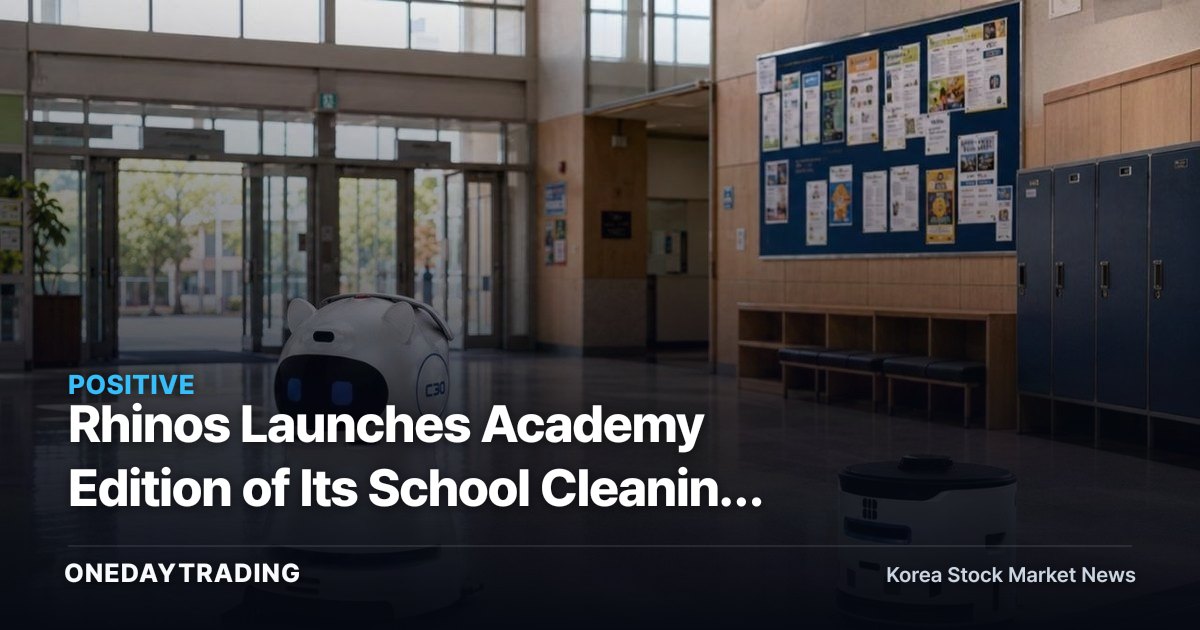
Rhinos, a service-robot specialist, announced the launch of the Academy Edition of its cleaning robot, designed to ease the cleaning burden and floor-dust management problems of large indoor spaces such as school gymnasiums. The product focuses on improving operational convenience at schools by bundling multiple functions into a single device.
Gymnasiums are large in area and see heavy student activity, so fine dust and floor contamination accumulate quickly. Such spaces have traditionally been managed by hand, but as cleaning labor becomes harder to secure and parents and staff grow more sensitive to indoor air quality, demand for automation has come to the fore.
The Academy Edition reads as a product-lineup strategy that specializes features for this particular use environment. By targeting the school channel rather than offering a general-purpose cleaning robot, it offers a gauge of potential entry into the procurement markets of regional education offices and public institutions down the road.
Structural Backdrop
The service-robot industry draws its adoption momentum from two axes: rising labor costs and labor shortages. Public spaces such as schools, government offices, and airports have budgets executed on a single-year basis and standardized use cases, making it a structure in which — once validated at one site — the same specification can readily spread to many institutions. That said, public procurement also carries the weakness that revenue recognition hinges on bidding and budget-planning schedules, making quarterly earnings highly volatile.
Impact on Stocks and Industry Sectors
- Rhinos: The originator of this product, attempting to broaden its applications with an education-channel-specialized offering. That said, the top-line contribution from a single school-cleaning-robot product is limited, so the pace of securing procurement references is the key factor.
- Everybot: A floor-cleaning robot specialist and a comparable name that could be mentioned alongside as demand in the cleaning-robot category expands.
- Rainbow Robotics and Robotis: Service- and collaborative-robot platform stocks, and an axis affected by industry-sector investor sentiment when the public/facility automation theme comes to the fore.
- Yujin Robot: Handles autonomous-driving-based cleaning and logistics robots, placing it in direct contact with indoor automation demand.
Bull vs. Bear Scenarios
The bull case is a picture in which a cleaning-labor shortage and heightened interest in air quality combine to establish cleaning automation at schools and public facilities as structural demand. Once adopted by one education office, it could spread to neighboring institutions as a standard specification, building up recurring revenue and maintenance income.
The bear case is the long sales cycle and budget constraints characteristic of public procurement. There is no guarantee that a product launch will translate directly into orders, and this announcement presented no concrete figures such as supply volume or contract value. The fact that robot theme stocks have already priced in expectations, accumulating valuation pressure, is another variable.
Investor Action Points
- Check whether the product launch converts into actual orders, and whether supply contracts at the education-office or institution level are disclosed.
- Review the revenue and profitability trend of the service-robot segment in the next quarter's earnings.
- Look at the overall valuation level of the robot industry sector alongside the government's policy schedule for public-robot adoption and indoor air quality.
- Rather than overreacting to news about a single product, use fundamental shifts — accumulating references and proven recurring demand — as the benchmark.
This article is content automatically summarized and analyzed based on the original news. View original (Maeil Business Newspaper, Corporate)