
At a Glance
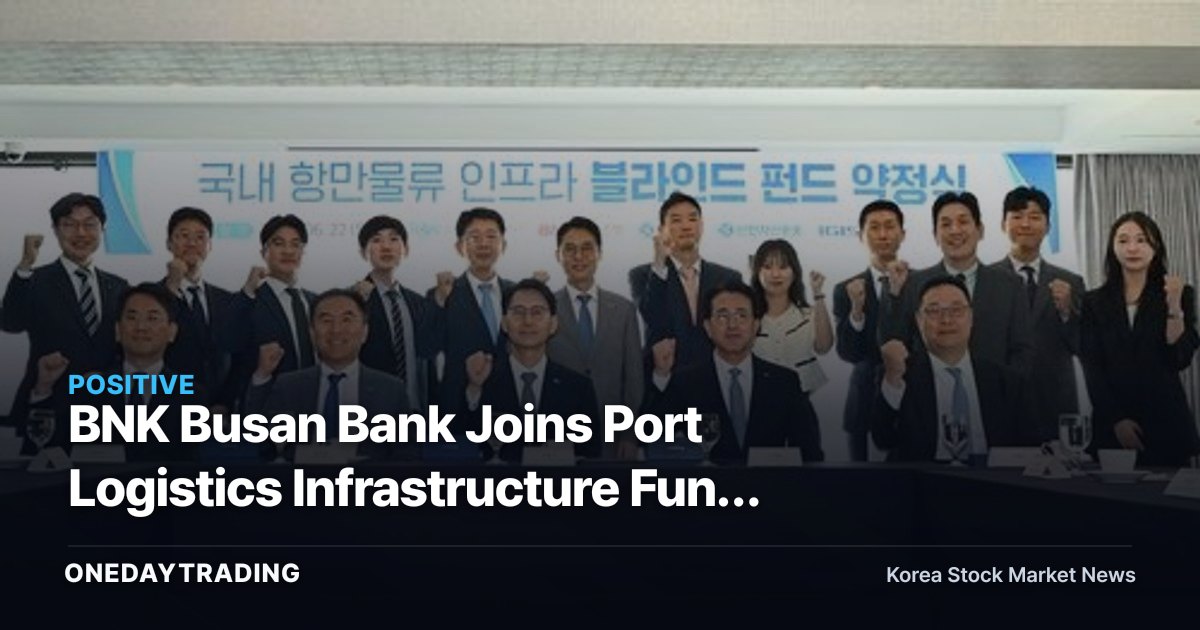
BNK Busan Bank has teamed up with the Korea Ocean Business Corporation, Shinhan Bank, IGIS Asset Management, and Shinhan Asset Management to join the formation of a domestic port logistics infrastructure fund. On the surface this is simply a partnership agreement, but it can be read as a move by a regional bank to broaden its revenue sources beyond the traditional deposit-loan margin into alternative investments and infrastructure finance. From an investor's perspective, it carries significance on two fronts: the diversification of BNK Financial Group's non-interest income, and exposure to logistics infrastructure policy centered on the Port of Busan.
Why It Matters Now
A bank's core earnings driver, the net interest margin, comes under pressure during periods of falling interest rates. In this environment, participation in an infrastructure fund represents a non-interest area where fee income and equity investment returns can be expected across the contribution, management, and advisory processes. Port logistics in particular are real assets with relatively stable cash flows, so for a bank the risk-adjusted returns are more manageable than those of highly volatile market-sensitive assets.
The composition of the participants is also worth noting. The involvement of the Korea Ocean Business Corporation, a policy institution, suggests that the fund goes beyond mere profit-seeking and aligns with the policy push to expand national logistics infrastructure, such as the Port of Busan and its logistics back-up complexes. For BNK, as a regional flagship bank, this amounts to securing both the rationale and the practical benefit of strengthening its ties to the Busan port logistics ecosystem.
That said, with partnership-style news like this, it is hard to gauge the actual contribution to profit and loss until the fund's size, contribution ratio, target return, and asset composition are disclosed. At this stage it is a directional signal, but the quantitative impact must be confirmed through subsequent disclosures.
Frequently Asked Questions
- Will this fund be reflected in BNK's earnings right away — It depends on the contribution size and management structure, and it is more about building a medium- to long-term base of non-interest income than about short-term profit.
- Why is a regional bank participating in an infrastructure fund — To reduce its reliance on the deposit-loan margin while simultaneously building up its alternative investment capabilities and its standing in regional policy finance.
- Where should I look if I want to invest through a listed company — BNK Busan Bank is unlisted; its holding company, BNK Financial Group, is the listed investment vehicle.
- Why are the Shinhan affiliates involved — Combining the management expertise and funding capacity of major financial groups such as Shinhan Bank and Shinhan Asset Management enhances the fund's stability.
Impact on Related Stocks and Sectors
- BNK Financial Group — As the listed parent company with Busan Bank as a subsidiary, it is the direct party to this development. The story of expanding non-interest income is now added to its case.
- Shinhan Financial Group — With Shinhan Bank and Shinhan Asset Management participating jointly, the group builds up its track record in alternative investments and infrastructure finance.
- Regional and holding-company financial sector — This is an example of the trend toward expanding revenue sources into infrastructure and alternative investments amid a low-growth, low-interest-rate environment.
- Port and logistics infrastructure — As a signal of policy and private capital flowing into logistics assets such as the Port of Busan, it is indirectly favorable for industry sectors tied to port operations and construction.
Points to Watch When Investing
- Estimating the contribution to earnings is limited until the fund's size and contribution ratio are disclosed.
- Infrastructure assets have a long-term return structure, so they are far removed from short-term share-price momentum.
- If interest rates, real estate, or the logistics cycle slow down, the value of infrastructure assets and management returns could be shaken.
- For regional bank share prices, core business metrics such as asset soundness, delinquency rates, and dividend policy remain the key variables.
Overall Outlook
The optimistic scenario is one in which BNK uses its participation in the infrastructure fund as a springboard to build an alternative investment track record, adding steady non-interest income from policy-finance linkages and stable assets. Conversely, if the fund is too small to make a meaningful contribution to profit and loss, or if the logistics and interest-rate environment deteriorates and asset values are shaken, the upside is limited. The points to confirm are future disclosures on the fund's formation and contribution size, the trend in BNK Financial Group's non-interest income next quarter, and core business soundness metrics such as the net interest margin and the delinquency rate.
BNK Financial Group Through Real-Time Data
BNK Financial Group's latest closing price is 17,020 won (-4.06% from the previous day), and the signal light combining foreign and institutional investor supply-demand (order flow) with news and momentum is 🟡 Neutral · Wait-and-See. With positive and negative signals mixed, it is a stretch to watch closely.
※ Price and foreign/institutional investor supply-demand (order flow) data are provided by Korea Investment & Securities (KIS), as of the time of publication.
This article is content automatically summarized and analyzed based on the original news. View original (Yonhap News Securities)