
Key Takeaways
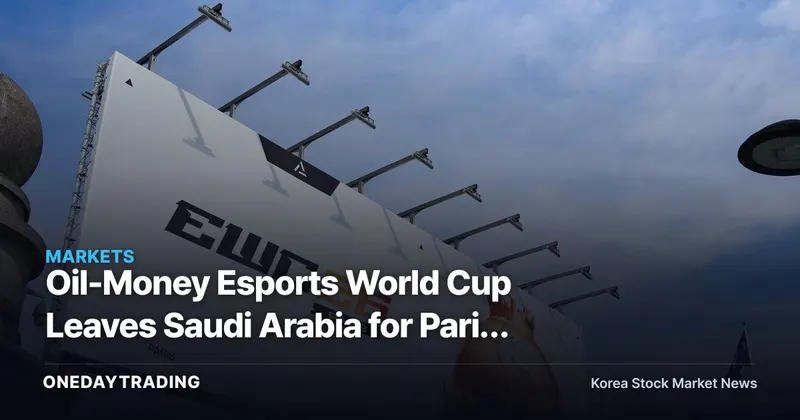
The Esports World Cup (EWC), which grew in scale on funding from Saudi Arabia's Public Investment Fund (PIF), was held for the first time outside Saudi Arabia, in Paris, France, marking its third edition. According to on-site reporting by Yonhap News Agency, this year's event looked less like a sports competition centered on player-versus-player rivalry and more like a gaming expo, with sponsor booths and experience zones placed front and center. This suggests the EWC's growth engine is shifting from prize-money spectacle toward a brand-exposure and marketing platform — a change that could also alter how Korean game companies and the esports industry make use of the event.
What Happened
The EWC, first held in Riyadh in 2024, has expanded in scale every year and is now in its third edition. Until now, the host city had always been Riyadh, the Saudi capital, but this year the event moved to Paris — a symbolically significant first, marking the first time Saudi capital has directly run the tournament outside its own borders.
Yet the on-the-ground picture differed from expectations. The venue the reporter visited resembled a gaming expo more than a competition venue, with sponsor booths and experience spaces — rather than match-viewing areas — occupying the center of visitor flow. In other words, brand-activation space was given far more room than the competition itself.
Background and Context
Saudi Arabia has signaled, through its sovereign-fund-backed gaming and esports investment body, an ambition to build esports into a long-term content industry that goes beyond sportswashing. Holding the event outside Riyadh suggests this strategy is entering a new phase — evolving from a domestically hosted event into a globally touring one. The issue lies in the event's identity. A sports event that draws players and teams through large prize pools and a gaming expo sustained by sponsorship revenue have fundamentally different revenue structures. That the Paris edition leaned heavily toward the latter suggests the EWC has entered a phase where its sustainability as a marketing platform — rather than as a sports event — is being tested.
Impact on the Market and Stocks (Tickers)
- Krafton: The trend of the PUBG: BATTLEGROUNDS IP being adopted as a category in major global esports tournaments is favorable for IP exposure and live-service traffic. However, if the event's character continues tilting toward a gaming expo, exposure will depend more on booth marketing effects than on prize-money-driven buzz, changing the quality of that exposure.
- Kakao Games: For a company with a global publishing pipeline, large-scale events like the EWC serve as a promotional channel for new titles. If the tournament is restructured around sponsor booths, participation costs could rise while exposure effects narrow toward brand awareness alone.
- Companies with professional esports teams: If prize money recedes as the event's core draw, the revenue focus for players and teams could shift from prize winnings toward sponsorships and merchandise — a factor prompting a review of team operating revenue structures.
- Exhibition and infrastructure-related companies: If PIF continues experimenting with overseas hosting, future host-selection processes could open opportunities for domestic local governments and exhibition infrastructure companies as well.
Investor Checkpoints
- The timing and location of the host-city announcement for next year's fourth EWC — this will determine whether Paris was a one-off experiment or the start of a rotating-host format.
- Whether Korean game IPs such as PUBG: BATTLEGROUNDS are included when the participating game lineup is announced, along with disclosure of prize-money allocation by category.
- Changes in the scale of upcoming sponsorship deals and the number of participating companies under the EWC Foundation (Saudi Arabia's esports and gaming investment body).
- Whether Korean game companies' second-half earnings releases show changes in global esports marketing spend.
Outlook
On an optimistic view, the EWC's overseas expansion signals growth in the esports market's overall pie. If the event becomes established as a rotating-host format, it adds another global exposure channel accessible to Korean game companies and esports teams. Still, the risks are clear. If the event's identity settles more firmly into a gaming-expo format, the sense of sporting immersion that fans expect could weaken, potentially limiting growth in other revenue streams such as broadcasting rights and ticket sales. If the exhibition-hall format seen this time repeats itself, replacing the early growth formula built on prize-money spectacle, the EWC's long-term commercial viability will become increasingly dependent on continued capital injection from Saudi Arabia.
Krafton: A Real-Time Data Snapshot
Krafton's most recent closing price was KRW 230,000 (unchanged, 0.00% vs. the previous session), and the composite signal — combining foreign investor and institutional investor supply-demand (order flow) with news and momentum — reads 🟡 neutral / wait-and-see. With positive and negative signals mixed, this is a stock (ticker) to watch closely.
- ▼ Trend Alignment — short- and medium-term downward alignment (intraday +0.0% · 1-week -6.1% · 1-month -3.0%)
※ Price and foreign/institutional investor supply-demand (order flow) data are provided by Korea Investment & Securities (KIS) and reflect figures as of publication time.
This article is automatically summarized and analyzed content based on the original news report. View Original Article (Yonhap News, Industry)