
Summary
The government has officially put additional nuclear reactor construction on the table as a power-supply card for its semiconductor superpower strategy, judging that renewable energy alone cannot cover the electricity demand of the Yongin and southwestern semiconductor clusters. The leading option for new sites is to use vacant land adjacent to existing nuclear plants, but how radioactive waste is handled remains the variable that will determine whether construction actually goes ahead.
What Happened
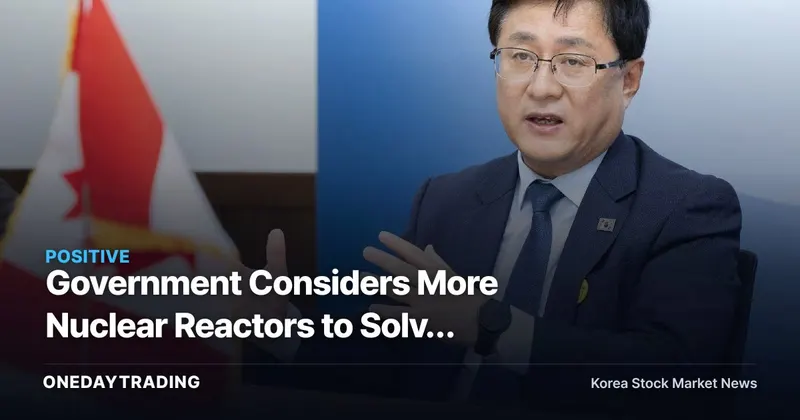
Industry Minister Kim Sung-hwan officially confirmed the government is reviewing additional nuclear reactor construction, stating that renewable energy alone falls short of supplying power as the semiconductor industrial complexes expand. The current administration, which had effectively abandoned its nuclear phase-out policy, has now pushed the discussion as far as securing new sites. The Yongin semiconductor cluster and the southwestern cluster are dense with foundry and memory fabs, generating power demand that is unusual even by the standards of a single industrial complex. From the outset, there were clear physical limits to relying solely on intermittent renewable energy to power cleanrooms that run 24 hours a day.
Rather than searching for an entirely new site, the approach under review is an expansion model that uses vacant land next to existing nuclear plants. This method has the advantage of a shorter process than a brand-new location in terms of permitting, community acceptance, and grid interconnection. However, as Minister Kim also noted, the key issue for additional construction is radioactive waste disposal. With the saturation point of spent nuclear fuel storage facilities already under discussion, building more reactors also means increasing the waste-disposal burden by a corresponding amount.
Structural Context
This review is closer to a policy signal than an actual order at this stage. For a nuclear reactor to reach the construction phase, it must go through several steps — site confirmation, preliminary feasibility studies, design contracts, and main equipment manufacturing orders — with a typical lag of several years between each. Given the precedent of nuclear main-equipment factory utilization rates already rebounding after the resumption of Shin Hanul Units 3 and 4, if this new review leads to actual orders, the structure is such that revenue recognition will come later the further downstream the supply chain goes. Right now, the design and engineering segment is the first to react, while main-equipment and construction revenue will follow much later.
Stock and Sector Impact
- Doosan Enerbility - Effectively holds a monopoly on manufacturing nuclear main equipment (reactors, steam generators), and its order backlog would be the first to fill once new reactors are confirmed. However, because the lag between order placement and revenue recognition is long, there is a gap between the stock's reaction at the review stage and its actual earnings impact.
- KEPCO E&C - Handles nuclear plant design and engineering and sits in the segment that receives service orders fastest once a site is confirmed. It is the stock (ticker) where an increase in order backlog can be confirmed earliest at this new review stage.
- KEPCO KPS - A dedicated nuclear plant maintenance and repair provider, generating revenue more from sustaining existing reactor operation rates than from new units. The broader trend toward nuclear expansion itself underpins long-term maintenance volume.
- KEPCO (Korea Electric Power Corporation) - A policy beneficiary of nuclear expansion but also the party bearing the construction cost burden. It carries both the responsibility of supplying stable power to the semiconductor clusters and the burden of raising large-scale investment capital.
- Woojin - A supplier of nuclear plant instrumentation and measurement equipment, part of the small-parts supply chain that sees volume added on a lagging basis once new reactors are ordered.
Bullish vs. Bearish Scenarios
In the bullish scenario, the government moves faster than scheduled on site confirmation and preliminary feasibility studies, and the order backlogs of Doosan Enerbility and KEPCO E&C actually increase. Because the power demand from the semiconductor clusters is unambiguous, the low likelihood of a policy reversal also supports this scenario.
In the bearish scenario, site selection is delayed by radioactive waste disposal issues, or the plan is scaled back due to community acceptance problems. Nuclear-related stocks have already priced in much of their valuation on expectations tied to the resumption of Shin Hanul Units 3 and 4, so if this review stays at a principle-level discussion without a concrete construction timeline, further upside momentum could be limited.
Investor Action Points
- Watch for the timing of the Ministry of Trade, Industry and Energy's site confirmation announcement and the list of target nuclear plants. The moment a specific site adjacent to an existing plant is identified is the first confirming indicator.
- Track whether KEPCO E&C discloses any new design-service order wins. This stage is the leading indicator of an actual shift to real orders.
- Check the projected saturation timing of spent nuclear fuel storage facilities and the schedule for announcing a radioactive waste disposal roadmap. If this variable is not resolved, site confirmation could be delayed.
- Check Doosan Enerbility's main-equipment factory utilization rate and order backlog trend together at its quarterly earnings releases.
Doosan Enerbility: A Real-Time Data Snapshot
Doosan Enerbility's most recent closing price was 86,200 won (+0.23% versus the previous day), and the combined signal based on foreign investor/institutional investor supply-demand (order flow) and news momentum reads 🟢 Net Buying Bias. Foreign investors, institutional investors, and news flow are all positive, making it worth watching.
- ▲ Dual Buying — Foreign investors +17.6 billion won and institutional investors +1.6 billion won in combined net buying
Recent related news skews favorable, with 2 positive catalysts and 0 negative catalysts.
※ Price and foreign/institutional investor supply-demand (order flow) data are provided by Korea Investment & Securities (KIS) and reflect the time of publication.
This article is content automatically summarized and analyzed based on the original news report. View original (Maeil Business Newspaper - Corporate)