
Summary
At the first FOMC meeting under new Fed Chair Warsh, the removal of the easing-bias language and a dot plot that tilts toward an additional hike within the year signal a retreat from the rate-cut scenario the market had been pricing in. This is a direct headwind for growth and tech stocks, which are sensitive to discount rates, but it acts as a differentiated opportunity for bank stocks — whose net interest margins widen — and for exporters that benefit from a weaker won. For investors, the key is not the policy shift itself, but whether the hike will actually be confirmed by the data.
What Happened
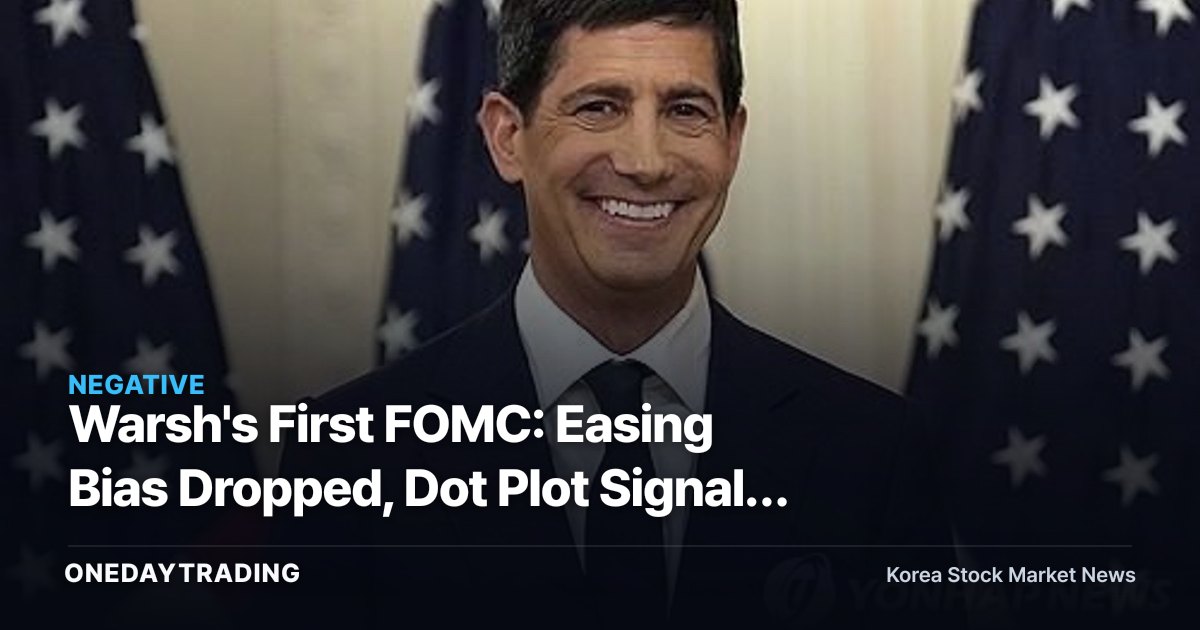
This meeting was the first monetary policy decision chaired by Kevin Warsh since taking office, and the biggest change was the dropping of the easing-bias language that the statement had long maintained. When a central bank revises its statement wording, it is not a mere editorial tweak but is read as a signal to the market about the future policy path.
On top of that, the dot plot — which aggregates committee members' rate projections as dots — reflected the possibility of an additional hike within the year. Together, these developments suggest the center of gravity in monetary policy has shifted from easing toward holding tight, or even further tightening. If the early rate cuts that market participants had expected are scaled back, bond yields and the dollar are likely to face upward pressure.
Structural Background
When the Fed's leadership changes, the first meeting becomes a test of the new chair's policy stance. A reluctance to give premature easing signals before there is firm conviction that inflation has fallen sufficiently toward target is read as an intent to keep the risk of a resurgence in inflation under control.
This change matters to Korean investors because the U.S. rate path transmits directly to the KOSPI and KOSDAQ through the won-dollar exchange rate and foreign investor fund flows. If U.S. real rates stay high, appetite for emerging-market risk assets weakens, and as exchange-rate volatility rises, the profit-and-loss picture diverges across industry sectors.
Impact on Stocks and Sectors
- Banks and financials (KB Financial, Shinhan Financial Group): A prolonged high-rate environment leads to wider net interest margins, which is favorable for net interest income. However, slowing loan growth and rising delinquency rates are offsetting factors.
- Large-cap exporters (Samsung Electronics, Hyundai Motor): A stronger dollar and weaker won increase the converted value of overseas revenue, supporting near-term earnings. For semiconductors, the industry cycle is a bigger variable than the currency effect.
- Growth and platform stocks (Kakao): When the discount rate used to convert future profits into present value rises, valuation pressure increases, making the share price more prone to volatility.
- Semiconductors (SK hynix): The exchange rate is favorable, but one must also consider how rising rates will affect global IT investment and demand.
Bull vs. Bear Scenarios
On the bullish side, if the dot plot's hike signal ultimately reflects confidence in price stability, expectations of an economic soft landing could revive, allowing financials and exporters to enjoy the benefit of a favorable exchange rate. On the bearish side, as rate-cut expectations retreat, capital could flow out of high-valuation growth stocks, while a weaker won stokes import-driven inflation and foreign net selling — risking broad downward pressure across the index. In particular, the dot plot is only a projection, not a commitment, so if subsequent inflation and employment data come in off the mark, market expectations could swing again.
Investor Action Points
- Watch the next U.S. Consumer Price Index (CPI) and employment data to check whether the dot plot's hike signal is backed by actual data.
- Monitor the won-dollar exchange-rate level alongside trends in foreign net buying and net selling, and adjust your allocation between exporters and domestic-demand stocks accordingly.
- Use the trajectory of the U.S. 10-year government bond yield as a leading indicator of valuation pressure on growth stocks.
- For bank stocks, check the next quarter's net interest margin (NIM) and delinquency-rate disclosures to see whether margin expansion is being offset by rising bad debt.
This article is content automatically summarized and analyzed based on the original news report. View original (Yonhap News, Securities)