
Key Takeaways
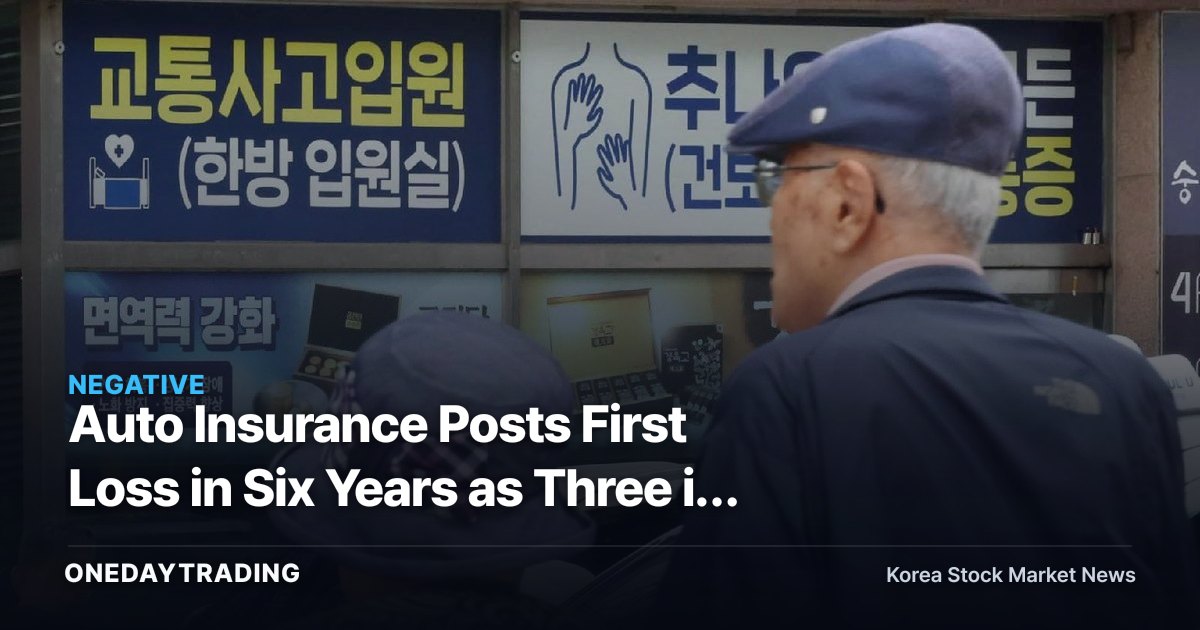
Auto insurance profits turned negative in the first half for the first time in six years. The cause isn't a rise in new accidents — it's an outdated claims structure. All of the top 10 hospitals by admission rate are Korean medicine (hanbang) hospitals, and three out of four minor-injury patients choose hospitalization over outpatient treatment. The number the market should be watching isn't accident volume — it's this claims structure itself.
What Happened
Within a non-life insurer's product portfolio, auto insurance is the line where loss ratio deterioration shows up first and most directly. The first-half swing to a loss is the first in six years. In the past, whenever the loss ratio worsened, buffering factors such as the spread of online direct channels or falling accident counts helped offset it — this time, that buffer didn't kick in.
The decisive clue is admission-rate data. The fact that all of the top 10 medical institutions by admission rate are Korean medicine hospitals shows this isn't a case of one or two outlier hospitals — it's a structural skew across the entire treatment channel. The rate at which three out of four minor-injury patients — those involved in light fender-benders for whom outpatient treatment would suffice — opt for hospitalization looks less like genuine medical necessity and more like claims practice.
What this really signals is that costs insurers can't easily control are rising. Under standard auto insurance terms, medical costs must be reimbursed on an actual-loss basis, and fee reviews for Korean medicine treatment are comparatively looser than for conventional (Western) medicine. The longer a hospital stay runs, the larger the payout automatically becomes, and insurers have little way to push back case by case short of litigation.
Background and Context
The skew of minor-injury patients toward Korean medicine isn't a new issue — it's an accumulated one. Once the temporary loss-ratio improvement driven by changes in mobility patterns ran its course, the underlying claims-practice problem that had been building up underneath was fully exposed. The fact that financial regulators have been reviewing flat-rate treatment costs for minor-injury patients and tighter screening of hospitalization requirements shows they were already aware of this structure.
The problem is that auto insurance gives insurers relatively little pricing power. With premium competition among direct channels already fierce, it isn't easy to pass a worsening loss ratio straight through to premium hikes. As a result, the burden ends up being absorbed by insurers' underwriting profit for a period of time.
Impact on the Market and Stocks
- Samsung Fire & Marine Insurance: With the industry's highest auto insurance revenue share and market share, a 1 percentage-point change in the loss ratio flows straight through to underwriting profit — giving it the largest direct exposure to this swing to a loss.
- DB Insurance: A company whose auto insurance loss-ratio management has long been recognized as the basis for its stock valuation premium. This data point could be read as a sign that basis is wobbling.
- Hyundai Marine & Fire Insurance: With a large auto insurance weighting, it shares the same structure in which rising Korean medicine treatment claims feed directly into the loss ratio.
- KB Financial Group: The auto insurance loss-ratio burden at non-bank affiliate KB Insurance could become a swing factor in the group's non-interest income growth story.
- Meritz Fire & Marine Insurance: With a relatively larger weighting toward long-term insurance, it has comparatively lower exposure to the auto insurance loss-ratio shock, which could highlight a relative competitive advantage.
Investor Checkpoints
- Each insurer's Q3 auto insurance loss ratio: the first data point that will show whether the first-half loss was a temporary skew or a trend-based deterioration.
- The timeline for regulators to introduce flat-rate treatment costs for minor-injury patients and revamp hospitalization-requirement screening: effectively the only policy lever that could turn the loss ratio around.
- Whether and by how much auto insurance premiums are raised: the key question is how much of the loss-ratio deterioration insurers can pass through to premiums, and when.
- Korean medicine treatment statistics from the General Insurance Association of Korea and the Health Insurance Review & Assessment Service: monthly data that shows whether the admission-rate skew is easing or persisting.
Outlook
The optimistic scenario is one where regulators actually implement flat-rate treatment costs for minor-injury patients or tighten hospitalization-requirement screening. In that case, the loss ratio would have room to recover. However, this requires overcoming legislative revisions and pushback from the Korean medicine industry, so the pace is hard to guarantee.
The risk runs the other way. If regulatory reform is delayed due to political burden, or premium hikes are blocked by consumer backlash, the loss-ratio deterioration could become structural. In that case, the center of gravity of insurers' profits is likely to shift even faster from auto insurance toward long-term insurance and asset management.
Samsung Fire & Marine Insurance: Real-Time Data Snapshot
Samsung Fire & Marine Insurance's most recent closing price was 618,000 won (0.00% vs. the previous day), and the signal combining foreign and institutional investor supply-demand (order flow) with news and momentum reads 🟡 Neutral / Wait-and-see. With positive and negative signals mixed, this is a range to watch.
- ▼ Trend Alignment — Short- and mid-term downward alignment (today +0.0% · 1 week -3.1% · 1 month +0.0%)
※ Price and foreign/institutional investor supply-demand (order flow) data are provided by Korea Investment & Securities (KIS) and are as of the time of publication.
This article is automatically summarized and analyzed content based on the original news report. View original (Maeil Business Newspaper, Economy)