
Key Takeaways
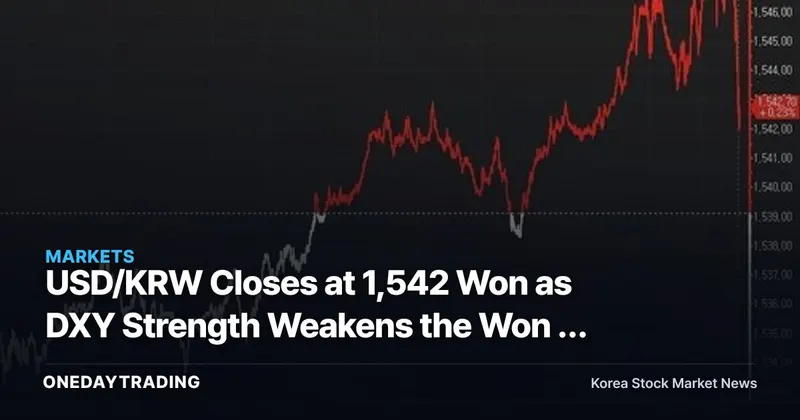
The USD/KRW exchange rate extended its gains in overnight trading to close at 1,542.70 won. The move reflects downward pressure on the won from a stronger U.S. Dollar Index (DXY), and the variable that separates winners from losers across sectors is the durability of dollar strength rather than the exchange rate level itself. This is a phase in which the translated earnings of exporters — who receive much of their revenue in dollars — and importers — who buy raw materials and fuel in dollars — move in exactly opposite directions.
What Happened
After the regular session, USD/KRW continued to climb in overnight trading, rising to the 1,542-won range. The direct driver of the move was strength in the DXY, which reflects the dollar's value against major currencies. When the dollar strengthens against major currencies, the won and other emerging-market and Asian currencies tend to weaken in relative terms, and the same mechanism was at work this time.
An exchange rate in the 1,540-won range is far above the historical average trading band, the cumulative result of a dollar-strength trend rather than a short-term fluctuation. The fact that gains widened further in overnight trading suggests that bets on won weakness are continuing in offshore markets as well.
Background and Context
Behind the dollar's strength lie the interest-rate and growth gaps between the United States and other countries, along with safe-haven demand. When expectations for U.S. rate cuts recede or global risk aversion intensifies, capital flows into the dollar, which translates directly into a higher DXY and a weaker won. Because Korea depends on imports for most of its energy and raw materials, a rising exchange rate is a macro-sensitive variable in that it is passed straight through to import inflation and corporate costs.
Impact on the Market and Stocks
- Hyundai Motor and Kia: With a high share of overseas revenue from North America and elsewhere, profits increase when dollar-denominated revenue is converted into won. A weaker won is also favorable for local price competitiveness.
- Samsung Electronics and SK Hynix: Because semiconductor export proceeds are denominated in dollars, a rising exchange rate improves translated revenue and operating profit. That said, higher import costs for equipment and materials are a partial offsetting factor.
- Korean Air and Asiana: With jet-fuel payments and aircraft lease costs denominated in dollars, a rising exchange rate feeds directly into cost burdens and foreign-currency debt valuation losses, making these a textbook adversely affected sector.
- S-Oil and SK Innovation: Because they purchase crude oil in dollars, a rising exchange rate pushes up input costs. The direction of earnings depends on refining margins and whether higher costs can be passed through to product prices.
- Korea Electric Power (KEPCO): With a large share of fuel imports such as liquefied natural gas (LNG) and coal, a rising exchange rate is a factor that increases fuel-cost burdens.
Investor Checkpoints
- The direction of the DXY and the U.S. rate-cut timeline: the outcome of Federal Reserve monetary policy meetings and the dot plot will determine whether dollar strength persists.
- Support and resistance for the exchange rate in the 1,540-won range: further gains add cost pressure on importers, while a pullback weakens expectations of foreign-exchange gains for exporters.
- Commentary on currency effects in exporters' earnings releases: it is worth checking the exchange-rate assumptions and hedge ratios in next quarter's guidance.
- Foreign investor flows: monitor whether won weakness leads to outflows of foreign capital, alongside net buying trends on the KOSPI and KOSDAQ.
Outlook
If dollar strength persists, expectations for improved translated earnings at exporters remain valid, but a rising exchange rate does not guarantee higher share prices. A weaker won stokes import inflation, weighing on domestic demand and corporate costs, and excessive weakness can spill over into foreign capital outflows and greater market volatility. Conversely, it should be viewed in a balanced way that if U.S. rate cuts come into view, dollar strength could reverse and expectations of translation gains could cool quickly. It is more reasonable to approach the exchange rate not as a single variable that determines an individual stock's fundamentals, but as a conditional variable whose effect on earnings differs by sector structure.
This article is automatically summarized and analyzed content based on the original news. View original (Yonhap News Securities)