
Three-Line Briefing
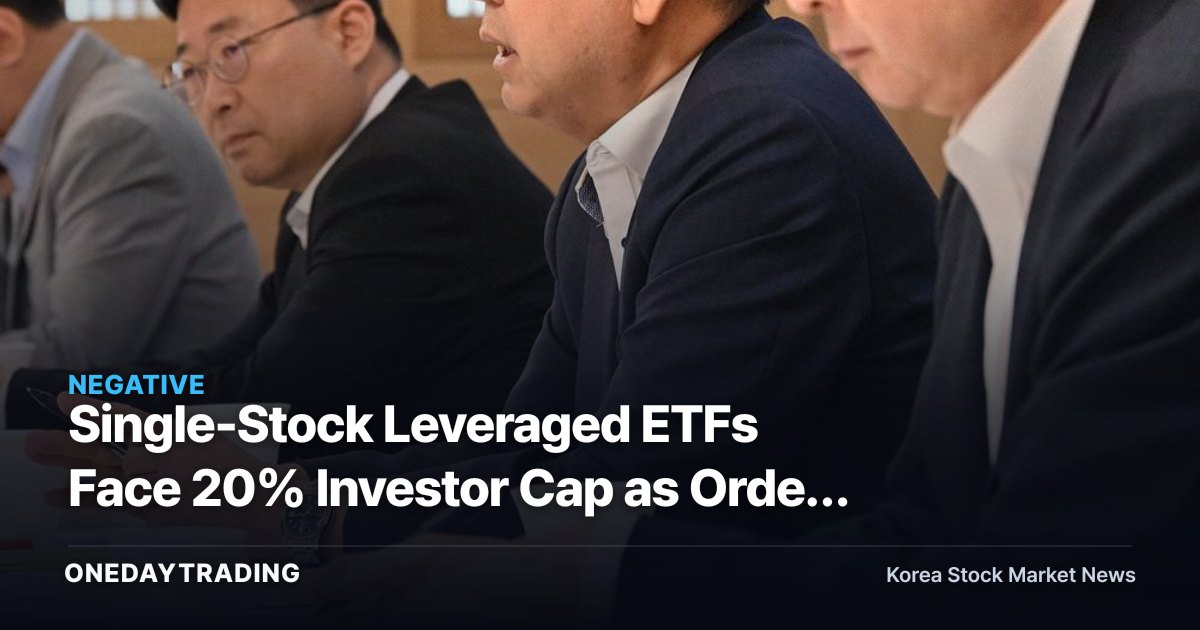
- If demand for single-stock leveraged ETFs fails to cool, financial regulators are considering imposing per-investor caps. The threshold under discussion is 20% of an individual's total financial investment products.
- Tighter minimum deposit requirements take effect first, starting on the 31st. If mock trading, re-education, and investment-experience requirements are layered on top, retail investors' short-term turnover trading will face both added cost and added procedure.
- The key impact lies less in Samsung Electronics' and SK Hynix's own earnings than in the surrounding order flow (supply-demand). Leverage from money betting on volatility rather than share price direction could be dialed back.
What's Changing
731.5 billion won in a single day. What this figure really signals isn't conviction about the semiconductor business cycle. The fact that retail investors piled into 14 single-stock leveraged ETFs tracking Samsung Electronics and SK Hynix on a day of sharp drops shows that the market is pricing volatility more richly than earnings. The regulator's review of a per-investor cap is a measure to slow the speed of this money.
Single-stock leveraged products track the daily move of the underlying stock at a multiple. The problem is closing-price rebalancing. In a downturn, asset managers must cut exposure; in a rally, they must raise it again. When same-direction orders bunch up near the close, it amplifies volatility in the underlying shares of Samsung Electronics and SK Hynix. That's why regulators have told asset managers to spread rebalancing throughout the trading session instead.
The 20% per-investor cap functions less as a product-sales restriction and more as a position-size restriction. Simply raising the minimum deposit still lets well-capitalized investors keep coming in. But capping exposure as a share of total investment assets shrinks the actual footprint high-risk products can occupy within an account. The market has already priced in the tighter deposit requirement. What it hasn't fully priced in yet is how much the cap regulation would actually cut into investors' real purchasing power.
Numbers and Context
Regulators approved single-stock leveraged and inverse products tracking blue-chip domestic stocks (stocks/tickers) on May 27. At launch, retail investors were required to post a 10 million won minimum deposit and complete prior education. But as volatility rose, additional safeguards were quickly floated. The sequence: tighter deposits on July 31, then a 20% investment cap if demand doesn't ease, followed by mock trading and re-education requirements.
Order flow (supply-demand) already tells the story of overheating. On a day the share price rose, net retail buying came to just 6.4 billion won; but on a day it plunged nearly 29% at the worst point, 731.5 billion won poured in. That's less bargain-hunting than piling on more leverage as losses deepened. The same message shows up elsewhere: total ETF assets under management fell by 39 trillion won even as leveraged products gained 5 trillion won. This isn't broader risk appetite — it's a rotation into products that compress risk.
Stocks to Watch
- Samsung Electronics (005930): The flagship underlying stock (ticker) for single-stock leveraged products. If regulation tightens, the first visible effect may be reduced intraday and closing-price volatility rather than a shift in share price direction. That said, a near-term drop in trading value could slow any rebound momentum.
- SK Hynix (000660): With a strong AI-memory narrative, leveraged demand tends to concentrate here. The investment cap is a variable that could curb both overheated buying and panic selling during sharp drops (plunges) alike. The fundamental driver remains HBM demand, but near-term share price action is influenced by product-driven order flow.
- Mirae Asset Securities: As both a liquidity provider and a retail trading gateway, the brokerage sector broadly could see fee income and liquidity-provision profit pressured by slowing turnover.
- Korea Investment Holdings: Large brokerages such as Korea Investment & Securities could see brokerage momentum weaken if leveraged ETF trading contracts. Conversely, a calmer market lowers risk-management costs.
- Kiwoom Securities: Platform brokerages with a high share of retail investors are especially sensitive to this regulation. Restrictions on short-term trading hit trading value directly.
Risk Check
- If the 20% cap isn't formally adopted, the market may price in only the tighter deposit requirement and leveraged demand could rebound.
- Overly strict regulation could create a balloon effect, pushing money out of domestic products and into overseas single-stock leveraged ETFs instead.
- Spreading out rebalancing lowers volatility but may increase tracking error and management costs.
- The bigger variables ultimately determining Samsung Electronics' and SK Hynix's share prices are semiconductor pricing, AI server investment, and Chinese memory competition. Regulation alone won't erase business-cycle risk.
Bottom Line
Regulating single-stock leveraged ETFs won't change the intrinsic value of large-cap semiconductor stocks, but it could lower the volatility premium created by retail order flow (supply-demand). The next checkpoints are trading value and the tracking gap after the July 31 deposit tightening, and whether financial regulators actually move forward with implementing the 20% cap.
This article is an automatically summarized and analyzed piece based on the original news report. Read the original (Maeil Business Newspaper, Securities)