
At a Glance
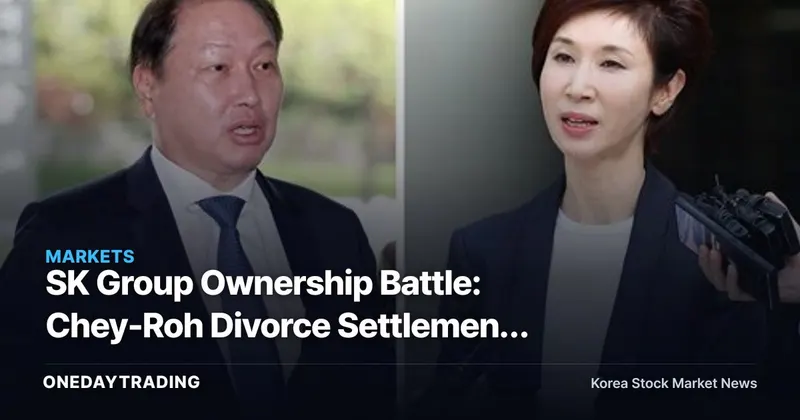
The second mediation session in the retrial of the property division case between SK Group Chairman Chey Tae-won and Roh So-yeong, director of the Art Center Nabi, is scheduled for the 15th. The two will meet face-to-face in court for the first time in about two years, and whether mediation is reached, along with the scale of the division, has been flagged as the key variable for the stock (ticker) of SK Inc., the holding company at the apex of SK's governance structure. Given that the stock has already risen sharply on value-up expectations, market attention is concentrated on this session.
Why It Matters Now
At its core, this case is not simply a domestic dispute but a matter of stability in SK Group's governance structure. Chairman Chey controls the group's core affiliates broadly through his stake in the holding company, SK Inc. Therefore, if the property division results in a confirmed obligation to pay a large sum in cash, the method used to raise those funds inevitably raises the possibility that his shareholding could come into play.
In the second-instance ruling, Director Roh's side was awarded a substantial property division and alimony, and following a Supreme Court review, the case is now in retrial. If mediation is reached, uncertainty would be resolved quickly; but if mediation breaks down and the case proceeds to a ruling on the merits, the dispute could drag on. Either way, the final scale of the division and the payment method are what the market is watching most closely.
SK Inc.'s stock (ticker) has recently risen sharply amid growing recognition of subsidiary value and expectations for shareholder returns. Against this backdrop, whether the chairman's funding needs lead to a stake sale or the use of shares as collateral could directly affect supply-demand (order flow) and market sentiment, making this session a potential turning point for near-term volatility.
Frequently Asked Questions
- Will this session produce a conclusion? The second mediation session is a procedure aimed at reaching an agreement — mediation may be reached, but if it breaks down, a hearing on the merits will follow.
- Why is this linked to SK's stock? Because Chairman Chey controls the group through the holding company SK Inc., the process of raising the division settlement could involve changes to his shareholding.
- Is a stake sale a confirmed matter? No. The method of raising funds has not been determined, and a sale is just one of several possible scenarios.
- What should investors watch? The final scale of the division, the payment timeline, and the method of funding are the key checkpoints.
Related Stocks (Tickers) and Sector Impact
- SK Inc. As the holding company at the apex of the governance structure, it is the direct party to this case, and its stock (ticker) is likely to be most sensitive to the direction of the shareholding and overhang concerns.
- SK Hynix. As the group's core cash cow, its value is linked to SK Inc.'s corporate value and could be indirectly affected.
- Major affiliates such as SK Innovation and SK Telecom. The possibility of governance changes could spill over into investor sentiment across the group.
- Holding company sector. As owner risk and governance events draw attention, this case could also serve as a comparative benchmark for other holding companies' valuations.
Investment Considerations
- Legal proceedings involve many variables, so outcomes cannot be assumed with certainty — it's important to distinguish between speculation in reporting and confirmed facts.
- A stake sale is not a confirmed fact but one possibility among others, so investors should be cautious of overreacting to overhang fears.
- Short-term event-driven volatility should be assessed separately from the company's underlying fundamentals.
- The impact will vary depending on the group's approach to funding, so follow-up disclosures and official statements should be monitored.
Overall Outlook
In the optimistic scenario, mediation is reached smoothly, uncertainty is resolved early, and funding is completed without a stake sale. In this case, the governance risk premium that has weighed on the stock could ease, and value-up expectations could resurface. Conversely, if the division settlement exceeds market expectations or mediation breaks down and the dispute drags on, funding needs and potential shareholding changes could weigh on supply-demand (order flow). Ultimately, the key factors are the scale of the division and the funding method, and investors are advised to calmly track confirmed facts and subsequent procedures rather than making emotional bets.
This article is automatically summarized and analyzed content based on the original news source. View original (Maeil Business Newspaper, Corporate)