
At a Glance
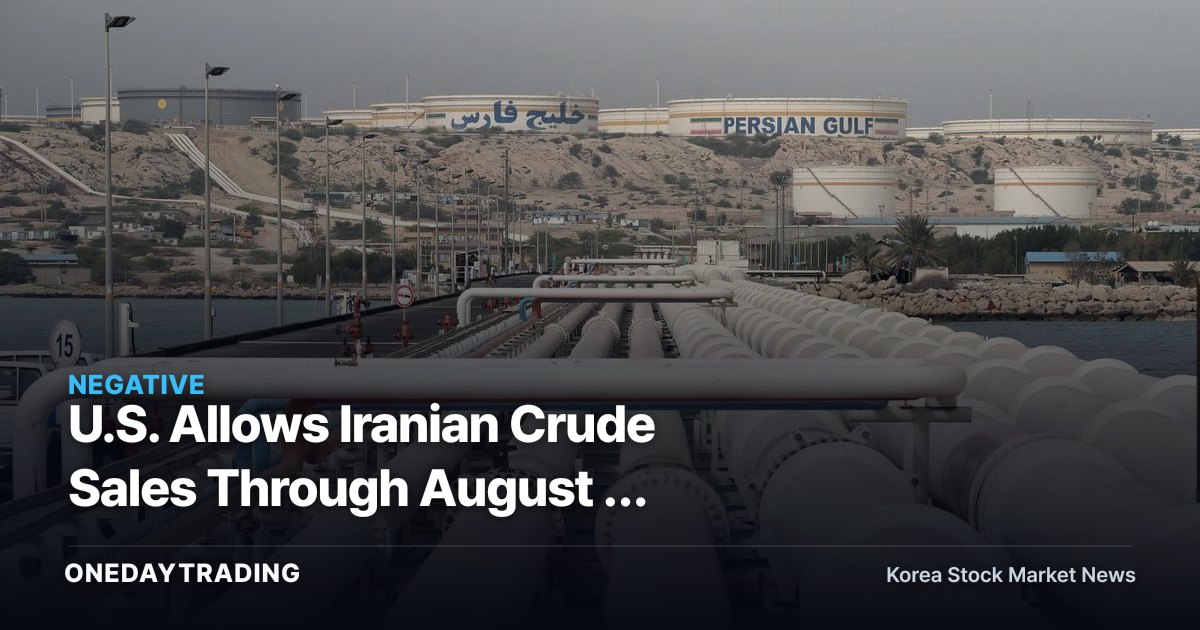
With the U.S. Treasury permitting sales of Iranian crude through August, Iran's supertankers — which had been concealing their positions during the conflict — are switching their transponders back on and slipping out of the Persian Gulf loaded with crude. As this signals additional supply entering the market, it is read as a factor capping the upside of global oil prices in the near term. For Korea, this is an issue that simultaneously moves crude procurement costs, refining margins, and the cost structures of the airline and shipping sectors.
Why It Matters Now
The crux of this measure is that Iranian volumes — effectively blocked until now by sanctions and war risk — are re-entering the market through legitimate channels. Tankers switching their transponders back on is a symbolic signal of trade normalization, meaning the discounts associated with covert transport shrink and actual loadings and deliveries begin to show up in the statistics. As supply-side uncertainty eases, some of the geopolitical premium comes out, and the volatility of oil prices itself may decline.
That said, the measure carries a temporary deadline of August, so whether it will be extended remains unclear — a key variable. The market is likely to treat this not as a permanent supply increase but as a limited window, and the premium could quickly return if conditions in the Middle East deteriorate again. In other words, the direction is to the downside, but its magnitude and durability are subordinate to the political calendar.
Because Korea relies entirely on imports for its crude, falling oil prices are favorable on a macro level for the trade balance and inflation. Refiners, on the other hand, bear both valuation losses on their inventories and swings in refining margins at the same time, so it is worth noting that the same drop in oil prices produces diametrically opposite profit-and-loss outcomes across sectors.
Frequently Asked Questions
- Will oil prices necessarily fall — Additional supply is downward pressure, but given the August deadline and Middle East variables, the more likely path is a narrowing of volatility rather than a one-directional decline.
- Why is it a burden for refining stocks — If oil prices fall quickly, valuation losses arise on inventory bought earlier at higher prices, and refining margins swing alongside, blurring near-term earnings visibility.
- Which industry sectors benefit — Airlines and shipping, where fuel costs make up a large share, and petrochemicals, which use crude as a raw material, are relatively advantaged on the cost side.
- What about the Korean economy overall — Given its nature as an energy importer, a drop in procurement prices can lead to easing pressure on the trade balance and consumer inflation.
Impact on Related Stocks and Sectors
- Refiners such as S-Oil, SK Innovation, and GS — In the event of a sharp drop (plunge) in oil prices, their exposure to inventory valuation losses and refining-margin swings is large, which can act as a burden on the share price in the near term.
- Airlines such as Korean Air and Asiana — With fuel costs making up a high share of operating expenses, stable or falling oil prices connect directly to a path of cost reduction.
- Shipping companies — A drop in bunker fuel prices lowers operating costs and is favorable for margins.
- Petrochemical firms — When the input cost of raw materials such as naphtha falls, there is room for spreads to improve.
- Power and industry broadly — Lower energy costs can lead to a wide-ranging easing of cost structures.
Points to Watch When Investing
- Check whether the temporary measure will be extended and the direction of sanctions after August against the policy calendar.
- Monitor oil prices in tandem with refiners' refining-margin indicators alongside WTI and Brent levels.
- Because of inventory effects, refining stocks' share prices can diverge from the direction of oil prices in the near term, so look directly at the inventory profit-and-loss line items in quarterly earnings releases.
- Should tensions in the Middle East flare up again, the geopolitical premium could return, so keep the risk of a one-directional bet in mind.
Overall Outlook
The optimistic scenario is one in which Iranian supply is confirmed through actual loadings, oil-price volatility declines, and the cost burden on airlines, shipping, and petrochemicals eases — working favorably for import-dependent Korea's economy. Conversely, if the measure is not extended after the August deadline or conditions in the Middle East waver again, supply expectations would quickly recede, and refiners could be exposed to two-way shocks from inventory valuation. Ultimately, it is reasonable to view this issue as a tug-of-war between two variables: the extent of supply normalization and the policy deadline.
This article is auto-summarized and analyzed content based on the original news. View Original (CNBC)