
3-Line Briefing
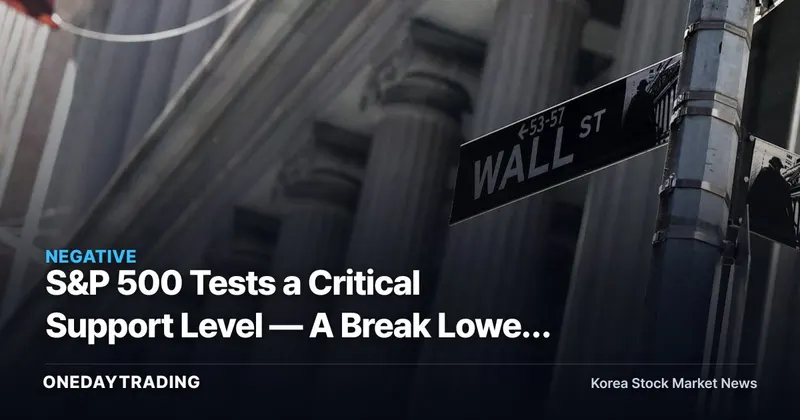
- On Thursday's closing price, the S&P 500 stalled just above a key support level, leaving it at a technical inflection point that will determine its next direction.
- Caution has grown that a break below support could trigger continued selling over the coming days to weeks, prolonging the correction.
- The direction of U.S. indices feeds through—via exchange rates and risk appetite—to high-beta assets such as Korean exporters and semiconductors with a time lag.
What's Changing
The crux of this issue is not individual corporate earnings but the fact that the market's overall risk appetite sits at an inflection point. Whether the index holds the technical line that has supported its trend, or breaks below it, will decide where short-term money flows. If it holds above support, dip-buying sentiment may flow back in; but if the closing price is confirmed below that line, a chain of stop-loss and profit-taking sell orders could emerge, shifting the market into a phase of expanding volatility.
This signal matters to Korean investors because U.S. indices serve as the benchmark for global risk assets. When the S&P 500 wavers, it is often accompanied by a stronger dollar, a weaker won, and foreign net selling, which directly affects foreign investors' order flow in the KOSPI and KOSDAQ. In particular, industry sectors sensitive to the U.S. economy and global demand—such as semiconductors and autos—tend to see amplified volatility during U.S. index corrections.
That said, a technical support level is not an absolute prophecy but rather a psychological reference line that market participants collectively keep in mind. Even at the same level, if earnings season, the interest-rate path, and macro indicators are favorable, the index can quickly reclaim support, leaving the breakdown as a false break.
By the Numbers and Context
The original report says the S&P 500 ended Thursday's session sitting precisely on the boundary of a major support level. No specific index level or price change rate figures were given, but the key point lies in the fact itself that the closing price was above support. In other words, a downside break has not yet been confirmed; rather, the coming days' closing prices represent a verification window that will determine the trend.
Technically, for a downside break of support to carry meaning, it requires confirmation on a closing-price basis accompanied by trading volume—not merely a temporary intraday breach. Conversely, if the closing price forms above support and the index rebounds, the recent correction fears could be quickly reversed as having been overdone.
Winners and Losers
- Semiconductor exporters (Samsung Electronics, SK Hynix, etc.): With high correlation to U.S. indices and the Philadelphia Semiconductor Index, they fall directly within the impact zone of deteriorating foreign-investor order flow during U.S. market corrections.
- Auto and parts exporters: Sensitive to U.S. consumer demand and risk appetite, they tend to wobble alongside the index when volatility expands, though a weaker won provides a partial cushion for export profitability.
- Financial sector (brokerages, asset managers, etc.): With earnings tied to trading value and risk appetite, expanding volatility cuts both ways—boosting short-term trading activity while adding valuation-loss pressure.
- Defensive, high-dividend, and consumer-staples stocks: They can stand out as relative safe havens during index corrections, tending to see their relative strength improve.
Risk Check
- Limits of technical signals: A break of support does not immediately mean a further sharp drop (plunge), and rebounds after false breaks are frequent.
- Macro variables: The interest-rate path, inflation data, and Big Tech earnings releases can sway short-term direction more than technical lines.
- Exchange-rate pass-through: A weaker won acts as a cushion for exporters but a burden on foreign investors' order flow, so the impact varies across industry sectors.
- Short-term trading bias: Over-relying on support-line trading risks missing the medium- to long-term judgment grounded in macro and earnings.
Bottom Line
The S&P 500 is in a verification window that will decide between further correction and support, making it hard to commit either way until the coming days' closing prices and trading volume are confirmed. For Korean investors, a reasonable approach is to monitor whether the U.S. index's closing price defends support, the level of the won-dollar exchange rate, and the timing of a shift to foreign net buying, while adjusting exposure to high-beta industry sectors.
This article is auto-summarized and analyzed content based on the original news report. View Original (MarketWatch)