
At a Glance
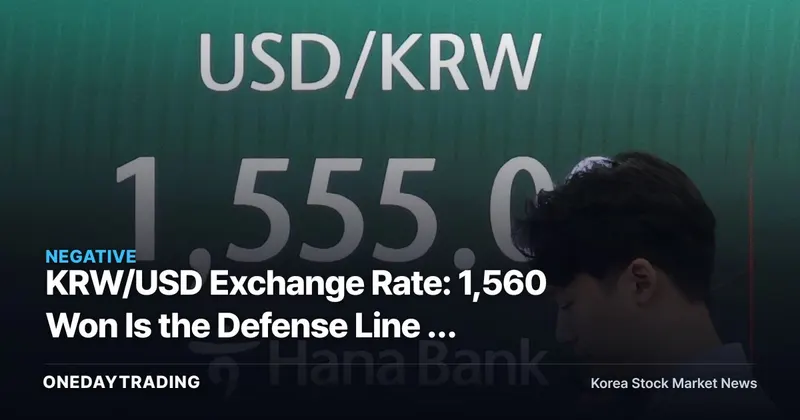
The KRW/USD exchange rate has climbed past 1,550 won. Considering it was hovering around 1,500 won in mid-June, the won has weakened by nearly 50 won in just two weeks. Seo Jeong-hun, senior research fellow at Hana Bank, pointed to 1,560 won as the first line of defense, warning that a breach of this level could trigger an exodus of up to 100 trillion won in foreign investor capital from Korea's stock and bond markets.
Why It Matters Now
What matters more than the exchange rate itself is the direction it signals. A sharper won depreciation means foreign investors see their dollar-converted returns on won-denominated assets erode. Even if the KOSPI rises, if currency losses offset stock price gains, foreign investors have an incentive to sell. When Seo cites the 100-trillion-won figure, it should be read as capital exposed across both government bonds and equities alike.
What the market has already priced in is the won depreciation itself. What hasn't been priced in yet is how much this trend will narrow the Bank of Korea's room to maneuver on monetary policy. If defending the exchange rate becomes urgent, the pace of rate cuts will inevitably slow. A slower pace of rate cuts keeps the discount rate applied to equities elevated, weighing first on the valuation multiples of rate-sensitive industry sectors such as growth stocks, biotech, and platform companies. Conversely, export-oriented stocks (tickers) seeking currency gains tend to show relatively resilient earnings during periods of won weakness.
Frequently Asked Questions
- Q. Why does 1,560 won matter? A. It is the first line of defense identified by Seo Jeong-hun; a breach of this level is expected to increase the scale of foreign capital outflows, according to the warning.
- Q. What is the 100-trillion-won figure based on? A. It is an estimate of the amount of foreign-held assets in Korea's bond and equity markets that could exit if the exchange rate defense line breaks.
- Q. Is won weakness always a negative catalyst for the stock market? A. Not necessarily. Companies with high export exposure benefit from higher dollar-converted revenue, but if this coincides with foreign net selling, the index as a whole comes under downward pressure.
- Q. How can the Bank of Korea respond? A. Options being discussed include adjusting the pace of rate cuts, intervening in the foreign exchange market, and utilizing currency swap lines — but each carries its own side effects.
Impact on Related Stocks (Tickers) and Sectors
- Samsung Electronics (005930) / SK Hynix: Since semiconductor export proceeds are settled in dollars, won-converted revenue rises during periods of won weakness, but high foreign ownership also leaves them most exposed to supply-demand (order flow) volatility if capital exits.
- Hyundai Motor / Kia: With a high share of overseas sales, won weakness benefits both price competitiveness and converted profits, though this is partly offset by rising costs on imported raw materials and parts.
- Korean Air: With a large share of dollar-denominated liabilities such as jet fuel payments and aircraft lease costs, prolonged won weakness increases the burden of foreign currency translation losses.
- KB Financial Group, Shinhan Financial Group, and other bank stocks (tickers): As a sector with notably high foreign ownership, these stocks could decline more sharply than the broader index if capital exits, and wider exchange rate volatility also affects trading gains and losses.
- Chemical and refining industry sectors with high reliance on imported raw materials: Rising dollar-denominated procurement costs could increase cost burdens.
Investment Considerations
- Investors should monitor both whether the 1,560-won defense line is breached and the scale of foreign net selling that follows. It is premature to judge the direction of supply-demand (order flow) based on the exchange rate alone.
- Benefits to exporters are not immediate. The timing of currency gains reflected in earnings varies by company depending on hedging ratios and settlement currency structures.
- The Bank of Korea's Monetary Policy Board decisions and the U.S. Federal Reserve's rate path are intertwined, so interpreting won weakness through domestic factors alone risks misjudgment.
- The 100-trillion-won figure is an estimate based on a worst-case scenario, not a confirmed outflow amount. The actual pace of capital flight should be confirmed through daily supply-demand (order flow) data in the days following any breach of the defense line.
Overall Outlook
In the optimistic scenario, won weakness eases at the 1,560-won level as effective authority intervention coincides with expectations of U.S. rate cuts. In that case, foreign capital flight would remain a concern rather than a reality, and export stocks (tickers), which have already demonstrated earnings resilience during the won's decline, are likely to continue leading the market. The risk scenario is the opposite: if 1,560 won is breached and capital flight accelerates starting with valuation-heavy growth stocks, the entire KOSPI would be exposed to a supply-demand (order flow) vacuum. The next indicators to watch are the schedule of the Bank of Korea's Monetary Policy Board rate decisions, the U.S. consumer price index due in the interim, and above all, how many days the KRW/USD exchange rate holds above 1,560 won.
This article is automatically summarized and analyzed content based on the original news source. View original article (Maeil Business Newspaper Economy)