
At a Glance
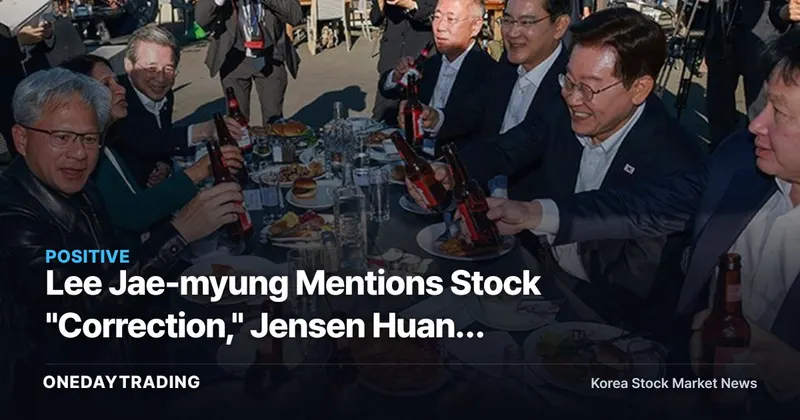
President Lee Jae-myung, wrapping up his schedule at the AI Summit in San Francisco on the 24th (local time), directly addressed the recent KOSPI correction, and Nvidia CEO Jensen Huang, who was present, responded by saying the market would soon rebound. The impromptu remark from the head of a foreign company dominated headlines in Korea's investment community, but before treating this single comment as a buy signal, what needs to be examined is not the weight of the remark but the evidence behind it. For the KOSPI to actually rebound, three axes—interest rates, the exchange rate, and supply-demand (order flow)—must move first.
Why It Matters Now
What truly deserves attention in this scene isn't what Jensen Huang said, but the fact that the president was the one to first bring up the word "correction" in a public setting. The fact that a top government official raised stock market trends as a topic is close to evidence that the government, too, senses the concerns market participants have held for months—that the AI- and semiconductor-led rally has already entered a valuation-strained zone. Huang's optimistic remark should be soberly understood not as data that directly refutes this concern, but as diplomatic lip service offered on a courtesy occasion.
For Nvidia, Korea is a core axis of its HBM supply chain. Nvidia's roadmap for next-generation accelerators depends on SK Hynix and Samsung Electronics (005930) stably supplying next-generation HBM volumes. In other words, CEO Huang's optimism about the Korean stock market reflects the perspective of a stakeholder who equates improved earnings at Korea's semiconductor makers with the stability of his own supply chain—not an independent market analysis. What the market has already priced in is the narrative of expanding HBM supply to Nvidia; what has not yet been priced in is the actual shipment volumes for next quarter that would support that narrative, along with the trajectory of Korea's benchmark interest rate and exchange rate.
FAQ
- Can Jensen Huang's remark serve as an actual investment signal? Since it was made on a diplomatic occasion rather than in official research or earnings guidance, it lacks supporting data. It's worth noting, but too early to use as a basis for trading.
- Why did the KOSPI correction occur? It's interpreted as the result of profit-taking after AI- and semiconductor-leading stocks posted a sharp gain in a short period, pushing valuation burdens higher.
- Which stocks (tickers) are directly linked to this remark? Samsung Electronics and SK Hynix, Nvidia's key partners, are the most directly mentioned.
- What indicators should be watched next? The Bank of Korea's Monetary Policy Board rate decision, whether the won-dollar exchange rate settles in the 1,300 range, and U.S. semiconductor demand indicators.
Related Stocks and Sector Impact
- SK Hynix: As Nvidia's largest HBM supplier, it is the supply-chain party that forms the real backdrop of this remark. Next-generation HBM yield rates and the pace of capacity expansion will determine its earnings.
- Samsung Electronics: Spanning both HBM and foundry within Nvidia's value chain, it is cited as the biggest potential beneficiary of improving sentiment toward AI semiconductors.
- Semiconductor equipment and materials stocks (tickers): Continued HBM capacity expansion would also lift demand for back-end process equipment and materials.
- Rather than import-related stocks that benefit from a stronger won, large-cap exporters broadly—where expectations of improved foreign investor supply-demand (order flow) are reflected—fall within the range of near-term sentiment improvement.
Investment Considerations
- A congratulatory remark from a head of state is not a verifiable metric like earnings or order backlogs. Short-term chasing purchases based on it should be avoided.
- Valuation pressure in the AI and semiconductor industry sector has not been resolved. The very fact that the word "correction" surfaced is evidence of this.
- If the won-dollar exchange rate turns upward again, rebound expectations that rely on foreign investor supply-demand (order flow) could quickly reverse.
- It's worth remembering that a rally driven by narrative alone, without earnings confirmation, will ultimately be tested against next quarter's shipment volumes and guidance.
Overall Outlook
The optimistic scenario is one where expectations for a rate cut revive at the next Monetary Policy Board meeting, the won-dollar exchange rate stabilizes, and Nvidia-bound HBM demand is confirmed in hard numbers. In that case, CEO Huang's remark would turn out, in hindsight, to be a prediction that happened to be right. Conversely, if the exchange rate weakens again and semiconductor demand indicators soften, this remark is likely to be remembered merely as an episode that briefly soothed investor sentiment during a correction. The next Monetary Policy Board decision, the level of the won-dollar exchange rate, and the next-quarter earnings releases from Nvidia and Korean semiconductor companies are the real tests of this remark.
This article is automated summary and analysis content based on the original news report. View Original (Maeil Business Newspaper, Securities)