
Summary
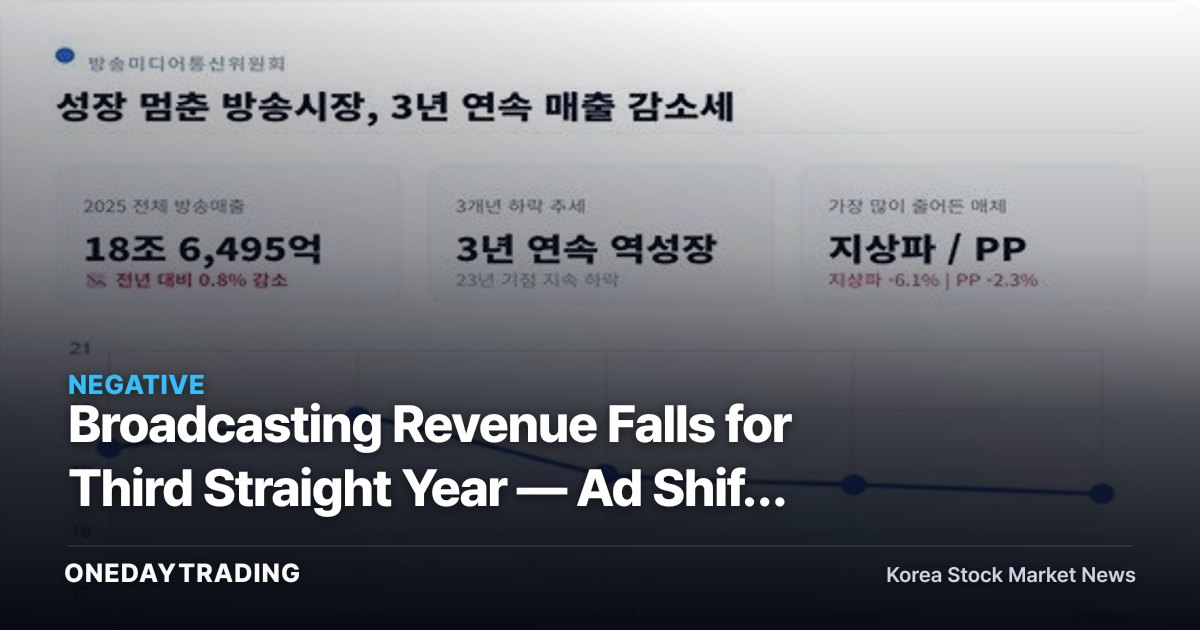
Broadcasting business revenue has slipped for three years running, and even broadcast advertising revenue has fallen to the 2 trillion won range. This reflects not a short-term economic slump but the entrenchment of a structural shift in ad budgets away from broadcasting toward mobile and digital platforms. It acts as an earnings pressure point for companies heavily weighted toward traditional media, and as an opportunity to expand market share for the platform operators absorbing digital advertising.
What Happened
South Korea's broadcasting business revenue has extended its decline for a third consecutive year, accelerating the contraction of the traditional broadcast market. Particularly painful is the fact that broadcast advertising revenue — long the core of broadcasters' income — has dropped to the 2 trillion won range. Advertising rates are determined by ratings and reach, but as the live-viewing audience shrinks and advertisers shift their budgets to digital media where results can be measured instantly, the pricing power of broadcast advertising itself is weakening.
The center of gravity in the ad market has already moved to mobile. Search, video, and social advertising allow precise targeting and conversion measurement, giving advertisers a return-on-investment edge over broadcasting. For the same ad budget, it becomes the rational choice to flow toward mobile advertising that pinpoints high-purchase-intent users rather than TV that reaches an undifferentiated mass. As a result, broadcasters face the dual pressure of falling ad rates and departing ad volume.
Structural Background
This decline is not a one-off variable but the cumulative result of changing viewing behavior. As household-based viewing has fragmented into individual-level streaming and short-form content, the very amount of live-broadcast viewing time available to carry ads has shrunk. If content sales and retransmission revenue — which must fill the gap left by lost ad revenue — fails to keep pace with rising production costs, operating leverage deteriorates rapidly. The trend in which the value of content IP itself comes to the fore over the value of broadcasting as a distribution channel falls within the same context.
Impact on Stocks and Sectors
- Terrestrial and comprehensive-programming media stocks: Directly hit due to their high reliance on broadcast advertising revenue. When falling ad rates combine with a fixed-cost structure, operating profit volatility expands significantly.
- Platform operators such as Naver and Kakao: The beneficiary camp absorbing budgets that have moved to digital and mobile advertising. Search-, video-, and commerce-linked advertising draws in the volume departing from broadcasting.
- Content production and IP-holding companies (drama and entertainment studios): As the value of content rights becomes more important than the distribution channel, producers capable of supplying OTT platforms and distributing globally differentiate themselves from ad-dependent media.
- Advertising agencies and digital marketing firms: The more ad spending shifts to measurable digital channels, the more demand for performance marketing rises, creating potential for structural benefit.
- Pay-TV (IPTV and cable) operators: With subscriber-based revenue, the shock is smaller than for ad-dependent broadcasters, but they are not free from the cord-cutting trend.
Bullish vs. Bearish Scenarios
On the bearish side, the key point is that the migration of ad spending to digital is irreversible. If the retreat of broadcast advertising to the 2 trillion won range hardens into a trend without any temporary rebound, the earnings strength of media companies highly dependent on ad revenue could continue to weaken. That said, a bullish scenario cannot be ruled out either. For platform stocks absorbing digital advertising, if the ad market pie itself is not shrinking but merely shifting channels, rising market share translates into earnings. Moreover, producers with competitive content IP can diversify their revenue streams through OTT demand regardless of the ad slump. The counter-risk is that platform stocks have already priced in expectations of an ad recovery in their valuations, so if an economic slowdown shrinks total ad budgets, digital could contract alongside broadcasting.
Investor Action Points
- In media companies' quarterly earnings, check the broadcast advertising revenue growth rate and the share of advertising within total revenue to assess whether the structural decline is slowing.
- Compare quarter by quarter whether platform operators' display and video advertising revenue growth is actually absorbing the volume departing from broadcasting.
- For content producers, track whether they are breaking free of ad dependence through OTT and global distribution contract disclosures and the share of rights revenue.
- Monitor consumer sentiment and corporate marketing budget trends — leading indicators of the overall ad cycle — alongside the schedule of the next ad-spending data release.
This article is content automatically summarized and analyzed based on the original news report. View original (Yonhap News, Industry)