
At a Glance
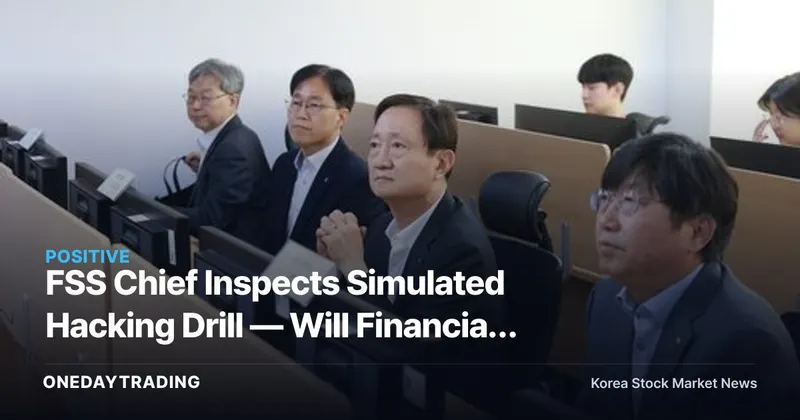
Financial Supervisory Service (FSS) Governor Lee Chan-jin visited the Financial Security Institute's financial security monitoring center on June 12 to inspect the status of the blind simulated hacking drill conducted across the financial sector for the first half of 2026. The governor stressed that protecting financial consumers must be the top priority in the event of an incident. As financial authorities step up their oversight of cybersecurity, expectations are rising for the security solutions and monitoring services industry sector.
Why It Matters Now
A blind simulated hacking drill is a high-intensity assessment that, without prior notice, probes a financial firm's IT networks for vulnerabilities just as a real hacker would. The fact that financial authorities are personally overseeing this is read not merely as a routine inspection, but as a signal that effectively mandates security investment across the entire financial sector. With digital financial transactions now part of everyday life, a single breach can lead to massive leaks of personal information and financial losses, so regulators' attention naturally translates into expanded investment by the industry.
In particular, a string of ransomware and hacking incidents targeting financial and telecommunications firms at home and abroad over the past few years has highlighted the importance of security. If authorities institutionalize simulated hacking drills and raise their intensity, banks, brokerages, insurers, and card companies will have no choice but to allocate larger budgets to breach response systems and the adoption of security solutions. This feeds expectations for improved earnings at domestic information security firms.
Frequently Asked Questions
- What is a blind simulated hacking drill? It is a drill that attempts to penetrate a system like a real attacker, without notifying the target in advance, in order to verify the effectiveness of its defenses.
- Why is the FSS inspecting it directly? Because financial incidents directly harm consumers, the intent is for authorities to proactively manage financial firms' security response capabilities.
- What does this mean for investors? Tighter security regulation carries the character of a policy-driven positive catalyst that could lead to increased demand for information security solutions and monitoring service firms.
- Will it show up in earnings right away? Security investment often takes the form of medium- to long-term budget execution, so it is reasonable to view this as a gradual expansion of demand rather than a short-term sharp gain (surge).
Affected Stocks and Sectors
- AhnLab As a leading domestic information security firm, it is expected to be a direct beneficiary if demand for security solutions and monitoring in the financial sector expands.
- WINS A leader in network security and intrusion prevention solutions, it is among the direct beneficiaries of expanded security investment by financial firms.
- SGA Solutions As a supplier of system and data security solutions, it could see rising demand amid tightening regulation.
- IGLOO Corporation As a firm in the security monitoring and SIEM field, it is within the sphere of influence of rising monitoring demand.
- Dream Security As an authentication and encryption security firm, it is closely linked to the trend of strengthening financial security.
Points to Watch When Investing
- News tied to policy or inspection events can drive heightened short-term volatility on thematic expectations, so caution is warranted against chasing the rally.
- There is a time lag before security budget execution becomes visible in contracts and earnings, so it is necessary to confirm whether actual orders materialize.
- Information security stocks often have small market capitalizations, making risk management important in terms of trading volume and volatility.
- This is not a matter in which specific order sizes or budgets have been presented, so expectations should not be excessively priced in ahead of time.
Overall Outlook
The optimistic scenario is one in which the authorities' institutionalization of simulated hacking drills and their emphasis on consumer protection lead to expanded security investment across the financial sector, driving a steady improvement in orders and earnings at domestic information security firms. The structural backdrop of spreading digital finance and rising cyber threats also supports this. That said, since this particular development is more an inspection and messaging event than an announcement accompanied by a concrete budget or orders, the short-term stock price reaction may remain merely thematic. While the medium- to long-term demand direction for the security sector is positive, the prudent strategy is to approach it while confirming individual companies' actual contracts and the materialization of their earnings.
This content was automatically summarized and analyzed based on the original news article. View original (Yonhap News Securities)