
Summary
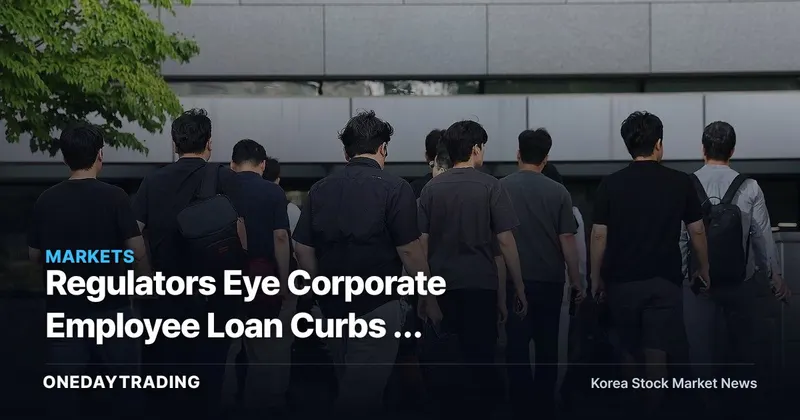
Financial regulators have identified corporate employee loans — low-interest funds companies extend to staff under internal policy — as a potential bypass route fueling housing market overheating, and have intensified their monitoring. However, authorities are proceeding cautiously on direct regulation, meaning the trajectory for construction, real estate, and banking industry sectors could diverge depending on the timing and severity of any measures.
Background
As apartment transaction prices have surged sharply in parts of Seoul's Gangnam district and Gyeonggi Province's Dongtan, corporate employee loans have come under scrutiny as a funding source filling the gaps left by policies tightening aggregate household lending. The concern is that these loans — extended by companies to employees at below-market rates under internal rules — frequently fall outside the banking sector's household lending regulations and debt service ratio (DSR) calculation framework.
While regulators are wary that such funds could flow into home purchases, they are taking a guarded stance on blanket direct restrictions, given that employee loans are fundamentally a form of staff welfare and an area governed by internal corporate policy. The prevailing read is that authorities will first assess the scale and purpose of such loans before taking a phased closer look if warranted.
Structural Context
The core issue here is not a specific loan product but rather the balloon effect. The pattern has repeated itself: the harder authorities squeeze bank household lending, the more demand migrates into regulatory blind spots such as employee loans, insurance policy loans, and policy-backed financing. Regulators need to prevent further home price stimulus, but overly aggressive direct intervention risks curtailing employee welfare benefits and triggering fairness concerns — making calibration unavoidable. Ultimately, the variable the market will focus on is not whether regulation comes, but how fast and how broadly.
Stock (Ticker) and Industry Sector Impact
- Construction (Hyundai E&C · GS Engineering & Construction · DL E&C): If presale and transaction demand holds up, conditions remain favorable for residential segment margins and new presale recovery. However, if restrictive funding measures intensify, buyer sentiment could cool, leading to a slowdown in orders and presale rates.
- Real estate and developer-related stocks: Directly linked to trading volume and prices, these are the most sensitive to policy direction. As long as the cautious-on-regulation stance persists, expectations for a transaction recovery remain alive.
- Banking holding companies (KB Financial · Shinhan Financial Group): Tighter household lending caps would constrain loan growth, but there is also room for the quality of bank lending to stand out by preventing demand from leaking into non-bank channels such as employee loans.
- Building materials and interior stocks: These names lag housing transaction turnover and move-in volumes, meaning any contraction in transactions would put downward pressure on earnings.
Bull vs. Bear Scenarios
On the bullish side, if authorities maintain a monitoring-first, cautious stance rather than resorting to direct controls, demand in Seoul's prime areas could persist, sustaining a favorable environment for construction residential divisions and real estate transaction-related stocks. On the bearish side, should home prices accelerate further and prompt authorities to move aggressively to cut off funding channels — including employee loans — a sharp freeze in buyer sentiment and a transaction cliff could significantly increase valuation pressure on construction and real estate stocks. The fact that some construction stocks already carry real estate project financing (PF) risk makes them additionally vulnerable to a regulatory shock.
Investor Action Points
- Monitor the FSC and FSS employee loan review outcomes, any announcement schedule for additional measures, and whether household debt management frameworks will be revised.
- Track the Korea Real Estate Board's weekly apartment transaction price trends and trading volume in Seoul and Dongtan to gauge demand strength.
- Watch construction companies' quarterly earnings for changes in residential presale rates, unsold inventory, and PF exposure as key indicators.
- Follow banking holding companies' household loan growth rates and net interest margin trends together to track whether regulatory impact is feeding through to earnings.
Hyundai E&C — Real-Time Data Snapshot
Hyundai E&C's most recent closing price is KRW 103,300 (–8.26% vs. prior day). The signal combining foreign investor and institutional investor supply-demand (order flow), news, and momentum reads 🟡 neutral · wait-and-see. Positive and negative signals are mixed, warranting a watchful stance.
- ▲ Supply-demand (order flow) continuity — Foreign investors net buyers for 6 consecutive sessions (+26.1 billion won)
- ▼ Trend alignment — Short- and medium-term downward alignment (–8.3% on the day · –19.7% over 1 week · –28.1% over 1 month)
Recent related news shows 2 positive catalyst items · 0 negative catalyst items — a favorable tone.
※ Price and foreign investor/institutional investor supply-demand (order flow) data are provided by Korea Investment & Securities (KIS) and are current as of the time of publication.
This article is auto-summarized and analyzed content based on the original news source. View original article (Yonhap News — Securities)