
3-Point Briefing
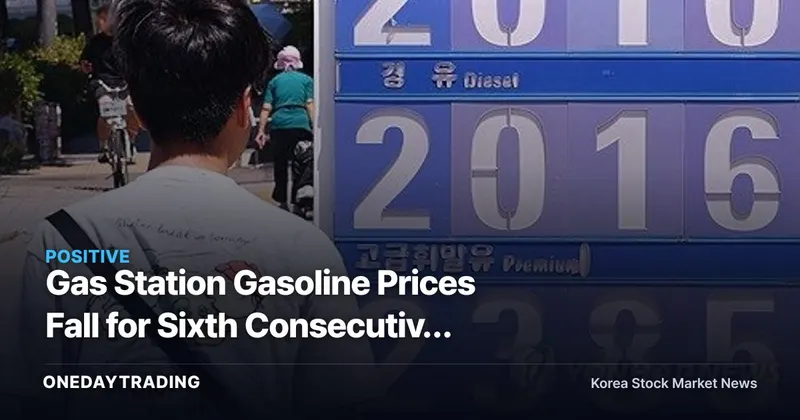
- The national weekly average gasoline price at domestic gas stations has fallen for six straight weeks, dropping into the low 2,000-won range, with diesel prices declining in tandem.
- The combination of stabilizing international oil prices and the government's petroleum price management policy is easing the burden on consumers, but is creating margin headwinds for refiners' crack spreads.
- The trend is favorable for aviation, shipping, and ground transportation — where fuel costs represent a major component of expenses — while sending a mixed signal to refiners, whose core business is refining and retail fuel sales.
What Is Changing
Retail gasoline prices reflect international product prices, the exchange rate, fuel taxes, and gas station distribution margins, each with a lag. Six consecutive weeks of declines suggest this is not a one-off fluctuation, but rather a downstream transmission of a downward trend in crude and petroleum product prices reaching the domestic retail level. The average price falling into the low 2,000-won range implies a reduction in household fuel expenditure and room for the energy component of inflation indicators to ease its upward pressure.
That said, the same trend plays out very differently across industry sectors. Refiners buy crude and resell it as finished products, so in an environment where product prices are falling rapidly, inventory valuation losses and crack spread compression can occur simultaneously. Conversely, for transportation companies that purchase fuel as an input, cost savings can flow directly through to operating profit — meaning the direction of the price decline works in the exact opposite way.
Numbers and Context
The national average gasoline price falling for six consecutive weeks and holding in the low 2,000-won range represents a significant change in consumer experience compared to last year's high oil-price environment. The key variable is the durability of the decline. If international oil prices stabilize further and the exchange rate moves favorably, the retail price decline could extend; conversely, output cuts by oil-producing nations or a sharp gain (surge) in the exchange rate could trigger a reversal with a lag. Investors should therefore look beyond the simple fact of falling prices to understand what is driving them.
Stocks (Tickers) to Watch — Beneficiaries and Headwinds
- Korean Air, Asiana Airlines, and other aviation stocks: Jet fuel accounts for a very large share of operating expenses, so lower fuel costs can translate directly into improved operating profit margins.
- HMM and other shipping stocks: Lower bunker fuel costs provide breathing room on the cost side, independent of freight rate movements.
- CJ Logistics and other ground transportation and logistics stocks: Fuel costs are a major component of vehicle operating expenses, and cost savings are likely to be gradually reflected in earnings.
- S-Oil, SK Innovation, GS, and other refining stocks: In a sharp drop (plunge) environment for product prices, inventory losses and margin compression risk can weigh on near-term earnings.
- Fuel-tax-sensitive retail and consumer stocks: An increase in household disposable income could serve as an indirect positive catalyst for a recovery in non-essential consumer spending.
Risk Check
- If output cut decisions by oil-producing nations or geopolitical risks trigger a rebound in international oil prices, the retail price decline could reverse in the near term.
- A sharp gain (surge) in the USD/KRW exchange rate would raise import costs, offsetting the benefit of lower oil prices.
- For refining stocks, the impact of crack spreads and inventory effects tends to be reflected in quarterly earnings with a delay, creating a lag between share price movement and reported earnings.
- For aviation and transportation stocks, freight rates, demand, and labor cost variables carry significant weight beyond fuel costs alone, making it difficult to draw earnings conclusions from oil prices in isolation.
Bottom Line
Lower oil prices represent a favorable cost-relief signal for transportation and consumer stocks, while simultaneously posing a margin compression risk for refiners — a fundamentally two-sided dynamic. This is a period for investors to monitor next quarter's crack spread trends, the direction of international oil prices, exchange rate levels, and oil-producing nation policy schedules, and to take a selective, sector-differentiated approach to the diverging impacts.
This content was automatically summarized and analyzed based on the original news article. View original article (Yonhap News)